Dry kief can keep useful quality for about a year in a small airtight container stored cool and dark. It may remain sound longer, but aroma and chemical strength can fade as light, air, and heat reach the exposed resin glands.
Age alone does not make kief unsafe. Moisture, visible growth, a musty odor, pests, or unknown contamination are stronger reasons to discard it.

Treat one year as a quality checkpoint, not a safety expiration. Inspect condition first, keep the container small and dark, and prevent humid air from reaching cold material.
How Long Does Kief Keep Its Quality?
Loose kief exposes much more surface to the storage environment than intact plant material. The smell, color, and chemical profile can therefore change even when the jar stays dry and free of contamination.
Well-kept material can remain sound beyond a year
A small sealed jar in stable dark storage may retain useful aroma after the one-year point. The result depends on starting dryness, container seal, temperature, and how often the lid opened.
The date should prompt an inspection rather than an automatic discard. No calendar can confirm what happened inside a poorly sealed or damp container.
Fading normally appears as a quality change
Older kief may smell flatter, look darker, or feel drier. Like stored nutmeg or dry rosemary, it can lose aroma without showing mold or another contamination.
Appearance cannot reveal an exact remaining strength. Starting material, light, temperature, air, and time all affect the final profile.
Suspect condition overrides a young date
A new jar with droplets, wet clumps, fuzzy growth, or a musty odor is a worse candidate to keep than an older jar that remained dry and clean.
How Can You Tell Whether Kief Has Gone Bad?
Inspect the closed jar before moving or opening it. Disturbing suspect material can release dust and make the surface harder to judge.
- Fuzzy or web-like growth: Discard the full amount instead of removing one patch.
- Musty or basement-like odor: Do not taste the material to investigate further.
- Wet clumps or visible droplets: Moisture has entered a product that should remain dry.
- Insects or unknown debris: An unreliable storage history makes salvage a poor choice.
- Sharp chemical odor: Keep it away from food and discard it when contamination cannot be ruled out.
Dry kief can compact under pressure and still break apart without feeling wet. Unlike hardened brown sugar, a clump becomes concerning when it follows condensation, sticks with moisture, smells wrong, or carries visible growth.
Do not dry damp kief and assume the problem is gone. Drying can remove water without proving that contamination never developed while the material was wet, just as a damp batch of stored dried fruit may already have an unsafe history.
How Should You Store Kief Away from Light and Air?
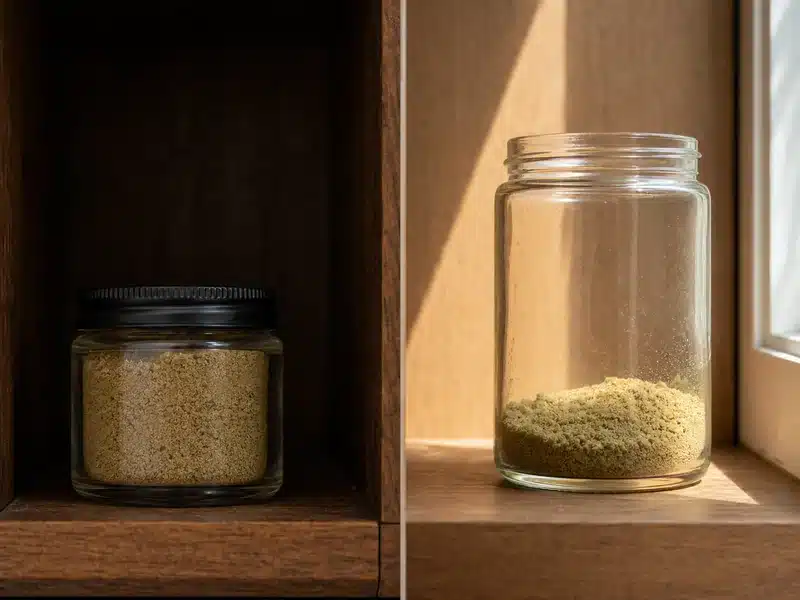
A thin layer spread across a large jar meets more trapped air than the same amount in a small close-fitting container. The same headspace that flattens stored coffee bean aroma can speed odor loss here, so choose clean dry glass with an intact seal and little empty space.
| Storage choice | Benefit | Main problem | Better decision |
|---|---|---|---|
| Small glass jar | Little headspace and a firm seal | Still gains air with each opening | Keep only a working amount inside |
| Large clear jar | Easy to inspect | Extra air and light exposure | Downsize and store behind a door |
| Thin plastic bag | Compact and light | Static, weak seal, and little protection | Use it only for short handling |
| Grinder compartment | Convenient collection | Poor long-term seal and repeated opening | Transfer the dry material to a jar |
Store the jar inside a dark interior cabinet away from a sunny window, stove, radiator, bathroom, or damp basement. Stable cool conditions help more than moving it between hot and cold places.
Use a clean dry tool and close the lid promptly. Fingers can add skin oil and moisture, while a cracked cap or worn liner leaks air even when the jar feels closed.
Do not add bread, fruit peel, or another wet item to change texture. Those items raise humidity and can introduce organisms into the container.
How Does Aging Change Kief?
Once moisture and contamination have been ruled out, weaker aroma and darker color can be understood as normal storage changes. This differs from the stale-oil warning signs in stored pistachios or almonds, and none of these changes turns into visible mold through the same process.
Aroma compounds escape
Volatile compounds can leave each time the jar opens. A strong smell in the room also means some of that aroma is no longer inside the material.
Light and oxygen change the chemical profile
Published storage studies found that light and air affect cannabinoids over time. Darkness and a tight seal slow these changes, although a closed jar still begins with some oxygen in its headspace.
Opening the lid often replaces that small amount with fresh air. Shaking, grinding, and transfers can also break resin glands and expose new surfaces.
Heat changes the speed
A hot shelf above an appliance speeds chemical and aroma loss. A cool cabinet provides more stable conditions without the condensation risks created by daily refrigeration.
These changes do not support a precise remaining-strength estimate. Laboratory results depend on the material and storage conditions, so a home jar cannot be measured by color alone.
Why Is Condensation the Main Storage Risk?
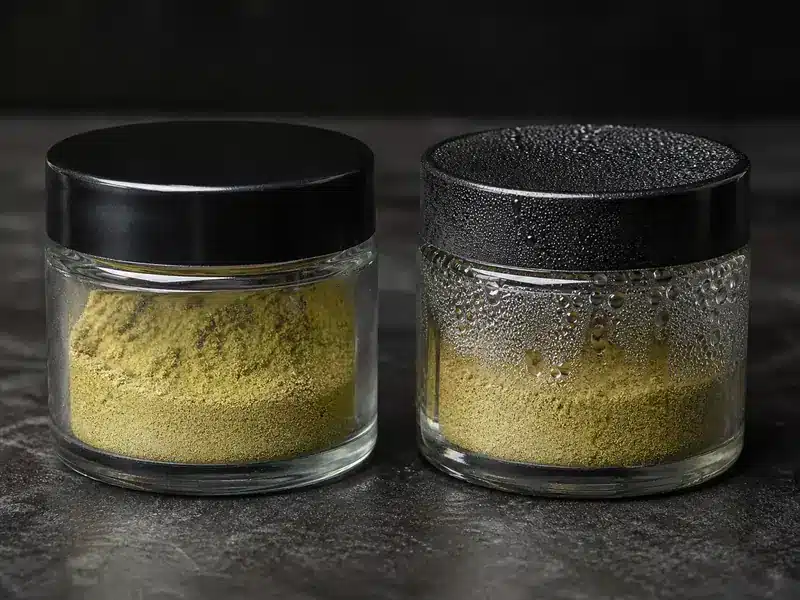
Cold storage becomes risky at the moment a cold container meets warm humid air. Opening the lid lets moisture reach the jar, where droplets can form on the container and material.
Dry compaction should loosen
Pressure can press fine particles into a firm shape. A dry clump breaks apart without smearing, wet shine, mustiness, or droplets around the jar.
Moist clumps carry an uncertain history
A clump that feels wet, sticks to the container, or appears beside condensation should be discarded. You cannot tell how long moisture was present by looking at it once.
Repeated trips between a refrigerator or freezer and a warm room multiply the opportunity for humid air to enter. The moisture risk resembles the stickiness that shortens hard candy quality, but kief cannot be rinsed or reheated to correct it.
Should You Refrigerate or Freeze Kief?
A cool dark cupboard gives the best balance for ordinary short-term access. Refrigeration and freezing can slow chemical change, but they add odors, humidity, and handling risk.
This is different from cannabutter, which is a perishable fat infusion that belongs in cold storage.
Choose a cupboard for the working jar
Stable room temperature avoids daily temperature cycling. Keep the jar away from heat sources and close it after each dry-tool access.
Use small portions for a long backup
Divide the dry material before cold storage so only one sealed portion needs to warm. Do not repeatedly expose the full supply.
Let a cold container reach room temperature while it remains sealed. Open it only after the jar and contents have warmed without contacting humid room air.
Do not return a partly warmed open jar to the freezer. Confirm that the rim and contents are dry before closing any portion for continued storage.
Advice for a liquid fat such as coconut oil does not solve moisture trapped in loose resin glands.
Cold resin glands can also be brittle. Avoid crushing or shaking the container while it is frozen.
How Should You Separate a Working Jar from Backup Kief?
One frequently opened jar and one untouched reserve create less exposure than opening the full supply each time. The working jar should hold only a short-term amount.
Manage the working jar
Use a small clean container, a dry tool, and short open time. Inspect the lid and rim before refilling because trapped residue can weaken the seal.
Protect the backup
Date the backup and keep it sealed in stable darkness. A date cannot prove quality, but it helps connect later aroma or color changes to the real storage period.
Do not top off an old working jar blindly. Empty and inspect it first so new material does not hide the age or condition of what remained at the bottom.
Review both containers after a move, leak, power outage, broken lid, or other storage change. One event can matter more than another month on the label.
Sources
- Journal of Pharmacy and Pharmacology study on cannabis stability during storage
- Forensic Science International study of light and temperature effects
- Study of cannabinoid stability in dried cannabis
Frequently Asked Questions
Does kief become unsafe just because it is old?
Age mainly predicts quality loss. Moisture, growth, pests, chemical odor, or unreliable handling creates the clearer discard reasons.
Why did stored kief turn darker?
Age, oxygen, light, and the amount of plant material can affect color. A color change still needs an odor and moisture check.
Should I add a humidity pack?
Separated dry material should stay dry. Do not add moisture unless the maker gives a tested direction for that exact product.
Can a plastic grinder store kief for a year?
A grinder is convenient for collection but is not ideal long storage. Transfer dry material to a small sealed light-protected jar.
Can damp kief be dried and kept?
Damp material has an uncertain contamination history. Discard it when you cannot rule out growth or identify how long it stayed wet.

Carrie is a food writer and editor with more than 15 years of experience. She has worked for some of the biggest names in the food industry, including Bon Appétit, Food & Wine, and Martha Stewart Living.
As the Editor in Chief of EpicureDelight, Carrie oversees all of the content on the site. She also manages the team of contributing writers and editors, who help to create delicious recipes, helpful tips, and informative articles that you’ll find on the site.
A native of the Chicago area, Carrie is passionate about all things food. She loves trying new restaurants and experimenting with new recipes in her kitchen. She’s also a graduate of the Culinary Institute of America, so she knows a thing or two about food!