Aleppo pepper has a very specific personality: fruity, gently smoky, and warm in the back of your throat rather than sharp on the tongue. That tangy, almost brined quality is what makes it taste "finished" on roasted chicken or a bowl of hummus-not just hot.
Finding a good aleppo pepper substitute means hunting for that same balance, not just swapping in whatever dried chili is closest to the stove.
The ratios below account for both heat and the flavor layer underneath it. Some swaps go in 1:1; others need trimming because they run hotter or are missing the fruity softness Aleppo brings.
Urfa biber is the closest swap at 1:1, matching Aleppo's fruity heat and dark warmth. Kashmiri chili powder works at ¾ of the amount for mild color-forward dishes. For a DIY approach, chili flakes + cumin + sumac rebuild Aleppo's tangy depth from scratch.
5 Best Aleppo Pepper Substitutes (with Ratios)
The table below is your quick decision tool before reading the full breakdown. Direct swaps (Urfa biber, Kashmiri) go in at or near the same amount.
Blends and cayenne-based options need more hands-on adjusting-start lower and taste as you go.
Finishing sprinkles and marinades behave differently. A swap that reads fine in a cooked sauce may taste flat or sharp if added raw at the table, so note the "best for" column before committing.
If you're working a recipe that also uses smoked paprika and want to know your options there, the guide on alternatives to smoked paprika covers that angle separately.
| # | Substitute | Best For | Ratio | Key Note |
|---|---|---|---|---|
| 1 | Urfa Biber | Both | 1:1 | Closest fruity-heat match |
| 2 | Kashmiri Chili Powder | Cooking | ¾:1 | Vivid color, mild heat |
| 3 | Smoked Paprika + Chili Flakes | Cooking | 1:1 | Smoky warmth, less tang |
| 4 | Cayenne + Garlic + Lemon Zest | Both | 1:2 | Hot; add zest at end |
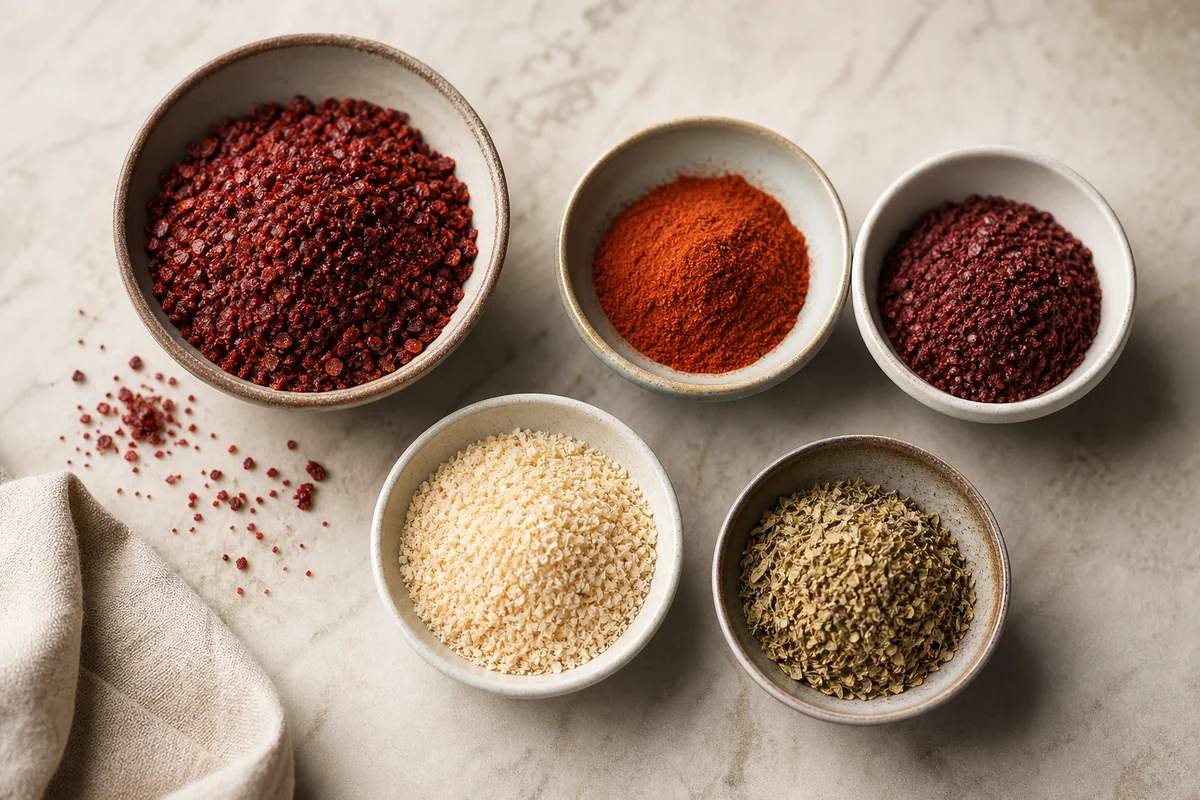
| 5 | Chili Flakes + Cumin + Sumac | Both | 1:1 | Best DIY tang control |
1. Urfa Biber
Urfa biber is the most direct stand-in for Aleppo pepper because it shares the same dark, raisin-like fruitiness and a heat that builds slowly rather than biting upfront. Use it at a straight 1:1 ratio for flakes, finishing sprinkles, and most sautés.
- Finishing dishes: Sprinkle directly over eggs, yogurt dips, or flatbread just before serving
- Grilling rubs: Works in lamb or chicken marinades at the same volume as Aleppo
- Quick pan sauces: Add early so the flakes soften and the heat rounds out
One thing to watch: Urfa biber reads slightly sweeter than Aleppo, so if your dish tastes flat after swapping, a small pinch of kosher salt closes the gap. Understanding aleppo pepper and its flavor in detail makes it easier to judge how far Urfa biber drifts from the original.
Skip if: You need that sour-brined edge and aren't using any acid elsewhere in the dish-Urfa biber nails the fruit and heat but doesn't replicate Aleppo's tangy note on its own.
2. Kashmiri Chili Powder
Kashmiri chili powder is mild and deeply colored, closer to a spiced paprika than a true chili heat-source. Use ¾ of the Aleppo amount to keep heat in check, since Kashmiri still builds faster than Aleppo in cooked applications.
It is a strong choice for any dish where color matters as much as flavor-roasted vegetables, curry bases, and spiced oils all benefit from its brick-red payoff. What it lacks is tang, so we recommend a small pinch of kosher salt or a few drops of lemon juice in the same step.
- Roasted vegetables: Toss with oil and Kashmiri powder before the oven; the color holds beautifully
- Curry base: Stir in early with your aromatics so the powder blooms properly
- Spiced yogurt: Swirl into plain yogurt with a drop of olive oil for a quick dip
If you ever need to work in the other direction and swap out Kashmiri chili powder itself, the guide on swapping out kashmiri chili powder is worth a look.
Skip if: You're using Aleppo as your main heat driver in a dish-Kashmiri alone won't deliver enough punch and the dish will taste warm but not alive.
3. Smoked Paprika + Mild Chili Flakes
Smoked paprika picks up Aleppo's deep, earthy warmth, and pairing it with mild chili flakes adds enough edge to approximate the heat. The result is a blend that reads "rounded" in longer-cooked dishes, though it leans smokier than fruity.
Smoked Paprika + Mild Chili Flakes
Works for: braises, roasted meats, slow-cooked sauces, spiced oils
Skip if: delicate fish dishes or light yogurt sauces where smoke reads bitter
- Choosing the flakes: Pick Aleppo-style mild flakes or standard Turkish red chili flakes-avoid anything labeled "hot" or "extra hot"
- Blend ratio: Start with 2 parts smoked paprika to 1 part mild flakes; taste and shift the ratio toward more flakes if the smoke dominates
- Smoke correction: If the smokiness overpowers, swap 25% of the smoked paprika for plain sweet paprika to soften it
Knowing smoked paprika and its flavor helps you judge how much smoke your dish can carry before the balance tips. Start at a 1:1 total swap for the full Aleppo amount, then adjust heat by increasing or reducing the flake portion.
Skip if: Your dish is light and acid-forward-smoke in fish with lemon or thin yogurt sauces often turns heavy rather than warming.
4. Cayenne + Garlic Powder + Lemon Zest
Cayenne replaces Aleppo's heat, but it replaces nothing else-it is sharp, direct, and has none of the fruitiness. Use half the Aleppo amount (a 1:2 ratio) and build the missing character back with a pinch of garlic powder and a small amount of fresh lemon zest.
The zest is the move that keeps this blend from tasting like a one-note chili blast. Add it near the end of a simmer, or off the heat entirely, so it stays bright and citrusy rather than bitter.
For more on using cayenne pepper in spice blends without overpowering a dish, that guide goes into the ratios in more detail.
Skip if: You have no way to add brightness-no lemon, no sumac, no vinegar. Cayenne without that lift will make your dish taste hot and flat rather than warm and complex, which is the opposite of what Aleppo does.
5. Chili Flakes + Cumin + Dry Tang
This is the most adjustable option and the one we reach for when we want to get close to Aleppo without buying a specialty spice. The goal is to equal the Aleppo amount in total volume (1:1), using chili flakes as the heat base and the cumin and dry tang as the depth layer.
| Component | Ratio | Notes |
|---|---|---|
| Mild chili flakes | 3 parts | Heat and body base; use Turkish or Aleppo-style if available |
| Ground cumin | ½ part | Adds earthy warmth; don't overdo it or it dominates |
| Sumac (or vinegar-reduction powder) | ½ part | Mimics the tangy brined note; keep modest to avoid sour dominance |
- For cooking: Bloom the blend in warm oil for 30-45 seconds before adding other ingredients so the cumin and chili open up
- For finishing: Mix dry and sprinkle over the dish just before serving; skip the bloom step to preserve the fresh tang from the sumac
If you want to understand the tang component better, sumac's flavor and uses explains why it mimics that sour-brined edge so effectively. And if your sumac supply runs low, the resource on sumac swaps that work has reliable alternatives.
Skip if: Your recipe already has strong sour elements-tomatoes, vinegar, citrus-adding more dry tang will push the dish sharp rather than complex.
Making Aleppo Pepper Substitutes Work in Real Recipes
The number-one mistake with these swaps is adding the substitute all at once and not tasting until it's too late to pull back. Add about two-thirds of the listed amount, taste after the first simmer or sauté, then decide if you need the rest.
Aleppo's balance is subtle-a little overshoot on heat or tang shows up fast.
- Finishing vs. cooking: Use your substitute as a finishing sprinkle if the dish is already well-seasoned; cooking it in longer rounds out heat but can mute the tangy, fruity notes you're trying to preserve
- Blooming for sauces: Add paprika- or flake-based substitutes to warm oil for 30-45 seconds before building the sauce-this unlocks fat-soluble flavor and reduces any raw, dusty edge
- Tang tuning: If the dish tastes flat or lacks brightness after adding the substitute, a small pinch of sumac or a few drops of lemon juice added off-heat will bring it back without making it taste sharp
Knowing how long aleppo pepper keeps is also worth a check-sometimes the reason a dish tastes flat isn't the substitute but an old jar of the original that has lost its oils.
Frequently Asked Questions
Urfa biber (Urfa chili flakes) is the closest match at a straight 1:1 ratio. It shares Aleppo's dark, fruity warmth and slow-building heat better than any other single spice.
Aleppo is significantly milder than cayenne, sitting around 10,000 Scoville units compared to cayenne's 30,000-50,000. Use only half the cayenne amount when substituting to avoid overpowering the dish.
Add a small amount of dry sumac or a few drops of lemon juice to your substitute blend. This mimics Aleppo's brined, slightly sour warmth without adding extra liquid.
Yes, but combine it with mild chili flakes to restore heat. Use smoked paprika as the larger portion and add flakes to taste so the smokiness doesn't dominate.
Keep all dried chili flakes and spice blends in an airtight jar away from heat and light. Most will stay flavorful for 12-18 months; after that, the oils that carry fruitiness fade noticeably.
5 Best Aleppo Pepper Substitutes (with Ratios)
Ingredients
Equipment
Method
- Pick the closest match for your use: direct-flake swaps (Urfa biber) for sprinkling and finishing, or spice blends when you need tangy depth in cooking.
- Start with the ratio listed in the WPRM table: use the full amount for the direct swaps, or reduce first when the substitute is hotter (like cayenne).
- If your substitute is flatter (often paprika-based), add a tiny “brightness” boost (lemon zest or a sour dry tang like sumac) before serving.
- Taste after the first simmer/saute turn (or after mixing into a sauce) and adjust heat in small pinches—Aleppo’s balance is subtle.
Notes
- Ratios assume Aleppo is used as a seasoning/flakes amount; if it’s used as the only chili in a recipe, add in pinches and adjust.
- For sauces, mix the substitute in early so it blooms; for finishing, use the flake-like options.
Tried this recipe?
Let us know how it was!
Carrie is a food writer and editor with more than 15 years of experience. She has worked for some of the biggest names in the food industry, including Bon Appétit, Food & Wine, and Martha Stewart Living.
As the Editor in Chief of EpicureDelight, Carrie oversees all of the content on the site. She also manages the team of contributing writers and editors, who help to create delicious recipes, helpful tips, and informative articles that you’ll find on the site.
A native of the Chicago area, Carrie is passionate about all things food. She loves trying new restaurants and experimenting with new recipes in her kitchen. She’s also a graduate of the Culinary Institute of America, so she knows a thing or two about food!