
That pull-apart softness, the barely-sweet crumb, the way a thick slice soaks up custard without falling apart. Challah does a specific job, and most breads can't fake it.
The good news is that a few enriched loaves come close enough that you won't notice the difference once it's in the pan.
Challah bread substitute searches usually come from two places: French toast that needs soaking power, or stuffing that needs cubes to hold. Both jobs depend on the same traits. Egg richness, a tender open crumb, and just enough sweetness to balance savory custard.
The five swaps below are ranked by how closely they match those traits. Each one includes a ratio and a note on when to skip it.
Challah's egg richness, tender crumb, and mild sweetness make it hard to replace with plain bread. Your best swaps are brioche and egg bread at 1:1. For softer options, milk bread and potato bread work well with minor adjustments. Use Hawaiian sweet bread at ¾ of the amount to avoid over-sweetening.
5 Best Challah Bread Substitutes Ranked by Texture
The table below ranks by closeness to challah's egginess, softness, and mild sweetness. Ratios are volume or weight equivalent unless noted.
| # | Substitute | Best For | Ratio | Key Note |
|---|---|---|---|---|
| 1 | Brioche Loaf | Both | 1:1 | Richer fat content |
| 2 | Egg Bread / Egg Loaf | Both | 1:1 | Check label for enrichment |
| 3 | Milk Bread (Shokupan) | Baking | 1:1 | Shorter soak time needed |
| 4 | Potato Bread | Both | 1:1 | Less eggy, more neutral |
| 5 | Hawaiian Sweet Bread | Baking | ¾:1 | Reduce added sugar |
Closest swaps match challah's enriched crumb more than its braid shape. Shape is irrelevant once the bread is sliced or cubed.
1. Brioche Loaf
Brioche is the single closest match you'll find on a grocery shelf. It's made with eggs, butter, and a touch of sugar, so the crumb behaves almost identically to challah when it soaks up a custard mixture.
For storing French toast leftovers, brioche actually holds up better than challah because the higher fat content slows moisture loss. Swap it at 1:1 and use the same slice thickness you'd use for challah.
Brioche Loaf
Works for: French toast, bread pudding, stuffing, and sandwiches where you want a buttery soft crumb
Skip if: you need a lower-fat bread-brioche will be noticeably richer and heavier than challah
- Use for: French toast, bread pudding, any soaked-bread dish
- Expect: A slightly richer result with more buttery flavor than challah
- Soak time: Same as challah-no adjustment needed for standard custard ratios
- Ratio: 1:1 by slice or weight
2. Egg Bread / Egg Loaf
Look for a loaf labeled "egg bread" or "egg loaf" at the bakery counter. The key word on the ingredients list is enriched-you want eggs and fat (butter or oil) in the top half of the ingredient list, not just as trace additions.
A properly enriched egg loaf will give you challah's tender crumb and mild sweetness without any special prep. Cut it to the same thickness as you would challah, and it browns at the same rate.
- Best for: French toast, bread pudding, and any dish where you need even soaking
- How to prep: Slice to the same thickness as your challah recipe calls for-no pre-drying needed for soaking dishes
- Label check: Avoid loaves with heavy added flavoring like cinnamon-raisin; they'll pull the flavor off-course
Skip if the loaf reads more like a plain sandwich bread on the label-less enrichment means it will dry out faster and lack the eggy note challah brings.
3. Milk Bread (Shokupan-Style)
Milk bread is made with a tangzhong (a cooked flour-water paste) that gives it an almost impossibly soft, pillowy crumb. It's slightly sweet and very tender, which makes it a natural stand-in for challah in quick breakfast dishes.
The softness is its main limitation. Soak it too long and it breaks apart.
- Soak time: Reduce by about 15-20 seconds per side versus challah
- Heat behavior: Browns quickly-keep pan heat at medium, not medium-high
- Ratio: 1:1, but cut slices slightly thicker to compensate for soft structure
Skip if you're making stuffing that needs cubed bread to hold its shape during baking. Milk bread may break down into a paste.
4. Potato Bread
Potato bread stays moist long after baking because the starch from potato flour holds water differently than wheat starch alone. That moisture retention is exactly what makes it forgiving in soaking and baking applications.
It's a softer, more neutral loaf than challah. The flavor is mild, slightly buttery, and less eggy.
That gap is small enough that most people won't notice it in a spiced bread pudding or a well-seasoned stuffing.
- Best for: Bread pudding, stuffing, French toast when you want neutral flavor
- How to use: Cut to the same thickness as challah; for stuffing, cube and air-dry overnight to firm up the texture
- Soak time: Matches challah closely-no adjustment needed for standard custard ratios
Skip if your recipe depends on challah's eggy character as a flavor note-potato bread won't deliver that.
5. Hawaiian Sweet Bread
Hawaiian sweet bread is soft, slightly pillowy, and noticeably sweeter than challah. It works well in dishes where sweetness is welcome, but you need to dial back the amount and adjust the recipe's sugar.
Use it at ¾ of the volume you'd use for challah. That reduction keeps the sweetness from taking over.
If you're curious about how challah's egg-forward flavor profile compares to sweeter loaves, the difference becomes obvious once you taste both side by side in a custard dish.
Hawaiian Sweet Bread
Works for: French toast, bread pudding, and sweet rolls where extra sweetness is fine
Skip if: your recipe relies on challah's mild, balanced sweetness-this swap can tip the dish noticeably sweeter
- Use when: Your dish is already designed to be sweet, or you're making a dessert-style bread pudding
- Adjustments: Reduce added sugar in the custard or batter by 1-2 tsp; shorten soak time by 10-15 seconds per side
- Ratio: ¾:1 versus the challah amount called for
Making Challah Substitutes Work
The biggest variable across all these swaps is enrichment level. Brioche and egg bread are already close to challah's egg-and-fat ratio, so they need no prep changes.
Softer loaves like milk bread and Hawaiian sweet bread need a shorter soak. Neutral loaves like potato bread or sandwich bread benefit from a longer rest after soaking so the custard distributes evenly.
Here are three adjustments that apply across all the substitutes above.
- Soak time by softness: Very soft breads (milk bread, Hawaiian sweet bread) soak in 30-40 seconds per side. Firmer enriched loaves (brioche, egg bread) handle 45-60 seconds without falling apart.
- Sweetness management: If your substitute is sweeter than challah, reduce added sugar in the batter by 1-2 teaspoon and taste before adjusting further.
- Stuffing prep: For any substitute going into stuffing, cube the bread and leave it uncovered overnight, or dry it in a 300°F oven for 15 minutes, so the cubes hold their shape during baking.
Frequently Asked Questions
Brioche is the closest match. It has the same eggy richness and soaks custard evenly without falling apart. Use it at 1:1 with the same soak time.
It's not ideal. Milk bread is very soft and may break down into a paste during baking. Dry the cubes overnight and bake at a slightly lower temperature to help them hold.
Use ¾ of the amount the recipe calls for, then reduce added sugar in your custard or batter by 1-2 tsp. Taste before adding any more sugar.
Soak slices briefly in an egg-milk mixture before using them, and add a small pat of butter to the pan. That mimics challah's eggy fat content well enough for most dishes.
Yes, for stuffing or bread pudding. Drying cubes overnight or toasting them at 300°F for 15 minutes helps any substitute hold structure instead of turning mushy.
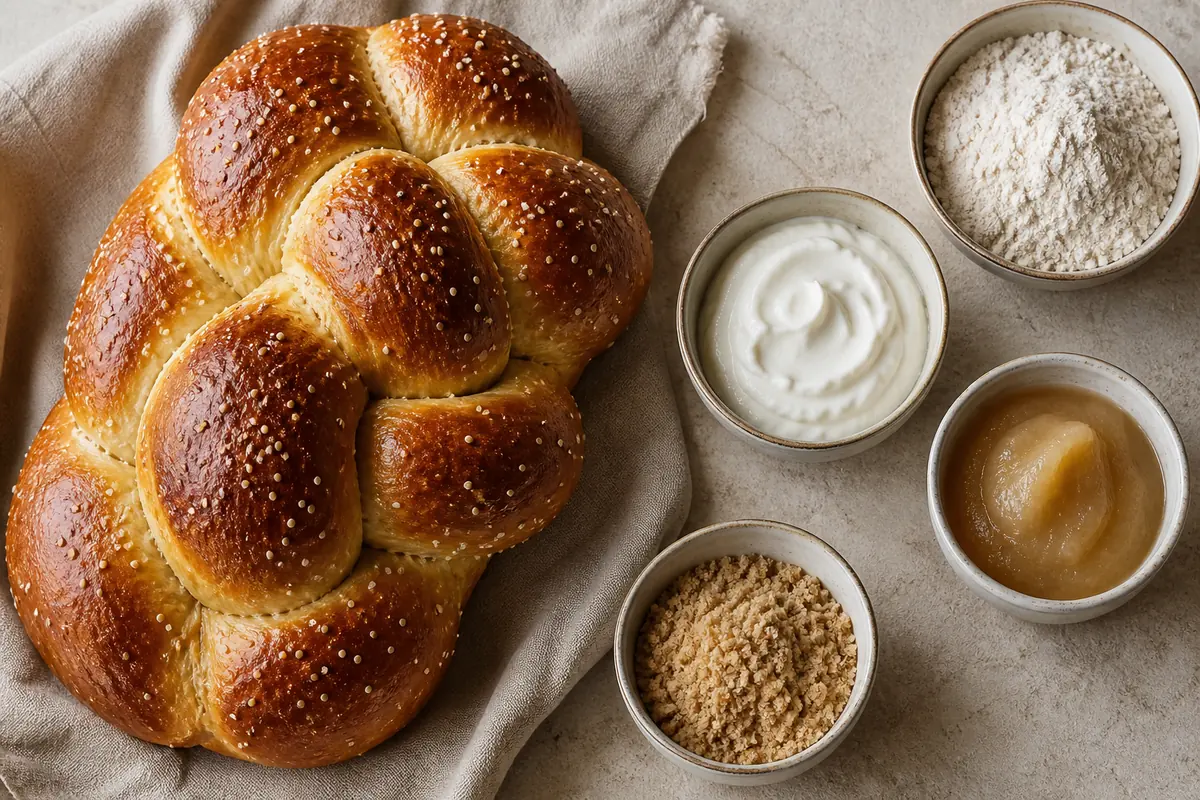
5 Best Challah Bread Substitutes (Quick Swaps)
Ingredients
Equipment
Method
- Match the recipe job: for French toast/stuffing, choose a substitute with the most moisture-retaining softness (brioche or egg bread first).
- Use the listed swap ratio; if your substitute is sweeter (like Hawaiian sweet bread), start at ¾ of the amount.
- For bland bread (like white sandwich bread), mimic challah’s richness by soaking slices briefly in an egg-milk mixture before using.
- If the substitute is very soft (milk bread, Hawaiian bread), shorten soaking time to prevent mushiness.
- Taste the final result: add a pinch of salt or reduce added sugar in the recipe if the substitute is sweeter than challah.
Notes
- Best results come from matching both enrichment (egg/fat) and slice thickness/soak time.
Tried this recipe?
Let us know how it was!
Carrie is a food writer and editor with more than 15 years of experience. She has worked for some of the biggest names in the food industry, including Bon Appétit, Food & Wine, and Martha Stewart Living.
As the Editor in Chief of EpicureDelight, Carrie oversees all of the content on the site. She also manages the team of contributing writers and editors, who help to create delicious recipes, helpful tips, and informative articles that you’ll find on the site.
A native of the Chicago area, Carrie is passionate about all things food. She loves trying new restaurants and experimenting with new recipes in her kitchen. She’s also a graduate of the Culinary Institute of America, so she knows a thing or two about food!



