
That sweet, icy-green hit in a Grasshopper cocktail or a mint-chocolate sundae sauce? That's crème de menthe doing two jobs at once: delivering clean mint flavor and adding a syrupy sweetness that pure extract never quite matches alone.
When your bottle runs dry mid-recipe, you need a creme de menthe substitute that covers both angles, not just one.
The five swaps below handle cocktails, sauces, frostings, and float-style drinks. Some are nonalcoholic, some near-identical in function.
Pick the one that matches your situation.
The best creme de menthe alternative depends on whether you need alcohol, color, or pure mint sweetness. Peppermint extract + simple syrup gives the most control. Mint simple syrup is the cleanest nonalcoholic option. Green mint liqueur swaps 1:1 with minimal fuss.
5 Best Crème De Menthe Substitutes Ranked by Flavor Match
| # | Substitute | Best For | Ratio | Key Note |
|---|---|---|---|---|
| 1 | Peppermint extract + simple syrup | Both | 1:1 | Most precise mint control |
| 2 | Mint simple syrup | Both | 1:1 | Best nonalcoholic swap |
| 3 | Green mint liqueur | Cocktails | 1:1 | Check sweetness level first |
| 4 | Green Chartreuse | Cocktails | ¾:1 | Dilute to tame herbals |
| 5 | Mint tea concentrate + sugar | Both | 1:1 | Best emergency option |
1. Peppermint Extract + Simple Syrup
This combination is the most controllable creme de menthe substitute in cooking and cocktails. You're building the same two-component profile that crème de menthe already is: sweetness from syrup and mint punch from extract.
Mix roughly 1 part peppermint extract to 4 parts simple syrup, then taste. The syrup-versus-sugar tradeoff matters here because granulated sugar won't dissolve cleanly in cold drinks.
- Ratio: Use the combined mix 1:1 by volume in place of crème de menthe
- Add extract slowly: Go 1 drop at a time after the 4:1 base; mint extracts vary hugely in strength
- In frosting or ganache: Stir into room-temperature fat before folding in to avoid seizing
- In cocktails: Pre-mix the syrup-extract blend so you're pouring one ingredient, not two
Skip if: Your recipe is a delicate whipped cream or light mousse and you can't count drops carefully. Over-minting here is very easy, and you can't pull it back.
2. Mint Simple Syrup
Steep fresh mint leaves in hot simple syrup for at least 15 minutes, then strain. The result is a naturally sweet, clean mint liquid that replaces crème de menthe almost perfectly in nonalcoholic contexts.
- Ratio: Swap 1:1 by volume in dessert sauces, mocktails, and whipped toppings
- Stronger flavor: Steep mint leaves for 30 minutes instead of 15, or use spearmint for a softer tone
- Taste-adjust: After steeping, add an extra teaspoon of sugar if the syrup tastes thin or flat
- Color: A few drops of green food coloring match white crème de menthe to green for visual recipes
When you're working with layered creamy desserts, tangy dairy swaps and mint syrup together can actually improve the balance against rich chocolate.
Skip if: Your layered cocktail relies specifically on the alcohol density for floating. You'll need to add a splash of vodka to mint syrup or the layers will blend.
3. Green Mint Liqueur
Any commercially made green mint liqueur that isn't labeled crème de menthe still behaves almost identically in a glass. Brands like Bols Peppermint or similar mint schnapps products are close enough for most cocktail recipes.
- Ratio: Swap directly 1:1 in Grasshoppers, Stingers, and mint julep riffs
- Check sweetness first: Mint schnapps often runs sweeter; if yours does, reduce by 10-25% and dilute with a splash of water
- Mint intensity: Some liqueurs lean more peppermint-forward; taste before pouring to avoid sharp bite
Skip if: Your recipe specifies white crème de menthe for color neutrality. Green liqueurs can darken light sauces or creams noticeably.
4. Green Chartreuse
Green Chartreuse is herbal, complex, and only partly minty. It works when you want depth and your recipe can handle it, but it is not a gentle swap.
Green Chartreuse as a Crème De Menthe Swap
Works for: chocolate desserts, nut-heavy cocktails, espresso drinks, and recipes with bold supporting flavors that absorb herbals well
Skip if: your recipe is light and vanilla-forward, or if the dish is delicate enough that one herbal note will dominate everything else
- Ratio: Use ¾ of the crème de menthe amount, then dilute with water or plain simple syrup to reach full volume
- Sweetness gap: Chartreuse is less sweet; add 1-2 teaspoons of simple syrup per ounce to compensate
- Best use: A chocolate mint cocktail or a dark sauce over ice cream, where the herbal layers read as complexity
For anyone who needs to swap away from Chartreuse itself in a recipe, replacing herbal spirits follows a similar logic of taming bitterness with sweetness.
Skip if: You're making anything pale or cream-colored. Chartreuse turns the dish a murky olive tone.
5. Mint Tea Concentrate + Sugar
Brew 3 bags of peppermint tea in just 6 oz of hot water for 5 minutes. Then stir in sugar until it dissolves completely, using about 2 tablespoons of sugar per 4 oz of liquid.
The result is a surprisingly convincing sweet-mint liquid for baking and cold drinks.
Simmer gently for 2-3 minutes if the concentrate tastes thin after sweetening. The sweetener comparison options help if you want to use honey or agave instead of white sugar in this base.
- Ratio: Use 1:1 once fully sweetened and concentrated
- Concentration check: It should taste noticeably sweet-minty, not like iced tea with sugar
- Best use: Mint chocolate sauces, no-alcohol Grasshopper pie filling, or cold stirred drinks
Skip if: Your tea steeped too long or sat overnight. Over-steeped mint tea develops a grassy, almost bitter aftertaste that no amount of sugar covers once chilled.
Making Crème De Menthe Substitutes Work
The most common mistake is treating these swaps as exact scientific measurements. They aren't. Taste-matching is the real method: get sweetness close first, then adjust mint intensity in small increments.
A substitute that tastes right before mixing will almost always land right in the final dish.
For alcohol-free swaps specifically, let your finished drink or sauce sit for 10 minutes before the final taste. Mint flavor opens up and brightens as it rests, so what tastes slightly flat right after mixing often needs no extra extract at all.
- Step 1: Identify the recipe's primary need: mint flavor only, sweetness + mint, or alcohol lift + mint. Choose your swap accordingly.
- Step 2: Match sweetness first with syrup, then dial mint intensity with extract or steeping time, never the other way around.
- Step 3: For any homemade concentrate, scale in at 75% of the called-for crème de menthe volume, taste, and add more in small pours until balanced.
Frequently Asked Questions
Yes, but mix it into simple syrup first. Use about 1 drop of extract per teaspoon of syrup, then swap the combined mixture 1:1 for crème de menthe by volume.
Mint simple syrup is the cleanest option. Steep fresh mint in hot sugar syrup for 15-30 minutes, strain, and use 1:1 in any dessert recipe.
Yes for most baked recipes. Since it has no alcohol, it won't affect rise or texture, and the 1:1 volume swap keeps sweetness consistent.
Add mint flavoring in small steps and taste as you go. More sweetness softens perceived mint intensity, so add a little extra syrup if the swap tastes sharp.
Green mint liqueur is the easiest color match. For nonalcoholic options, add 2-3 drops of green food coloring to mint simple syrup before using.
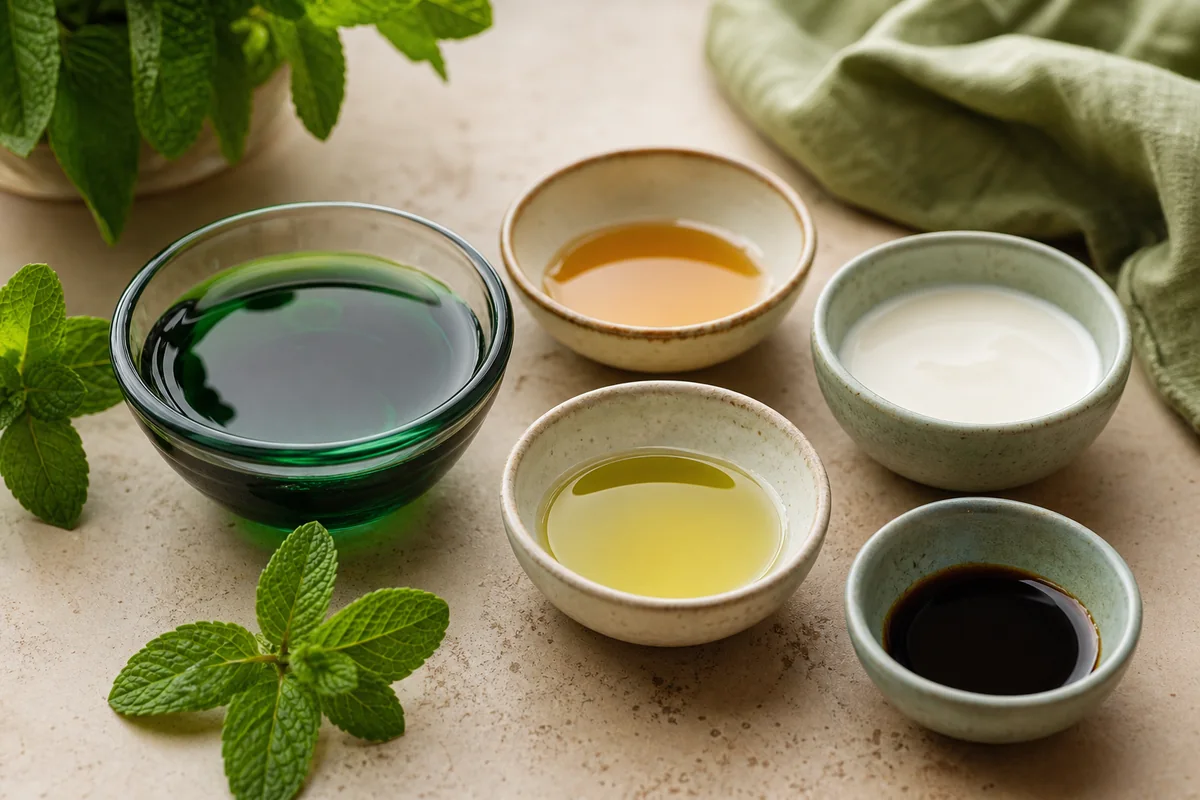
5 Best Creme De Menthe Substitutes (Tested Swaps)
Ingredients
Equipment
Method
- Identify how the recipe uses crème de menthe: color/flavor only (syrupy) vs liqueur function (alcohol lift).
- Pick the closest match: mint simple syrup (nonalcoholic), peppermint extract + simple syrup (most control), or green chartreuse (herbal punch).
- Measure using the ratio target; if your substitute is homemade or concentrated, scale in small steps and taste after mixing.
- If the substitute is less sweet or less minty than crème de menthe, add extra simple syrup (for sweetness) or a few drops of extract (for mint).
- For drinks, chill and then re-taste; for desserts, fold in gently and let flavors sit for 10 minutes before final adjustment.
Notes
- Color matters: white-style recipes usually want milder mint syrup; green-style recipes can handle a slightly stronger mint extract.
- Alcohol-free swaps taste brighter after resting 10 minutes.
Tried this recipe?
Let us know how it was!
Carrie is a food writer and editor with more than 15 years of experience. She has worked for some of the biggest names in the food industry, including Bon Appétit, Food & Wine, and Martha Stewart Living.
As the Editor in Chief of EpicureDelight, Carrie oversees all of the content on the site. She also manages the team of contributing writers and editors, who help to create delicious recipes, helpful tips, and informative articles that you’ll find on the site.
A native of the Chicago area, Carrie is passionate about all things food. She loves trying new restaurants and experimenting with new recipes in her kitchen. She’s also a graduate of the Culinary Institute of America, so she knows a thing or two about food!



