
That crumble of white cheese on a beet salad, the creamy smear on a tart, the tangy dollop in warm pasta. Goat cheese does three jobs at once, and finding a good goat cheese substitute means deciding which job matters most in your dish.
The best swap depends on texture first. A briny crumble needs a different stand-in than a smooth spread or a melted filling.
Once you know what your recipe actually needs, the right choice gets obvious fast.
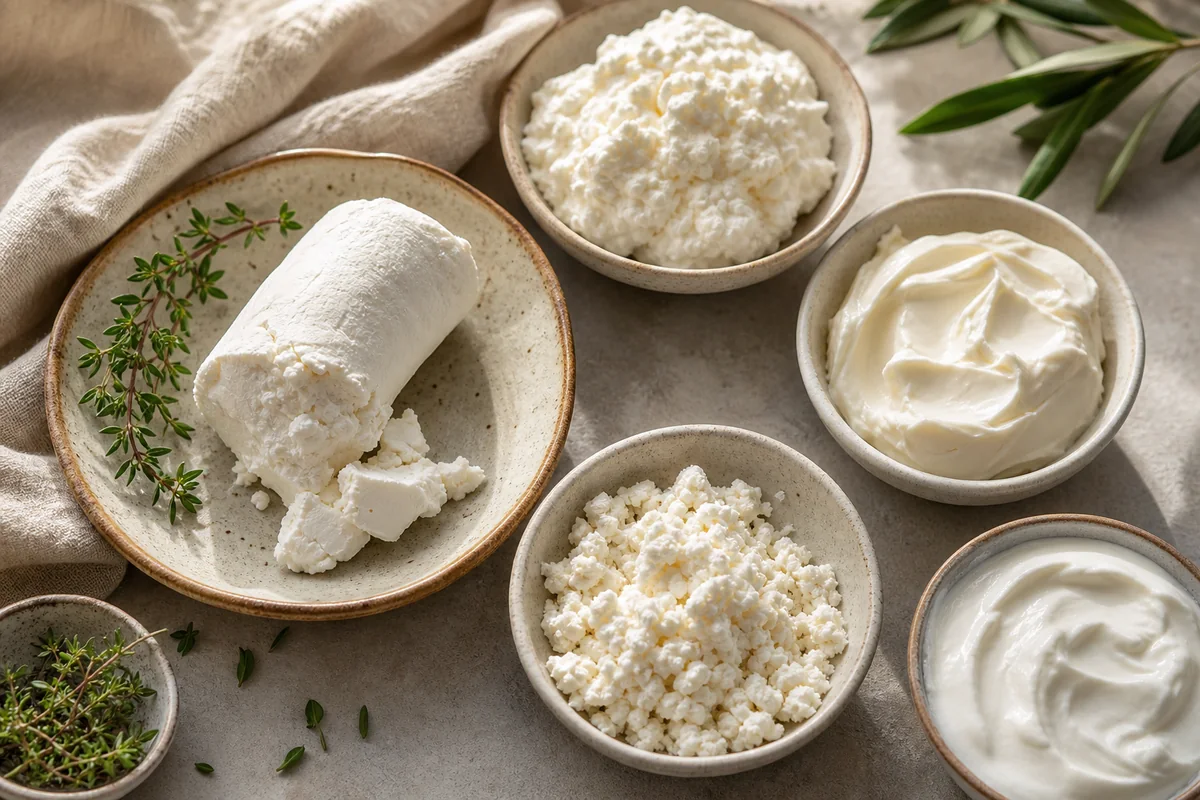
The closest match depends on your dish. Feta covers briny crumbles, cream cheese handles spreadable texture, and labneh comes closest for tang. Add lemon or a pinch of salt to close the flavor gap with any of these swaps.
Goat Cheese Replacement: The 5 Best Swaps (With Quick Use Notes)
Each substitute below covers a different goat cheese job. The table gives you a fast reference before you read the detail on each one.
If you want to understand what goat cheese flavor is actually built from, the breakdown of how the taste develops is worth a quick scan before you pick your swap.
| # | Substitute | Best For | Ratio | Key Note |
|---|---|---|---|---|
| 1 | Feta (crumbled) | Crumbles & Salads | 1:1 | Saltier, add lemon |
| 2 | Cream Cheese + milk | Spreads & Baking | ¾:1 | Add acid for tang |
| 3 | Ricotta (drained) | Pasta & Dollops | 1:1 | Drain to avoid water |
| 4 | Labneh / Greek yogurt | Spreads & Toppings | 1:1 | Strain for thickness |
| 5 | Tofu goat cheese | Dairy-free all uses | 1:1 | Blend smooth, add lemon |
Fresh goat cheese substitutes tend to taste milder. If your original cheese was aged and sharp, bump up the acid and salt before you call it done.
1. Feta (Crumbled)
Feta is the fastest crumble swap. It holds its shape in salads, bakes without melting away, and gives you a salty, tangy bite that reads similarly to goat cheese, even if the flavor is more briny than grassy.
The main thing to manage is salt. Feta runs saltier than most fresh goat cheese.
A squeeze of lemon adds tang without piling on more sodium. For a direct look at how these two cheeses compare, the feta and goat cheese breakdown shows where they land differently.
- Salads and grain bowls: Use at 1:1 and add a small squeeze of lemon to mimic goat cheese tang
- Tarts and flatbreads: Crumble over the top before baking; reduce any added salt in the recipe by half
- Warm pasta: Stir in at the very end, off the heat, so it softens slightly without turning grainy
- Salt check: Taste the dish before seasoning, feta often makes extra salt unnecessary
Skip if: your recipe needs a smooth, spreadable texture. Feta won't blend into a soft log or creamy topping.
2. Cream Cheese + Milk
Cream cheese is the best stand-in when your recipe needs something that melts, spreads, or holds a smooth dollop. On its own, it is denser than goat cheese and noticeably milder.
Thin it with 1 to 2 teaspoons of milk or cream per 2 oz, and it loosens to a consistency close to a soft goat cheese log.
The flavor gap is real. Cream cheese lacks the lactic tang that defines goat cheese.
Add a small squeeze of lemon juice and a pinch of salt before using. That tangy soft dairy spread is also worth keeping in mind for cheesecake-style recipes, where choosing a cheesecake base matters for texture.
Cream Cheese + Milk
Works for: spreads, baked fillings, dolloped toppings, stuffed pastas
Skip if: you need briny crumbles or a dairy-free option
- Consistency fix: Add 1-2 teaspoon milk per 2 oz and stir until it drops to a spoonable texture
- Tang fix: Mix in 1 teaspoon lemon juice and a small pinch of salt before using
- Baking use: Works at ¾ the amount called for, as cream cheese is denser than soft goat cheese
- Storage note: Once thinned, use within 2 days. The softened dairy timing matters for food safety
Skip if: you need a dairy-free replacement. Cream cheese is not dairy-free.
3. Ricotta (Drained)
Ricotta is a quiet workhorse for creamy applications. It is mild, slightly sweet, and much softer than goat cheese, but it fills the same creamy role in pasta, lasagna, or any dish where you'd spoon or layer the cheese.
The watery texture is the only real obstacle. Drain ricotta in a fine-mesh strainer for 10 to 15 minutes before using.
In warm dishes, folding in fresh ricotta at the end preserves its creaminess without breaking it down.
- Pasta and lasagna: Use at 1:1 after draining; add lemon zest and a splash of white wine vinegar for tang
- Cold dollops: Press in a cheesecloth for 15 minutes to firm it up before spooning over dishes
- Warm sauces: Stir in off the heat, not into a rolling boil, to stop it from going grainy
- Tang boost: A few drops of apple cider vinegar bring ricotta closer to goat cheese's tartness
Skip if: your recipe calls for a briny crumble. Ricotta is soft, mild, and won't hold crumbled form.
4. Labneh (or Strained Greek Yogurt)
Labneh is the closest flavor twin for spreads and cold toppings. It is naturally thick and tangy.
The lactic sharpness in labneh lands very close to fresh goat cheese, which makes it the easiest swap when you don't want to adjust much.
If all you have is Greek yogurt, check out yogurt-based swaps for straining guidance. Strain the yogurt over a bowl for 20 to 30 minutes until it holds a spoon trail, then use it as-is.
Labneh vs. Strained Greek Yogurt
Works for: spreads, dips, cold toppings, flatbread bases
Skip if: you need a crumble or a melted filling; both are too soft for that job
- Consistency test: It should hold a soft peak. If it slumps, strain it longer
- Flavor gap: Greek yogurt is milder than labneh. Add a pinch of salt and a few drops of lemon to close the gap
- Cold use: Spoon straight onto salads, grain bowls, or roasted vegetables at 1:1
- Spread use: Mix with a drizzle of olive oil and a pinch of za'atar for a goat-cheese-style board spread
Skip if: you need crumbles. Labneh and strained yogurt are smooth and won't break into firm pieces.
5. Tofu Goat Cheese
Blended tofu is the most versatile dairy-free option. Store-bought tofu goat cheese is the easy path.
If you're making your own, blend firm or silken tofu with lemon juice, a pinch of salt, and a small splash of apple cider vinegar until fully smooth.
Partially blended tofu stays beany and grainy. A full blend is what makes the difference between something spreadable and something that tastes like it came from the fridge wrong.
| Use | Ratio | Notes |
|---|---|---|
| Spread / dip | 1:1 | Blend silken tofu until smooth; add 1 tablespoon lemon per 4 oz |
| Pasta dollop | 1:1 | Use firm tofu blended; stir in off heat to preserve creaminess |
| Baked topping | 1:1 | Firm tofu crumbled roughly; add salt and lemon before baking |
| Cold salad | 1:1 | Silken or firm both work; chill before using for best texture |
- Tang rule: Use 1 tablespoon lemon juice per 4 oz tofu; taste and add more in small drops
- Blend time: At least 90 seconds in a blender; shorter leaves a grainy finish
- Heat behavior: Tofu goat cheese holds well in warm dishes but can dry out if overbaked; add it in the last few minutes
- Salt balance: It needs more salt than you'd expect; season gradually and taste after each addition
Skip if: you want a firm, briny crumble. Blended tofu stays soft and won't hold that texture.
Making Your Goat Cheese Substitute Taste Right
Most swaps miss on two things: not enough tang and the wrong amount of salt. Getting either wrong makes the dish taste flat or sharp in the wrong direction.
The fix is usually quick once you know what to adjust.
- Add acid in stages: Start with half a teaspoon of lemon juice per 2 oz of substitute, taste, then add more. Goat cheese tang is subtle, and you can overshoot it fast
- Add at the right moment: Soft substitutes like ricotta or labneh should go in at the end of cooking. Heat breaks them down and mutes their tang if added too early
- Test before serving: Stir the substitute into a small spoonful of your dish and taste it. If it reads bland, add salt first, then acid. Keeping the cheese at the right temperature also matters, so storing it properly between uses preserves the texture you adjusted for
Frequently Asked Questions
Yes, feta works well at 1:1 for crumbled salad toppings. It is saltier and brinier than goat cheese, so add a small squeeze of lemon and reduce any added salt in the recipe.
It works well for baked spreads and fillings. Soften it with a splash of milk and add lemon juice to bring the tang closer to goat cheese.
Blended tofu with lemon juice and salt is the most flexible option. Store-bought tofu goat cheese is easier if you need the texture right away without blending.
Drain it in a fine-mesh strainer for 10 to 15 minutes before using. Add it off the heat at the end of cooking so it doesn't break down in the pan.
Usually yes, unless your dish is already very acidic. Most substitutes are milder than goat cheese, and a small amount of lemon or vinegar closes the flavor gap quickly.
5 Best Goat Cheese Substitutes Worth Trying
Ingredients
Equipment
Method
- Select a substitute based on your dish type and the flavor match you need.
- Measure using the recommended ratio from the table above.
- Adjust for sweetness, acidity, or texture differences -- taste as you go.
- Add the substitute at the same stage you would add goat cheese in the original recipe.
- Taste the finished dish and correct seasoning if needed.
Notes
- For crumbly dishes (salads, tart crusts), prioritize briny crumbles like feta.
- For baked or spreadable use, choose thick/dairy-based options and thin or drain as needed.
Tried this recipe?
Let us know how it was!
Carrie is a food writer and editor with more than 15 years of experience. She has worked for some of the biggest names in the food industry, including Bon Appétit, Food & Wine, and Martha Stewart Living.
As the Editor in Chief of EpicureDelight, Carrie oversees all of the content on the site. She also manages the team of contributing writers and editors, who help to create delicious recipes, helpful tips, and informative articles that you’ll find on the site.
A native of the Chicago area, Carrie is passionate about all things food. She loves trying new restaurants and experimenting with new recipes in her kitchen. She’s also a graduate of the Culinary Institute of America, so she knows a thing or two about food!



