
Kefalotyri has a specific personality: salty, firm, and sharp enough to hold up under direct heat without dissolving into a puddle. Finding a good kefalotyri cheese substitute means matching those three qualities, not just grabbing the nearest block of hard cheese.
The right swap shifts depending on what you're doing with it. Grating over pasta calls for a different pick than frying slices in olive oil or building a browned crust on a baked dish.
Salt level matters more than most people expect. Some swaps run saltier than kefalotyri, so tasting before you season is not optional.
Kefalotyri is a firm, salty Greek hard cheese used for grating, frying, and baking. The best swaps are pecorino romano and grana padano for grating, halloumi for frying, and parmesan for baked crusts. Cotija works as a last-resort finisher. Always taste and adjust salt before serving.
5 Best Kefalotyri Cheese Swaps
Each of these substitutes preserves at least two of kefalotyri's core traits: firm texture, salt intensity, and the ability to brown without turning rubbery. The table below lets you pick fast.
| # | Substitute | Best For | Ratio | Key Note |
|---|---|---|---|---|
| 1 | Pecorino Romano | Grating / Baking | 1:1 | Reduce added salt 25% |
| 2 | Grana Padano | Grating / Topping | 1:1 | Milder, add lemon if needed |
| 3 | Parmesan | Baking / Gratin | 1:1 | Less tang, check seasoning |
| 4 | Halloumi | Frying / Grilling | 1:1 | Pat dry, slice thin |
| 5 | Cotija | Finishing / Topping | 1:1 | Very salty, use less |
1. Pecorino Romano
Pecorino romano is the sharpest match for kefalotyri's assertive, salty bite. It grates cleanly, browns well in the oven, and holds its shape in baked dishes without turning greasy.
This salty Greek-style hard cheese, which you can read more about at this tangy profile, shares a similar sheep's-milk base with pecorino. That sheep origin is exactly why the two behave so alike under heat.
- Grate finely: Fine grating helps it distribute and brown more like kefalotyri, especially on pastitsio or baked casseroles.
- Cut salt by ~25%: Pecorino runs saltier, so hold back on any additional salt until after you taste the finished dish.
- Use aged pecorino: Fresh or semi-aged versions are softer and won't grate or brown the same way.
Skip if: your recipe needs the specific Greek tang of kefalotyri. Pecorino's sharpness is slightly different and will change the flavor.
2. Grana Padano
Grana padano is a quieter Italian hard cheese. It is firm, finely grained, and aged long enough to grate well and form a decent browned crust.
It is not as salty as kefalotyri, but that makes it easier to control seasoning.
If you want to explore aged hard cheese options beyond this one swap, that comparison is worth a look. For kefalotyri purposes, grana works best in baked pastas and gratins where a sharp punch is less important than a clean, nutty top.
Grana Padano vs. Kefalotyri
Works for: baked pasta toppings, gratins, grating over warm dishes, any recipe where you control salt separately
Skip if: you need strong Greek tang, high salt impact, or a very firm bite in a non-baked application
- Add a squeeze of lemon: A small amount of lemon juice compensates for the lower tang when finishing a dish.
- Grate finely: Coarse grating leaves gaps in a baked crust. Fine grating gives a more even, golden top.
- Salt up front: Because grana is milder, season the dish base more than you normally would.
Skip if: you rely on kefalotyri for a distinctly salty, high-intensity bite with no other seasoning added.
3. Parmesan (Parmigiano-Reggiano)
Parmesan is the most widely available hard cheese on this list, and it performs well for any baked or gratin-style application. It grates finely, forms a proper browned crust, and stays firm without melting into a pool. For someone building a dish that needs a hard, textured top, parmesan is a reliable choice.
Flavor is where it differs. Parmesan is nuttier and less aggressively salty than kefalotyri.
If you're swapping it into a dish that depends on the cheese for most of its salt, you'll need to add a little more seasoning. When choosing a firmer topping cheese matters for texture, parmesan is a solid starting point.
Skip if: you need kefalotyri's sharper, briny tang as the dominant flavor in a dish. Parmesan won't deliver that intensity on its own.
4. Halloumi (for Grilling or Frying)
Halloumi earns its spot here on behavior, not flavor. It holds its shape under direct heat, develops crisp edges in a hot pan, and resists melting the way kefalotyri does.
If storing halloumi before use is a concern, it keeps well in brine for weeks in the fridge.
| Use | Ratio | Notes |
|---|---|---|
| Pan-frying slices | 1:1 by weight | Pat dry, high heat, 2-3 min per side |
| Grilling | 1:1 by weight | Brush with olive oil to prevent sticking |
| Crumbled over salad | 1:1 by weight | Grill first, then break apart while warm |
- Pat slices dry: Moisture on the surface steams the cheese instead of browning it.
- Use high heat: A medium-hot pan gives crisp edges in under 3 minutes per side.
- Don't grate it: Halloumi is too rubbery raw and won't form a proper grated crust the way kefalotyri does.
Skip if: you're expecting your cheese to melt into a smooth, unified layer. Halloumi stays firm and is not a melting cheese.
5. Cotija
Cotija is a Mexican aged cheese with a crumbly texture and a bold, salty finish. It does not grate into a unified layer or form a firm crust, but it works as a salty crumbled topping when nothing else is on hand.
The feta and cotija comparison is worth reading if you want to understand where each sits on the salt and crumble scale.
- Crumble, don't grate: Cotija breaks apart rather than forming shreds, so use it as a scattered finish rather than a layered crust.
- Reduce salt elsewhere: Cut added salt in the dish by at least a third before tasting.
- In baking: It browns but won't form the same firm, unified crust. Use it on top of dishes rather than mixed in.
Skip if: your recipe needs a firm, uniform grated crust that holds together when sliced or served.
Making Kefalotyri Substitutes Work
The key to a clean swap is matching the cheese to the cooking method first, then adjusting flavor. For grating and baked crusts, pecorino or parmesan give the closest result.
For a hot pan or grill, halloumi is the only option here that physically behaves like kefalotyri under direct heat.
- Match use case first: Grating or topping calls for pecorino, grana, or parmesan. Frying or grilling calls for halloumi. Finishing or crumbling calls for cotija.
- Prep the cheese correctly: Grate hard cheeses finely for even browning. Pat halloumi slices dry before they touch heat.
- Taste before you season: Every substitute has a different salt level. Season the dish last, not first.
Frequently Asked Questions
Pecorino romano is the closest match for grating. It shares a sheep's-milk base, grates cleanly, and has a sharp, salty bite very similar to kefalotyri.
Halloumi works in baked dishes only if the recipe calls for firm pieces rather than a melted layer. It browns but stays rubbery rather than forming a crust.
Always taste the dish before adding any extra salt. Pecorino and cotija run saltier than kefalotyri, so reduce added salt by at least 25% and season at the end.
Halloumi is the only substitute here that holds its shape under direct high heat without melting. Pat it dry and use a hot pan for crisp edges.
Kefalotyri has a low moisture content and high salt level that limits how much it melts. Softer or lower-salt cheeses spread more, so chill or finely grate them before baking.
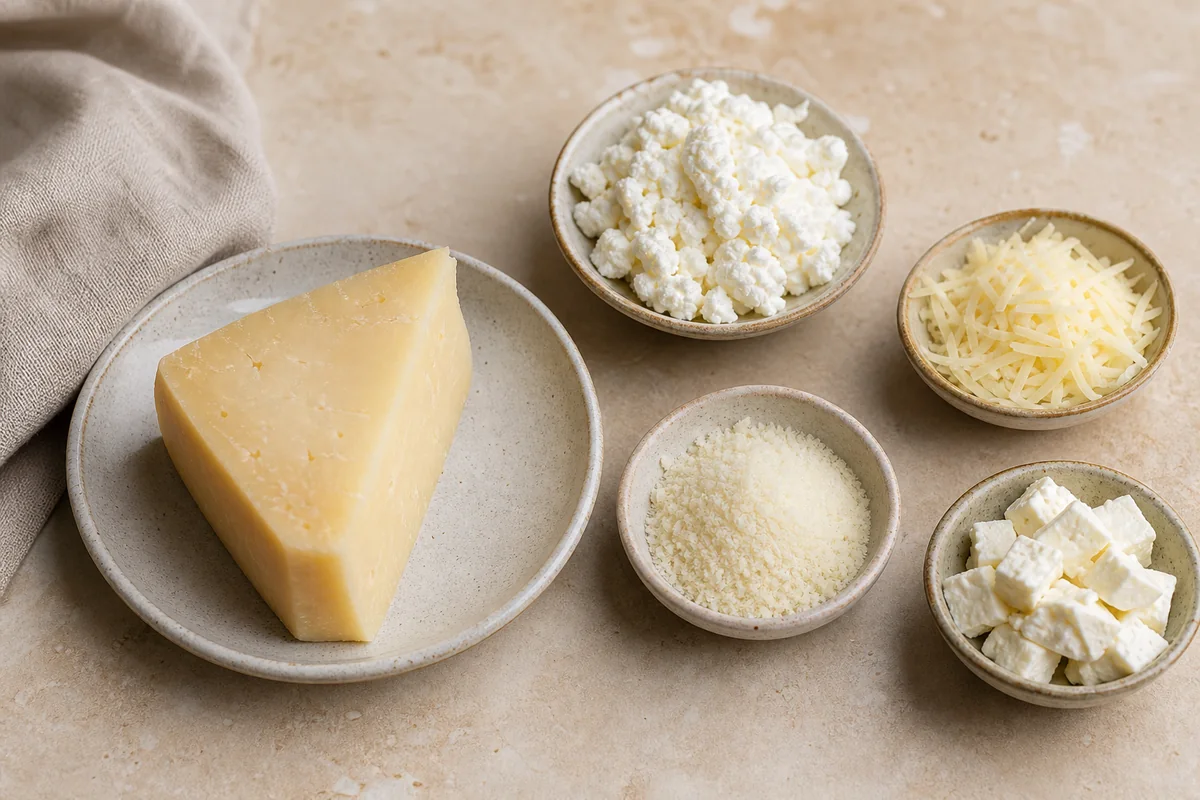
5 Best Kefalotyri Cheese Substitutes (Quick Swaps)
Ingredients
Equipment
Method
- Match the cooking method: grating/topping (Parmesan/Pecorino/Grana) vs. frying/grilling (halloumi).
- Use the table swaps at a 1:1 cheese ratio, then taste and adjust salt or acidity.
- For baked/gratin-style use, grate the substitute finely so it forms a similar browned crust.
- If the substitute is softer than kefalotyri, pat it dry or chill briefly to reduce spread.
Notes
- Kefalotyri is typically very salty and firm; substitutions should keep that bite when grated.
- If your dish depends on crisp frying (not melting), prioritize halloumi-style behavior.
Tried this recipe?
Let us know how it was!
Carrie is a food writer and editor with more than 15 years of experience. She has worked for some of the biggest names in the food industry, including Bon Appétit, Food & Wine, and Martha Stewart Living.
As the Editor in Chief of EpicureDelight, Carrie oversees all of the content on the site. She also manages the team of contributing writers and editors, who help to create delicious recipes, helpful tips, and informative articles that you’ll find on the site.
A native of the Chicago area, Carrie is passionate about all things food. She loves trying new restaurants and experimenting with new recipes in her kitchen. She’s also a graduate of the Culinary Institute of America, so she knows a thing or two about food!



