
That specific sponge texture, the way a ladyfinger holds espresso without falling apart, is harder to replace than most people expect. A good ladyfinger substitute depends on two things: how fast it absorbs liquid and how much structure it keeps after soaking.
Get those two factors right, and your tiramisu or trifle holds together beautifully.
Soak speed matters most for tiramisu-style desserts, where the cookie should soften evenly but not dissolve. Firmer layers, like those in a trifle, can handle a less absorbent swap.
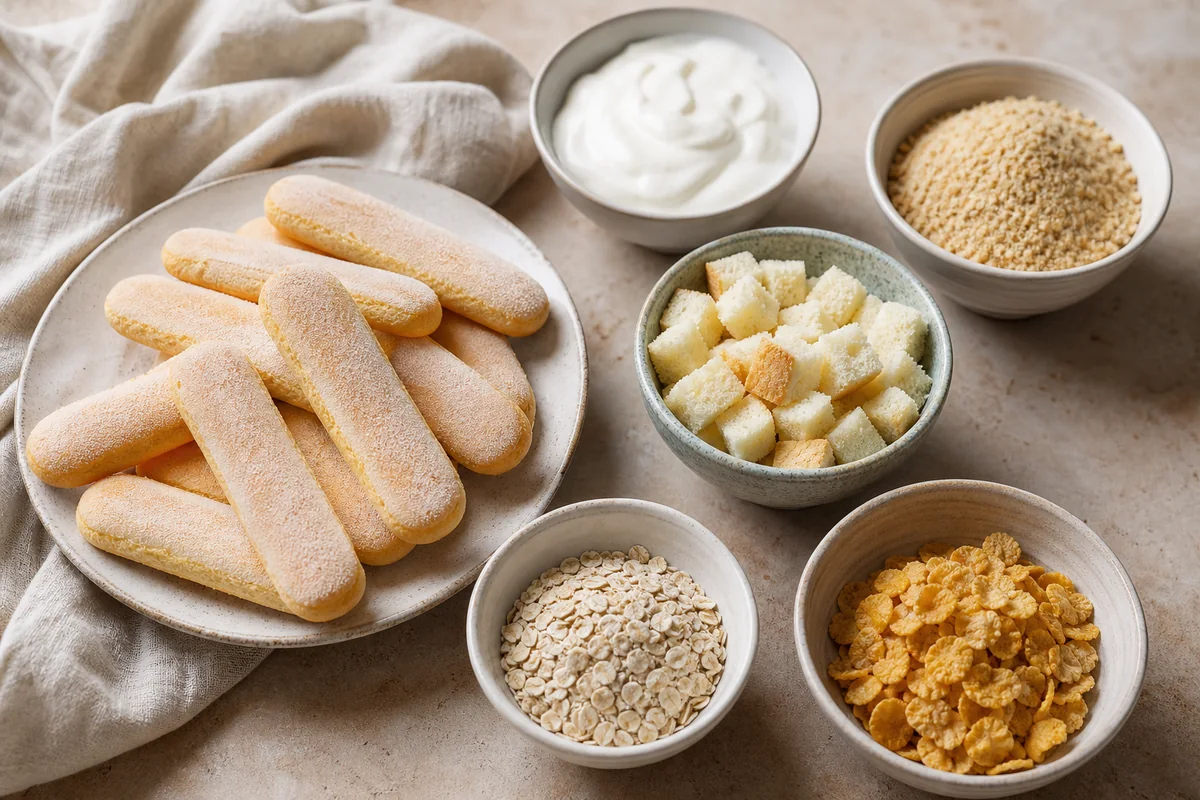
The best ladyfinger substitutes are savoiardi-style sponge cookies (closest match, 1:1), angel food cake (fast-absorbing, use ¾), pound cake pieces (¾ ratio), graham crackers (1:1, moisten lightly), and biscotti or tea biscuits (1:1, soak longer). Match your swap to the soak speed your recipe needs.
5 Best Ladyfinger Substitutes Ranked by Soak and Texture
Choose by your target texture first, then check the ratio. Cake-based swaps absorb faster than cookie-based ones, so they often need less quantity.
Keep your pieces consistent in size so every layer soaks at the same rate. Fast-absorbing swaps like angel food cake work well when the bitter dusting powder on top helps balance sweetness.
| # | Substitute | Best For | Ratio | Key Note |
|---|---|---|---|---|
| 1 | Savoiardi sponge cookies | Both | 1:1 | Closest soak match |
| 2 | Angel food cake | Soft layers | ¾:1 | Very fast absorb |
| 3 | Pound cake pieces | Soft layers | ¾:1 | Tear for less mush |
| 4 | Graham crackers | Firm layers | 1:1 | Moisten briefly only |
| 5 | Biscotti / tea biscuits | Firm layers | 1:1 | Needs longer soak |
1. Savoiardi-Style Sponge Cookies
These are the closest thing to ladyfingers you can buy. Many store-brand "savoiardi" cookies are essentially the same product, just sold under a different label.
The sponge crumb absorbs espresso or flavored syrup at nearly the same rate as a standard ladyfinger. That means you can follow your recipe's soak timing without adjusting.
- Texture: Dry, airy, and slightly crisp on the outside before soaking
- Soak behavior: Soaks evenly in 2-3 seconds per side in espresso
- Best use: Tiramisu layers, Charlotte cakes, layered icebox desserts
Savoiardi Sponge Cookies
Works for: Any recipe calling for ladyfingers, especially tiramisu where soak timing is critical
Skip if: You need a gluten-free option, or your recipe requires very firm layers that resist quick softening
2. Angel Food Cake
Angel food cake is extremely light and porous, which means it absorbs liquid faster than any cookie swap on this list. Tear it into rough 1-inch pieces rather than slicing cleanly, because jagged edges soak more evenly than smooth cuts.
The risk here is over-saturation. Dip pieces for no more than 1 second in your espresso or syrup, then layer and chill immediately.
If you want more guidance on choosing this airy option, it helps to understand how the cake behaves before you start layering.
Skip if: your dessert sits assembled for more than 2 hours before serving. Angel food cake can collapse into a dense, wet mass when it sits too long in liquid-heavy fillings.
3. Plain Pound Cake
Pound cake is denser than ladyfingers and absorbs filling more slowly, but tearing it into irregular pieces closes that gap. The uneven surface area pulls in espresso or syrup at a better rate than neat slices.
When storing leftover cake before using it as a swap, keep it wrapped so it doesn't dry out too much.
- Ratio: Use ¾ the quantity called for; pound cake is heavier and fills layers faster
- Pre-moisten technique: Dip torn pieces for 1-2 seconds, no longer; the dense crumb holds moisture longer than sponge
- Layer thickness: Keep layers no thicker than ¾ inch so the center soaks through before chilling
Skip if: your pound cake is lemon-flavored or heavily sweetened. Those flavors can overpower espresso and cocoa, shifting the entire dessert's taste profile.
4. Graham Crackers
Graham crackers are an emergency swap that works well when you need structure rather than a sponge-like crumb. They hold their shape long enough to layer, but they do soften, so timing matters.
The dry, shelf-stable cracker absorbs moisture quickly once exposed to wet filling. You need to control contact time carefully.
- Moisten time: 1-2 seconds in espresso or syrup, then transfer immediately
- Piece size: Break into halves or thirds; smaller pieces soak more evenly than whole sheets
- Best use: Trifle-style desserts and icebox cakes where some firmness is acceptable
Skip if: your filling is very thin or your dessert assembles more than 3 hours ahead. Thin filling seeps into crackers and turns them gummy well before serving.
5. Biscotti or Tea Biscuits
Biscotti is the firmest swap on this list. It holds shape even after soaking, which makes it ideal when you want layers that don't compress under the weight of filling or fruit.
Split plain biscotti lengthwise before soaking so liquid reaches the center. Submerge each piece for 4-6 seconds, which is roughly twice as long as a ladyfinger soak.
For tea biscuits, 2-3 seconds is usually enough because they are thinner. You can see how soaking almond biscotti changes the texture before you commit to a full batch.
Biscotti / Tea Biscuits
Works for: Desserts that chill overnight, firmer trifle layers, recipes where structure matters more than tenderness
Skip if: You need instant assembly with no soak time, or your recipe is alcohol-free and your biscotti is flavored with liqueur
Making Your Ladyfinger Substitute Actually Work
The core principle is simple: match your soak time to how dense or porous your substitute is. A porous cake swap needs a shorter dip; a firm cookie swap needs a longer one.
Getting this right prevents the two most common problems, underdone dry patches and collapsed soggy layers.
- Adjust soak duration: Cake swaps (angel food, pound cake) need 1-2 seconds; cookie swaps (graham, biscotti) need 2-6 seconds depending on density
- Keep piece sizes consistent: Uneven pieces soak at different rates, which creates dry spots next to soggy ones; cut or tear to a similar thickness throughout
- Assemble and chill immediately: Layer your substitute, add filling, and refrigerate within 10 minutes; any longer at room temperature and fast-absorbing swaps begin to break down
Even layers come from consistent sizing and immediate cold. If your lightly sweet cracker base tastes flat after soaking, stir a pinch of cocoa into the filling to bring the flavor back into balance.
Frequently Asked Questions
Angel food cake absorbs espresso almost instantly, in about 1 second per side. Use it when you need a very quick build, but assemble and refrigerate right away to prevent collapse.
Start at a ¾:1 ratio, meaning use ¾ the volume of cake that your recipe calls for in ladyfingers. Cake is denser and fills layers faster, so less is usually enough.
Yes, if you moisten them for no more than 2 seconds and layer immediately. Longer contact with liquid turns graham crackers paste-like before you can build even layers.
Yes. Biscotti needs 4-6 seconds and should be split lengthwise first. Tea biscuits are thinner and need only 2-3 seconds, similar to a standard ladyfinger soak.
Layer and refrigerate within 10 minutes of soaking. Cake-based swaps break down quickly at room temperature, and even sponge cookies soften further if they sit before chilling.
5 Best Ladyfinger Substitutes (Tested Swaps)
Ingredients
Equipment
Method
- Identify the dish: quick-soak desserts (tiramisu-style) need high-absorbency; layered trifles need structural crumbs.
- Pick the substitute in the table that matches your target texture (soft soak vs firm layer).
- Use the stated ratio; for cake swaps, start at the lower end (¾) because cake absorbs faster than cookies.
- Moisten in the filling just long enough to soften the outside: assemble and chill immediately so layers set without turning to paste.
- Taste after a 5–10 minute soak window: add a quick pinch of cocoa/sugar to balance if the substitute reads bland.
Notes
- For even layers, keep piece sizes similar—small differences create uneven soak.
- If using firmer biscuits/biscotti, pre-split pieces and moisten longer before layering.
Tried this recipe?
Let us know how it was!
Carrie is a food writer and editor with more than 15 years of experience. She has worked for some of the biggest names in the food industry, including Bon Appétit, Food & Wine, and Martha Stewart Living.
As the Editor in Chief of EpicureDelight, Carrie oversees all of the content on the site. She also manages the team of contributing writers and editors, who help to create delicious recipes, helpful tips, and informative articles that you’ll find on the site.
A native of the Chicago area, Carrie is passionate about all things food. She loves trying new restaurants and experimenting with new recipes in her kitchen. She’s also a graduate of the Culinary Institute of America, so she knows a thing or two about food!



