
That cool, thin-skinned crunch is genuinely hard to replace. Persian cucumber substitute searches spike every time local stores run short-and the wrong swap will leave your salad soggy or your quick pickles limp. The good news is that five specific options can cover nearly every use case, provided you know which one fits your dish.
Persian cucumbers are prized for two things: their thin, edible skin and a firm bite that stays crisp even after dressing. These thin little cucumbers are also nearly seedless, which means less water in your bowl.
Knowing that, the ranking below prioritizes crunch first, then flavor closeness, then skin and seed similarity.
Persian cucumbers have thin skin, a crisp bite, and a mild, nearly seedless center. Mini seedless cucumbers match closest. English cucumber works for salads. Kirby holds up best in quick pickles. Regular cucumber needs peeling and seeding. Zucchini and bell pepper are crunch-only swaps.
5 Best Persian Cucumber Substitutes, Ranked by Crunch
| # | Substitute | Best For | Ratio | Key Note |
|---|---|---|---|---|
| 1 | Mini Seedless Cucumber | Both | 1:1 | Closest size and crunch |
| 2 | English Cucumber | Salads | 1:1 | Slice thin, eat fresh |
| 3 | Kirby Cucumber | Pickles | 1:1 | Firm, lightly seed |
| 4 | Regular Cucumber | Salads | ¾:1 | Peel stripes, seed center |
| 5 | Zucchini (raw) | Salads | 1:1 | Crunch only, pat dry |
1. Mini Seedless Cucumber
This is the closest match you'll find. Mini seedless cucumbers-sometimes labeled "Persian-style" at the grocery store-have the same thin, tender skin and nearly identical diameter.
You don't need to peel them, and they hold their snap for hours after slicing.
These small cucumbers, like these mild, thin-skinned cucumbers, are virtually interchangeable in both salads and brines. Use them whole for crudités or sliced into coins for dressed bowls.
- Slicing for salads: Cut into ¼-inch coins or diagonal slices; no peeling necessary.
- Quick pickles: Halve lengthwise into spears and brine immediately-the skin holds the crunch well.
- Ratio: 1:1 in all applications; no adjustment needed.
Skip if: you specifically want the slightly seedy, textured center that Persian cucumbers have. Seedless varieties taste cleaner but noticeably less "seedy."
2. English Cucumber
English cucumber is the most widely stocked option, and it works well when you slice it paper-thin. The skin is slightly thicker than Persian but still edible, and the flavor is comparably mild and fresh.
The risk is moisture: English cucumber releases water faster once dressed.
- Preventing sogginess: Salt slices lightly for 5-10 minutes, then pat dry before adding any dressing.
- Best dishes: Greek salads, raita, cucumber-avocado bowls, and anything served within 30 minutes.
- Slicing guide: Use a mandoline at 2mm for the best crispness; hand-cut rounds at ¼ inch also work.
- Ratio: 1:1; no reduction needed.
For a broader look at the hothouse vs. standard tradeoff, there's more context on which seedless style holds up best in dressed dishes.
Skip if: your recipe needs firm, chunky pickle cuts. English cucumber softens faster in brine than Persian or Kirby varieties.
3. Kirby Cucumber
Kirby cucumbers are the pickle world's favorite for a reason. They're noticeably firmer than Persian cucumbers, with a thicker skin and a denser center that resists softening even in acidic brines.
Kirby vs. Persian Cucumber
Works for: quick pickles, chunky salads, long-marinating applications, and any dish where firmness matters more than delicacy.
Skip if: you need that slim, elegant look of Persian cucumbers-Kirby tends to be stubbier and harder to slice paper-thin without the center going soft.
For more detail on kirby flavor and texture notes, that page covers what makes Kirby distinct and where it falls short.
- Prepping for crunch: Leave the skin on-it's the main source of firmness.
- Reducing water: Scoop seeds lightly with a spoon if your cucumber releases a lot of juice when sliced.
- Best cuts: Half-moon slices (⅓ inch) or spears for quick pickles; coins for chunky salads.
Skip if: you're slicing thin for a delicate salad. Kirby's denser flesh can feel almost too firm and less refined than Persian at very thin cuts.
4. Regular Cucumber
Regular slicing cucumbers are the backup most people already have. They work, but with conditions.
The skin is thick and waxy, and the seed cavity tends to hold more water than Persian cucumbers.
Use ¾ of the amount you would use for Persian cucumbers. That slight reduction keeps your dish from turning watery.
- Peel in stripes: Remove alternating strips of skin rather than peeling fully. This softens the waxy bite while keeping some structure.
- Seed if loose: Run a spoon down the center if the seed cavity looks wet and hollow.
- Slice thin: Aim for 3mm slices max; thicker cuts amplify the watery texture.
Regular cucumber still performs well in fresh salads eaten right away. Add a splash of lemon juice or vinegar to bring the brightness that Persian cucumbers carry naturally.
Skip if: you're assembling a salad more than an hour ahead. The extra water content will pool at the bottom of the bowl faster than with Persian-style cucumbers.
5. Zucchini (Raw)
Raw zucchini is a texture substitution only-this is not a flavor match. It has a firm, mild bite that can stand in for cucumber crunch in a pinch, but it reads slightly greener and earthier.
Keep expectations realistic.
- Cut it thin: Julienne into thin matchsticks or use a spiralizer for ribbons; chunky zucchini pieces taste more like cooked vegetable.
- Control moisture: Salt lightly, wait 5-10 minutes, then pat completely dry before mixing into any dish.
- Best dishes: Simple dressed salads, grain bowls, and wraps where cucumber is a supporting texture-not the star.
- Ratio: 1:1, but taste as you go since zucchini's flavor is less neutral.
If zucchini isn't your only option and you want more ideas, vegetable crunch swaps covers a range of alternatives worth checking.
Skip if: you need the exact mild, lightly seedy cucumber mouthfeel. Zucchini's flesh is smoother and the flavor will register as "squash" rather than "cucumber" to most palates.
Making Persian Cucumber Substitutes Taste Right
The difference between a good substitute and a watery disappointment often comes down to technique, not the ingredient. Whichever swap you choose, the same three-step process protects crunch: control moisture first, then slice to the right thickness, and add acid at the end.
When keeping these delicate cucumbers fresh is the underlying issue, the solution may be as simple as better storage before the swap becomes necessary.
- Salt-and-pat watery substitutes: Sprinkle ¼ teaspoon salt per cup of sliced vegetable, wait 8 minutes, and press firmly between paper towels before dressing.
- Slice at the right thickness: Paper-thin (2mm) for dressed salads; ⅓-inch for quick pickles. Thicker cuts amplify water release in softer cucumbers.
- Dress at the last moment: Add vinegar or lemon juice no more than 10 minutes before serving; acid draws water from any cucumber substitute faster than oil does.
Frequently Asked Questions
Mini seedless cucumber is the closest match for crunch and skin texture. English cucumber works too-slice it thin, salt briefly, and pat dry before dressing.
You can, but English cucumber softens faster in brine. Use it for same-day refrigerator pickles only; Kirby cucumber holds up better for anything brined longer.
Peel in alternating stripes, scoop out loose seeds, and use ¾ the amount called for. Salt slices for 8 minutes and pat dry before adding any dressing.
Kirby cucumber is your best option. It has a slightly seedy center and a mild, clean flavor that comes closest to Persian cucumber's characteristic bite.
Julienne both into thin matchsticks no wider than 3mm. Salt zucchini first and pat dry; cut bell pepper just before serving so it stays crisp.
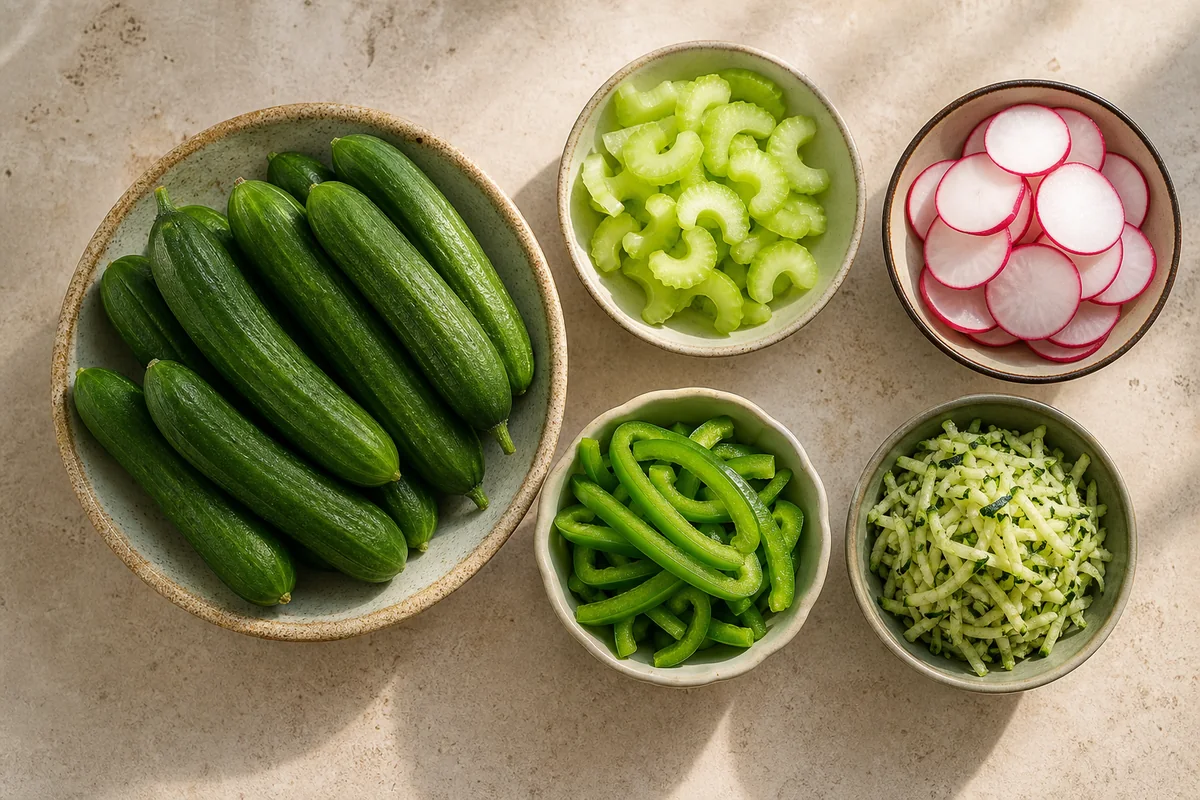
5 Best Persian Cucumber Substitutes (Ranked)
Ingredients
Equipment
Method
- Choose your goal first: slicing (salads) needs crisp + thin skin; quick pickles need firmness and less watery flesh.
- Start with the ratio in the table: use 1:1 for mini seedless/English cucumber, and use ¾:1 for regular cucumber if it’s extra watery.
- Prep for texture: slice very thin for English/mini cucumbers; for thicker cucumbers, seed lightly or peel in stripes.
- If the substitute is wetter (regular cucumber, zucchini), salt lightly for 5–10 minutes, then pat dry before adding to the dish.
- Taste and adjust the dish: add a small pinch of salt or a splash of vinegar/lemon to compensate for milder cucumber flavor.
Notes
- For best results in salads, prioritize thin skin + crisp bite; for pickles, firm flesh matters more than perfect seediness.
- If the substitute feels soft or watery, prep with salting and drying to protect crunch.
Tried this recipe?
Let us know how it was!
Carrie is a food writer and editor with more than 15 years of experience. She has worked for some of the biggest names in the food industry, including Bon Appétit, Food & Wine, and Martha Stewart Living.
As the Editor in Chief of EpicureDelight, Carrie oversees all of the content on the site. She also manages the team of contributing writers and editors, who help to create delicious recipes, helpful tips, and informative articles that you’ll find on the site.
A native of the Chicago area, Carrie is passionate about all things food. She loves trying new restaurants and experimenting with new recipes in her kitchen. She’s also a graduate of the Culinary Institute of America, so she knows a thing or two about food!



