
That deep teal-green color in your smoothie bowl isn't just for show. Spirulina powder brings an unmistakably earthy, faintly oceanic flavor that most other powders don't replicate exactly.
Choosing the right spirulina powder substitute depends on what your recipe actually needs: green color, algae-forward flavor, or a protein-and-greens nutrition bump.
Not every swap works the same way in every recipe. A matcha swap runs sweeter and more tea-like in baking.
A chlorella swap stays closer to the algae character but can read slightly medicinal in delicate dishes.
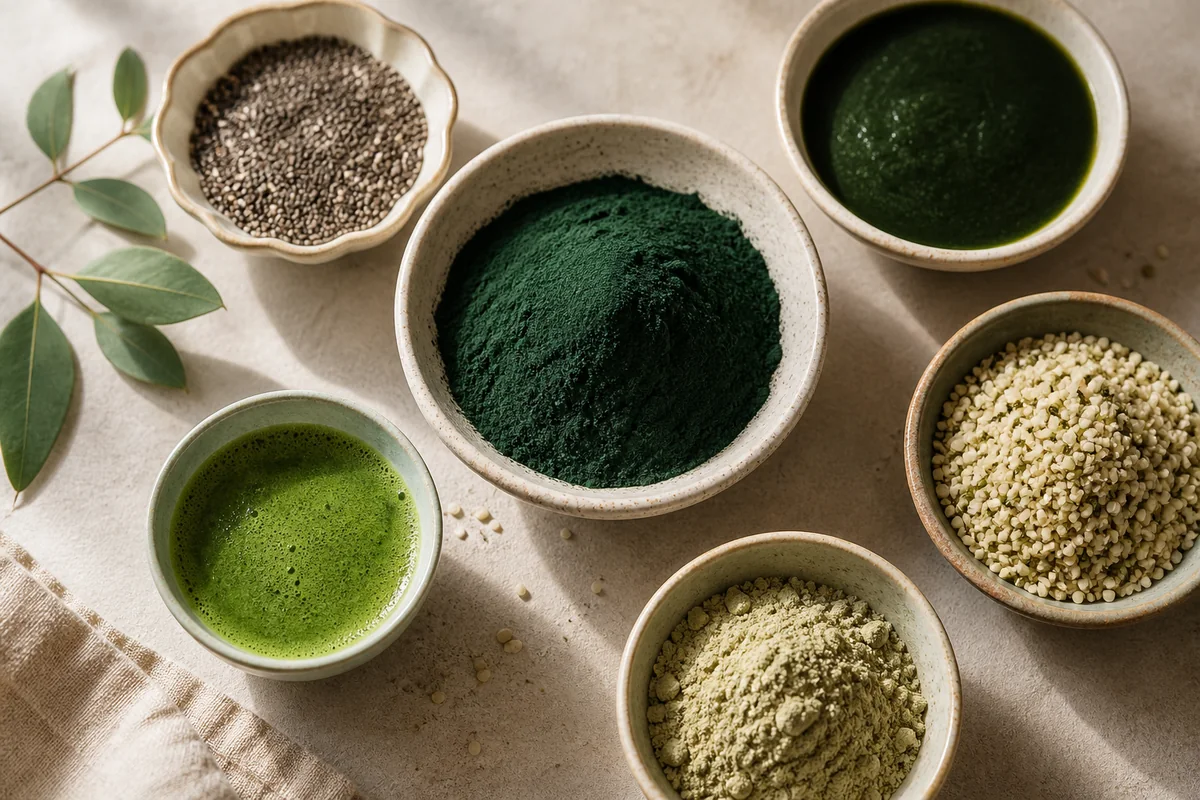
The five best spirulina powder substitutes are chlorella powder, matcha powder, green powder blend, dried spinach powder, and wheatgrass powder. Match your swap to your goal: chlorella for algae-like flavor, matcha for familiar bitterness, spinach powder for color with mild taste.
5 Best Spirulina Powder Substitutes Ranked by Use
Each substitute below earns its place for a different reason. Start with the ratio listed, then taste before you commit.
| # | Substitute | Best For | Ratio | Key Note |
|---|---|---|---|---|
| 1 | Chlorella Powder | Both | 1:1 | Closest algae flavor |
| 2 | Matcha Powder | Both | ¾:1 | Smoother, tea-like taste |
| 3 | Green Powder Blend | Both | 1:1 | Check for added sweeteners |
| 4 | Dried Spinach Powder | Cooking | 2:1 | Lighter color; grassy note |
| 5 | Wheatgrass Powder | Both | ⅔:1 | Sharp; pair with citrus |
Start at the listed ratio and adjust up or down by ¼ teaspoon at a time. If your substitute reads bitter fast, that's your signal to reduce and add a neutralizing flavor like vanilla or lemon.
1. Chlorella Powder
Chlorella is the most direct swap available. It is another single-celled algae, so the flavor profile stays close: earthy, faintly oceanic, and similarly vegetal to spirulina.
If you want to understand what makes the flavor profile distinct before choosing, that comparison holds up well across both powders.
Use it at a 1:1 ratio in smoothies, energy balls, and green batters. The color lands in a similar deep-green range.
| Use | Ratio | Notes |
|---|---|---|
| Smoothies | 1:1 | Blend into liquid before adding solids |
| Baking batters | 1:1 | Mix into wet ingredients first |
| Savory sauces | 1:1 | Whisk well; earthiness blends in |
- Color: Deep green, similar intensity to spirulina; slight blue-green shift possible.
- Texture: Fine powder; dissolves cleanly when pre-mixed into liquid.
- Clump prevention: Stir into 2 tablespoons of warm water or milk before adding to the full recipe.
Skip if: your recipe is a dessert that needs a mild, sweet base. Chlorella's earthiness can read medicinal in plain yogurt parfaits or vanilla cakes.
2. Matcha Powder
Matcha is the go-to when a recipe needs green color and some bitterness, but not algae flavor. It is familiar, widely available, and dissolves well in both wet and dry mixes.
Start at ¾ teaspoon for every 1 teaspoon of spirulina to avoid the tea-forward bite taking over.
- Bitterness control: The ¾:1 ratio keeps matcha from overpowering mild batters; add a pinch of salt to round the edge.
- In baking: Mix into dry ingredients; matcha distributes evenly in flour-based batters.
- In smoothies: Whisk into a small amount of liquid first, then combine. It can clump if added dry to a thick base.
- Color payoff: Bright grassy green rather than the blue-green of spirulina; slightly lighter overall.
Skip if: your recipe has no cocoa, vanilla, or fruit to balance bitterness and you're sensitive to tea-like flavors. Plain oat muffins with matcha can taste flat without a flavor anchor.
3. Green Powder Blend
These blends vary more than any other option on this list. A pea, spinach, and sea-moss blend with no added sweeteners works at 1:1 and performs reliably in smoothies and savory dishes.
If you're also exploring storing green powders long-term, blends often have shorter shelf lives than single-source powders.
Green Powder Blend
Works for: smoothies, green sauces, protein balls when the blend is mostly greens with no fruit powders or sweeteners added.
Skip if: the label lists cane sugar, fruit extract, or natural flavor in the first four ingredients - your recipe may taste unexpectedly sweet.
- Check the label: Look for pea protein, spinach, spirulina, or chlorella as the top ingredients.
- Sweetener warning: If the blend has fruit powders, drop to ¾:1 and taste before adding more.
- Fiber thickness: Some blends thicken liquids; add 1 to 2 extra tablespoons of liquid to compensate.
4. Dried Spinach Powder
Spinach powder is the most pantry-accessible option here. It gives reliable green color but at a lighter intensity than spirulina, so you need more of it.
Use 2 teaspoons of spinach powder for every 1 teaspoon of spirulina to get a comparable visual result.
The flavor is grassy and mild. Most people find it undetectable in a fruit-forward smoothie, but it is noticeable in plain or lightly seasoned recipes.
If you want greener smoothie options that mask the vegetal note well, pairing spinach powder with mango or banana is the easiest fix.
Whisk spinach powder into the liquid component before adding anything else. It clumps fast and settles to the bottom if left dry.
Skip if: your recipe is pale in color (vanilla batter, white sauce) and a grassy aftertaste would stand out. In those cases, matcha gives you better flavor control.
5. Wheatgrass Powder
Wheatgrass has a sharper, more aggressive greens flavor than spirulina. That sharpness is why the ratio drops to ⅔ teaspoon per 1 teaspoon of spirulina.
Use less, taste, then decide if you need more.
Wheatgrass Powder
Works for: citrus smoothies, cocoa-based energy bites, savory green bowls where a bold greens note fits the flavor plan.
Skip if: the recipe is delicate (plain yogurt, vanilla pudding, unflavored protein drinks) - wheatgrass can dominate quickly.
- Pairing: Lemon, cocoa, and vanilla all soften wheatgrass's sharp bite effectively.
- Mixing method: Blend into liquid first; it disperses better than dry-mixing into flour.
- Color: Bright, saturated green - often more vivid than spirulina in finished dishes.
- Scaling up: If color is too light at ⅔:1, increase by ⅛ teaspoon at a time rather than jumping to 1:1.
Making a Spirulina Powder Substitute Work
Three levers control most substitution outcomes: the starting ratio, bitterness management, and how you introduce the powder into the recipe. Get one wrong and the result can taste off even if you picked the right substitute.
Start lower than you think you need and scale up after a quick taste.
- Mixing method: Always pre-dissolve the powder in 1 to 2 tablespoons of liquid before adding it to the full recipe. This prevents clumping in smoothies and batter streaks in baking.
- Recipe-specific adjustment: In baking, add the powder to wet ingredients and reduce bake time by 2 to 3 minutes if the batter looks darker than usual. In savory cooking, stir in at the end of cooking to preserve color.
- Taste-test and tune: After mixing, taste the raw batter or smoothie base. If it's too sharp, add a neutral fat (coconut oil or yogurt) or a sweet element to rebalance before you commit to baking or blending the full batch.
Frequently Asked Questions
Chlorella powder is the closest match. It shares spirulina's algae-forward, earthy flavor and produces a similar deep green color at a 1:1 ratio.
Start at ¾:1, not 1:1. Matcha's bitterness concentrates in baked goods, and a full 1:1 swap can overpower mild batters like vanilla muffins.
Pre-mix the substitute powder into 1 to 2 tablespoons of liquid before adding it to the blender. This step works for every green powder on this list.
In fruit-forward smoothies, the grassiness is barely noticeable. In plain or lightly seasoned recipes, it can show through, so pair it with banana or mango.
Wheatgrass powder pairs well with both lemon and cocoa. Those flavors soften its sharp bite, making the ⅔:1 ratio easy to balance in most recipes.
5 Best Spirulina Powder Substitutes (with Ratios)
Ingredients
Equipment
Method
- Identify your recipe goal: match the green color (pick spinach/wheatgrass), keep an algae-like flavor (pick chlorella), or maintain a more familiar taste (pick matcha).
- Use the ratio listed in the table; if your substitute seems milder or less colored, scale up gradually rather than doubling at once.
- For thicker batters/smoothies, whisk the powder into the liquid first (or blend) to prevent clumps.
- Taste and adjust: if it tastes too grassy, reduce the swap and add a neutralizing element (cocoa/vanilla/lemon).
- If baking, consider lowering bake time slightly or add the powder to wet ingredients so color stays more even.
Notes
- Green powders can vary in bitterness and color intensity—start with the listed ratio and adjust after a quick taste-test.
- To avoid color speckling, mix powder thoroughly into the wet/base before adding dry ingredients.
Tried this recipe?
Let us know how it was!
Carrie is a food writer and editor with more than 15 years of experience. She has worked for some of the biggest names in the food industry, including Bon Appétit, Food & Wine, and Martha Stewart Living.
As the Editor in Chief of EpicureDelight, Carrie oversees all of the content on the site. She also manages the team of contributing writers and editors, who help to create delicious recipes, helpful tips, and informative articles that you’ll find on the site.
A native of the Chicago area, Carrie is passionate about all things food. She loves trying new restaurants and experimenting with new recipes in her kitchen. She’s also a graduate of the Culinary Institute of America, so she knows a thing or two about food!



