
That tiny tin of anchovies does a lot of quiet work. It melts into olive oil, disappears into tomato sauce, and leaves behind a deep, salty savoriness that's hard to name but immediately missed when it's gone.
Knowing the right anchovy substitute means you're not just swapping salt for salt - you're matching the specific role anchovy plays in your dish.
Anchovies do three things: they bring umami, they bring brine, and they melt completely into heat. The best replacement depends on which of those three your recipe needs most.
A cooked pasta sauce needs the umami-and-melt effect; a Caesar dressing needs brine and punch; a pizza topping needs both.
The best anchovy replacement depends on your dish. For cooked sauces, use anchovy paste or miso paste. For dressings and cold dishes, use capers or soy sauce. For pizza toppings, olive paste or capers hold their texture and briny depth well.
5 Best Anchovy Substitutes Worth Trying
Every option below replicates at least one of anchovy's core roles - salty umami, briny funk, or that melt-into-the-background effect. The sub-table below is your fast scan; the sections that follow give you the detail on when each one actually works.
| # | Substitute | Best For | Ratio | Key Note |
|---|---|---|---|---|
| 1 | Anchovy Paste/Powder | Both | 1:1 | Start small, very salty |
| 2 | Miso Paste (white/yellow) | Both | ¾:1 | Add lemon for brightness |
| 3 | Soy Sauce + Lemon | Both | 1:1 | Add acid to prevent flatness |
| 4 | Capers, finely chopped | Both | 1:1 | Chop fine, rinse if very salty |
| 5 | Olive Paste / Olives | Both | 1:1 | Use sparingly; bold flavor |
1. Anchovy Paste or Powder
Anchovy paste is the most direct swap you can make, and it works in almost every situation where whole anchovies are called for. Understanding the full anchovy paste taste helps you calibrate how much to use without overwhelming the dish.
The biggest risk is over-salting. Paste and powder are more concentrated than a single anchovy fillet, so always start with about half what you'd normally use and build from there.
- Cooked sauces: Add paste directly to warm olive oil and stir until it dissolves - about 30 seconds over medium heat.
- Dressings: Mix a small amount (start with ½ tsp) into the acid component first so it blends evenly.
- Salt correction: Hold back any added salt in the recipe until after you've tasted - paste already carries a heavy salt load.
Skip if: you're avoiding seafood entirely, or you can't find paste or powder locally and ordering isn't practical.
2. Miso Paste (White or Yellow)
Miso is our preferred swap for cooked sauces and dressings when the goal is savoriness rather than briny funk. If you're curious about what miso paste tastes like before committing to a full batch, that's worth a quick read.
Start with ¾ of the amount you'd use for anchovy, because white miso is surprisingly salty on its own.
The missing piece is brightness. Miso has no tang, so always add a squeeze of lemon or a small splash of rice vinegar alongside it to mimic the acidity that anchovies carry naturally.
- Pasta sauce: Stir in 1-2 teaspoon of white miso during the last few minutes of cooking so it doesn't scorch.
- Caesar dressing: Whisk miso with lemon juice and a little olive oil before adding other ingredients - it emulsifies well.
- Amount: Start at ¾ teaspoon per 2 anchovy fillets called for; taste and add more in small increments.
Skip if: you need the actual fishy, briny profile - miso gives umami without the ocean character. If that's not enough, check miso paste swaps as a further fallback.
3. Soy Sauce + a Squeeze of Lemon
Soy sauce already covers two of anchovy's three jobs: saltiness and umami. What it lacks is tang, and that's where lemon or a small splash of vinegar comes in. Together they make a surprisingly close anchor - the soy dissolves into cooked sauces completely and leaves no "soy" aftertaste once it's been simmered for even 5 minutes.
The ratio is simple. Use 1 teaspoon soy sauce plus ¼ teaspoon fresh lemon juice per 2 anchovy fillets the recipe calls for.
- In tomato sauce: Add soy at the start of cooking so it has time to fully mellow into the base.
- In dressings: Whisk soy with the acid component (lemon or vinegar) before emulsifying with oil.
- Salt warning: Skip any additional salt until you've tasted - soy adds a significant salt load on its own.
- Gluten-free: Use tamari instead of regular soy sauce; flavor is nearly identical.
Skip if: your recipe requires gluten-free and you don't have tamari on hand. Regular soy sauce contains gluten.
4. Capers, Finely Chopped
Capers vs. Anchovies
Works for: briny saltiness, cold dishes, salads, pizza, any recipe where you want a distinct punchy bite
Skip if: you need that mellow melt-into-sauce effect - capers stay present, they don't disappear
Capers are the go-to anchovy alternative for anyone avoiding fish entirely. They don't provide umami, but they nail the brine - and when chopped very finely, they blend into sauces and dressings much better than left whole.
Rinse salt-packed capers briefly under cold water and pat dry before chopping. Brine-packed capers can go straight in, but taste first because some jars are extremely salty.
- Caesar dressing: Use 1 teaspoon finely chopped capers per 2 anchovy fillets; add a pinch of nutritional yeast if you want extra umami.
- Pizza: Scatter over the top after baking to preserve the brine hit - heat dulls their punch.
- Pasta sauce: Stir in at the end of cooking so they don't lose all their sharpness.
Skip if: you want the dish to have that seamless savory background. Capers, even finely chopped, add a distinct flavor that stays identifiable.
5. Olive Paste or Chopped Olives
When you need briny depth fast and the pantry is short on options, olive paste is a solid emergency move. Choose a variety that's already salty and briny - Kalamata or Castelvetrano work well - and chop them as fine as you can manage, or use a ready-made tapenade if that's what you have.
Start with about ½ teaspoon per 2 anchovies called for, because olives carry a bold, assertive flavor that can easily take over a dish.
A small squeeze of lemon and a drizzle of olive oil alongside the olive paste keeps the flavor from turning flat or too earthy. If you're interested in keeping real anchovies stocked for next time, learning about storing anchovy paste properly means you'll rarely need an emergency swap again.
Black olive paste works best in cooked applications; if you're using olives raw in a dressing, go lighter still and taste as you add.
Skip if: you need a clean, neutral umami base. Olives have their own strong personality and will change the direction of a delicate dish noticeably.
Making Anchovy Substitutes Taste Right
The biggest mistake people make with anchovy substitutes is adding the full amount upfront and not tasting until the dish is done. Every option here - paste, miso, soy, capers, olives - carries its own salt load, and that load changes once heat is applied and the dish reduces.
The right approach is taste-then-correct: add half your substitute, simmer or mix briefly, taste, then adjust. Savory flavors also round out after a 5-minute rest, so don't over-season on the first taste.
If you're working with fish sauce as your base, the same logic applies - check the savory notes on fish sauce substitutes to understand how it behaves at different cooking stages.
- Too salty: Don't add water - stretch the dish instead with an unsalted base like more tomatoes, cream, or extra vegetables to dilute without thinning.
- Too flat: Add a small splash of lemon or vinegar; acid is what gives anchovy its bright, forward edge and most substitutes skip it.
- Too sharp or pungent: Stir in ½ teaspoon of olive oil; fat rounds out aggressive flavors in both cooked and raw preparations.
Frequently Asked Questions
Anchovy paste is the closest match - it dissolves fully into warm olive oil and replicates both the umami and salt. Start with ½ teaspoon per 2 fillets and taste before adding more.
Yes - finely chopped capers provide the briny punch Caesar needs. Add a pinch of nutritional yeast if you also want the umami depth that anchovies provide.
Use 1 teaspoon of soy sauce plus ¼ teaspoon lemon juice per 2 anchovy fillets. Hold back any other added salt in the recipe until you've tasted the final dish.
Not well - Worcestershire is more savory than briny and doesn't have the distinct bite of a whole anchovy on top. Capers or olive paste are better for that role.
Stretch the dish with an unsalted base - more tomatoes, cream, or extra vegetables. Adding water thins flavor; adding volume without salt dilutes the saltiness more effectively.
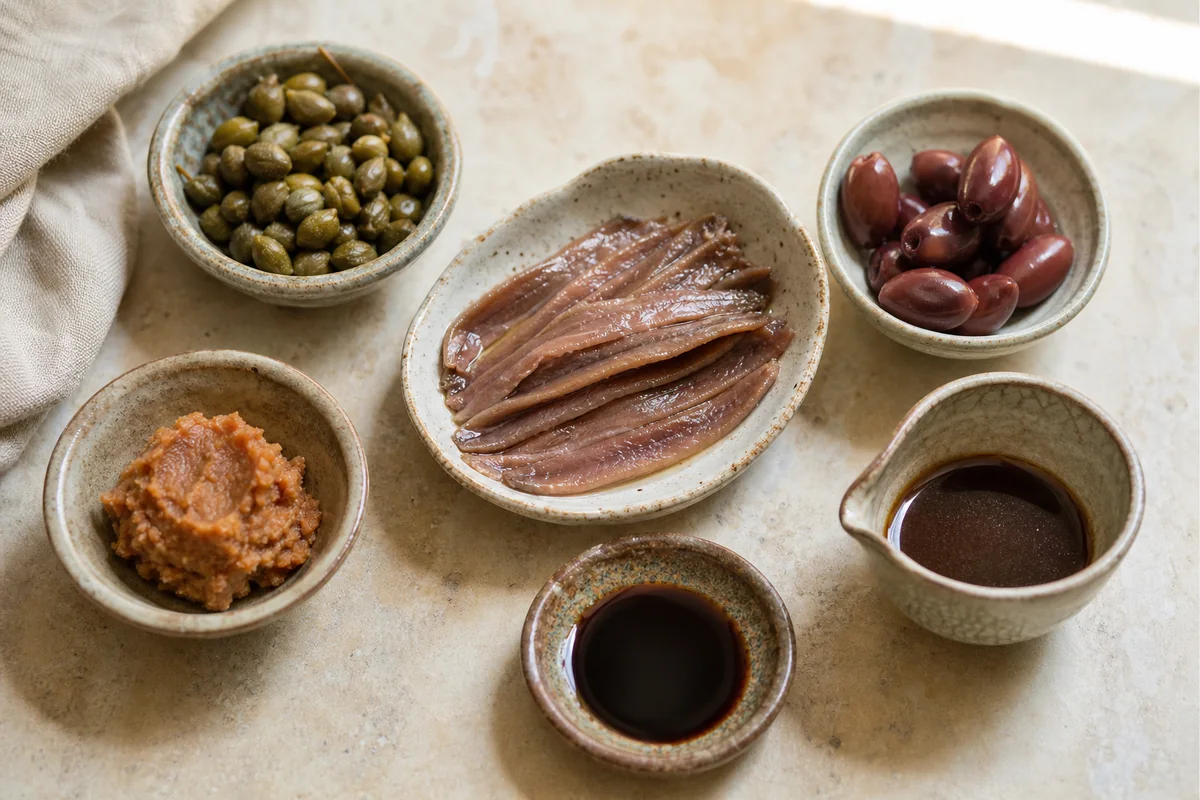
5 Best Anchovy Substitutes Worth Trying
Ingredients
Equipment
Method
- Identify what anchovy is doing in your recipe: pure umami (sauce), briny saltiness (salad/dressing), or melt-in background flavor (cooked sauces).
- Start with the closest pick from the table (aim for the listed ratio) and add it gradually—especially if it’s concentrated (paste/powder/soy).
- If your substitute tastes too sharp or flat, blend in a small amount of olive oil (for roundness) and a drop of lemon/vinegar (for anchovy-like brightness).
- If it tastes too salty, stretch the dish with an unsalted base (more tomatoes, more cream, or extra vegetables) instead of adding more liquid.
- Taste again after a short rest (5 minutes) because savory flavors blend and mellow as the dish sits.
Notes
- Anchor your choice to anchovy’s job: salty umami vs. briny funk vs. melt-into-sauce background flavor.
- Most substitutes need salt/funk balance—taste early and adjust with acid or olive oil.
Tried this recipe?
Let us know how it was!
Carrie is a food writer and editor with more than 15 years of experience. She has worked for some of the biggest names in the food industry, including Bon Appétit, Food & Wine, and Martha Stewart Living.
As the Editor in Chief of EpicureDelight, Carrie oversees all of the content on the site. She also manages the team of contributing writers and editors, who help to create delicious recipes, helpful tips, and informative articles that you’ll find on the site.
A native of the Chicago area, Carrie is passionate about all things food. She loves trying new restaurants and experimenting with new recipes in her kitchen. She’s also a graduate of the Culinary Institute of America, so she knows a thing or two about food!



