
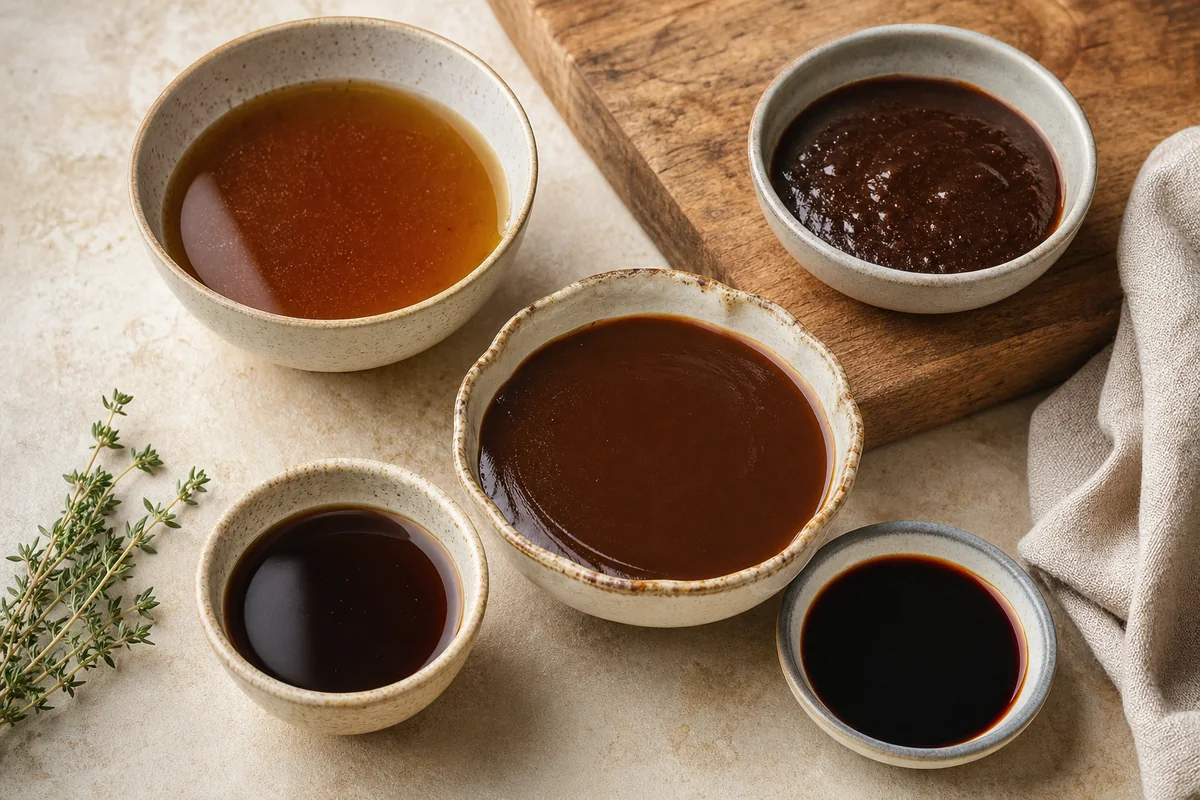
That glossy, spoon-coating sauce draped over a perfect steak fillet is almost always demi glace doing the work. When it's gone from the pantry, the right demi glace substitute can get you surprisingly close, but only if you match two things: concentrated flavor and sauce-coating body.
Demi glace earns its reputation by being both deeply savory and thick enough to cling. A thin broth won't do the job, and a starchy gravy alone won't taste right either.
The five options below are ranked by how closely they hit both targets.
The best demi glace substitutes are reduced beef stock with gelatin, red wine plus beef stock, concentrated brown gravy, Worcestershire-boosted beef stock, and a bouillon-cornstarch slurry. Each one works by combining concentrated flavor with a thickening agent to mimic that glossy coating.
5 Best Demi Glace Substitutes Ranked by Flavor and Body
| # | Substitute | Best For | Ratio | Key Note |
|---|---|---|---|---|
| 1 | Beef Stock + Gelatin | Both | 1:1 | Reduce first, add gelatin warm |
| 2 | Red Wine + Beef Stock | Both | 1:1 | Reduce wine before adding stock |
| 3 | Brown Gravy, Concentrated | Flavor | 1:1 | Reduce gently, watch salt |
| 4 | Worcestershire Beef Stock | Both | 1:1 + 1 tsp | Simmer before serving |
| 5 | Bouillon + Cornstarch | Texture | 1:1 + slurry | Simmer 60 sec after adding |
Pick the substitute that matches your available time. If you have 20 minutes, options 1 or 2 will get you the closest to the real thing.
Short on time, go straight to option 5.
1. Reduced Beef Stock + Gelatin
This is the nearest you'll get without making actual demi glace from scratch. Reducing a good low-sodium beef stock until it coats a spoon, then stirring in bloomed gelatin, replicates both the depth and the silky cling that define the real sauce.
For swapping in replacing gelatin altogether, the texture will shift, so stick with real gelatin here if you can.
Reduced Beef Stock + Gelatin
Works for: steak pan sauces, braises, any dish needing glossy coating and deep beef flavor
Skip if: you can't simmer for at least 15-20 minutes to reduce the stock
- Reduction target: Simmer 2 cups of stock down to roughly ¾ cup before adding gelatin
- Gelatin amount: Bloom ½ teaspoon unflavored gelatin in 1 tablespoon cold water, then stir into the warm (not boiling) reduced stock
- Texture check: Dip a cold spoon; the sauce should coat it and hold without running immediately
- Salt last: Stock concentrates as it reduces, so taste before adding any salt at all
2. Red Wine + Beef Stock
The pairing of red wine and beef stock gets surprisingly close to that browned, complex flavor profile. Knowing the flavor profile of dry reds helps you choose a wine that adds depth without a harsh, boozy edge.
Reduce the wine first by half before adding stock, and the sharpness mellows into something that tastes genuinely rounded.
- Wine choice: Use a dry, full-bodied red like Cabernet Sauvignon or Merlot; avoid sweet or fruity reds
- Reduction step: Reduce ½ cup wine in a hot pan for 3-4 minutes until it looks syrupy, then add 1 cup beef stock
- Simmer time: Continue reducing together for 8-10 minutes until the sauce coats a spoon
- Finish option: A few drops of Worcestershire or a small knob of butter rounds the flavor if it tastes one-dimensional
- Skip if: The dish has a strict no-wine requirement; the wine notes persist even after long reduction
3. Brown Gravy, Concentrated
Store-bought brown gravy is the most pantry-friendly option here. It already has the color and rough flavor direction, but it needs help to behave like demi glace.
Gently reducing it by about a third improves concentration and gives it a better sheen without making it gummy.
- Reduce carefully: Simmer on low, stirring often; reduce jarred or packet gravy by about ⅓ of its original volume
- Strain if needed: Some store-bought gravies have a starchy sediment; strain through a fine mesh for a cleaner finish
- Deepen the flavor: A few drops of Worcestershire after reduction adds savory weight; add after tasting, not before
- Acid balance: A tiny squeeze of lemon (⅛ tsp) can lift a flat-tasting gravy back to life
- Skip if: Your gravy already tastes aggressively salty; further reduction will amplify that and make it unpleasant
4. Worcestershire-Boosted Beef Stock
Worcestershire sauce is packed with fermented, savory depth that mimics the umami backbone of demi glace without needing a long simmer. Add it to using Worcestershire before it ages too far, since fresher bottles taste brighter and more balanced.
One teaspoon per cup of stock is usually enough; more than that and the tangy notes start to dominate.
Worcestershire-Boosted Beef Stock
Works for: quick weeknight pan sauces, roasts, braised short ribs where speed matters
Skip if: you need a wine-free and Worcestershire-free substitute (dietary or allergy reasons)
- Base ratio: 1 cup low-sodium beef stock plus 1 teaspoon Worcestershire sauce
- Simmer time: Bring to a low simmer for 5-6 minutes before serving; don't add and plate immediately
- Thicken if needed: Add ½ teaspoon cornstarch dissolved in 1 teaspoon cold water if you want a glossier finish
- Salt check: Worcestershire adds sodium; taste before seasoning and hold off on extra salt until the end
5. Beef Bouillon + Cornstarch Slurry
When dinner is almost on the table and the sauce is still thin, this combination is the fastest route to a coating consistency. Dissolve one good-quality beef bouillon cube (or 1 teaspoon paste) in 1 cup of hot water, bring to a simmer, then whisk in a slurry of 1 teaspoon cornstarch stirred into 2 teaspoon cold water.
Knowing how soy-based umami swaps work can help if you want to add an extra layer of savory depth alongside the bouillon.
- Slurry ratio: 1 teaspoon cornstarch in 2 teaspoon cold water per 1 cup liquid; whisk thoroughly before adding
- Simmer after adding: Keep the sauce at a gentle simmer for at least 45-60 seconds to cook out the raw starch taste
- Cloudiness fix: If the sauce turns opaque, add 2 tablespoon stock and re-simmer gently for 30 seconds
- Flavor boost: A drop or two of Worcestershire or soy sauce adds enough depth to push it past plain-tasting
- Skip if: You specifically need a gelatin-style glossy mouthfeel; cornstarch gives coating but not the same silky cling
Making Demi Glace Substitutes Work
Every substitute above has two control knobs: concentration (how reduced and intense the liquid is) and body (whether gelatin or starch is doing the thickening). Adjust both, and almost any of these options will hold its own on the plate.
For a deeper look at what you're aiming to replicate, the glossy brown coating of real demi glace is the target benchmark in terms of both color and cling.
- Too thin: Reduce gently on low heat; don't rush with high heat or the flavor can turn bitter at the edges
- Too thick: Loosen with 1 teaspoon of stock or water at a time, stirring between each addition
- Tastes flat: Add savory boosters in small amounts - a drop of Worcestershire, a pinch of tomato paste, or a few drops of soy - then taste before adding more
Frequently Asked Questions
Not straight from the carton. Reduce the stock by at least half first, then add bloomed gelatin to build the coating body that demi glace provides naturally.
Beef bouillon dissolved in hot water, thickened with a cornstarch slurry and simmered 60 seconds, gives a usable coating sauce in under five minutes.
Use bloomed gelatin instead of cornstarch for a clearer result. If you must use cornstarch, simmer the sauce for a full minute after adding the slurry to clear the cloudiness.
Reduced mushroom stock with a small amount of soy sauce works well. It won't taste exactly like beef demi glace, but the umami depth is solid for vegetable-based dishes.
Store in an airtight container for up to 4 days. Reheat gently over low heat, stirring constantly; high heat can break gelatin-thickened sauces and make starch-thickened ones go grainy.
5 Best Demi Glace Substitutes for Better Results
Ingredients
Equipment
Method
- Decide which goal you need: closest flavor (reduce stock + add body) or fastest fix (bouillon + thickener).
- If you have time, reduce beef stock until it coats the back of a spoon, then enrich with gelatin for a demi-glace-like cling.
- If you need speed, simmer bouillon with a splash of Worcestershire and (optionally) a little wine, then thicken with a cornstarch slurry.
- Warm the sauce gently and adjust thickness: reduce for body or add a teaspoon of water/stock to loosen.
- Taste and balance with a tiny pinch of salt (if needed) and/or a few drops of Worcestershire to land in that savory, browned depth.
Notes
- For the closest demi-glace feel, prioritize reduction (concentration) first, then add a small amount of gelatin for glossy coating.
- Avoid boiling gelatin-added sauce hard; warm gently so it stays smooth and coats.
Tried this recipe?
Let us know how it was!
Carrie is a food writer and editor with more than 15 years of experience. She has worked for some of the biggest names in the food industry, including Bon Appétit, Food & Wine, and Martha Stewart Living.
As the Editor in Chief of EpicureDelight, Carrie oversees all of the content on the site. She also manages the team of contributing writers and editors, who help to create delicious recipes, helpful tips, and informative articles that you’ll find on the site.
A native of the Chicago area, Carrie is passionate about all things food. She loves trying new restaurants and experimenting with new recipes in her kitchen. She’s also a graduate of the Culinary Institute of America, so she knows a thing or two about food!



