
Fromage blanc sits in a strange middle ground - smooth enough to pour but thick enough to hold a shape, mildly tangy but not as sharp as sour cream. That balance is exactly what makes a fromage blanc substitute tricky to pick without context.
The right swap depends less on finding an exotic match and more on answering two questions: how thick does it need to be, and how much tang can the dish handle?
If your recipe is a cold spread or a no-bake filling, texture is everything. If it's going into batter or a baked cheesecake, how the substitute behaves under heat matters just as much as flavor.
For a fromage blanc substitute, match thickness first, then tang. Full-fat Greek yogurt (strained) is the most reliable all-purpose swap. Labneh is closest when you need both tang and creaminess. Cream cheese loosened with milk works as a backup but needs a tang adjustment.
5 Fromage Blanc Substitutes (Pick the Closest Texture + Tang)
Not every swap works in every situation, and that's the honest truth about what you can use instead of fromage blanc. The options below are ranked by how closely they match both texture and tang, with notes on where each one earns its place.
Understanding fromage blanc and its flavor before you swap is worth 30 seconds of your time - it narrows down which substitute will actually behave correctly in your recipe.
| # | Substitute | Best For | Ratio | Key Note |
|---|---|---|---|---|
| 1 | Greek Yogurt (strained) | Both | 1:1 | Strain 20-30 min if runny |
| 2 | Labneh | Both | 1:1 | Loosen with 1-2 teaspoon milk |
| 3 | Sour Cream | Cooking | 1:1 | Sharper tang, reduce liquid |
| 4 | Ricotta (blended) | Baking | 1:1 | Blend smooth, drain if wet |
| 5 | Cream Cheese (loosened) | Both | ¾:1 | Add milk + lemon to adjust |
1. Greek Yogurt
Full-fat Greek yogurt is the closest everyday match for fromage blanc's texture when it's strained. The tang is in the right zone - present but not aggressive - and the thickness after straining is almost identical to a spoonable fromage blanc.
If your yogurt seems loose straight from the container, strain it through a fine-mesh sieve for 20-30 minutes. That step alone puts it in the right range for greek yogurt swaps that work in most applications.
- Perfect for: Cold spreads, dips, cake batters, and cheesecake-style fillings that need mild tang
- Prep step: Strain in a fine-mesh sieve for 20-30 minutes if the yogurt is loose or pourable
- In baking: Behaves well under heat without splitting; use full-fat only, not low-fat
- Ratio: 1:1 after straining
Skip if: your recipe needs a richer, cream-cheese-level dairy flavor rather than a yogurt tang - Greek yogurt will taste lighter and won't replicate that body.
2. Labneh
Labneh is strained yogurt taken further, and that extra thickness is what makes it so close to fromage blanc in baked and spread applications. The tang is slightly more pronounced but sits in a similar acidic register - not sharp like sour cream, just gently tart.
If you're exploring alternatives to labneh cheese for another recipe, that same resource covers swaps that mirror this dairy's profile from the other direction.
- Best for spreads: Excellent on bread or served cold - no adjustment needed
- Best for baking: Holds up well in tarts and cheesecake-style fillings
- Moisture adjustment: If labneh feels too stiff, whisk in 1-2 teaspoon milk per cup until it loosens to a spoonable consistency
- Watch for salt: Some commercial labnehs are salted - taste before adding any salt to your recipe
Skip if: your labneh is heavily salted or has an oily surface texture you can't blend out - it will throw off a dessert filling.
3. Sour Cream
Sour cream brings a brighter, sharper tang than fromage blanc, and it's slightly looser in texture. That matters in baking: a thin batter can get thinner, so you'll want to account for the extra moisture.
For dishes where a little more acidity is welcome - think savory sauces or baked cheesecakes - sour cream can step in cleanly. If you're working on a cake and wondering about sour cream in a cake stand-ins, those options overlap well with fromage blanc's role in moist cake batters.
- Sauce and dip use: Swap 1:1; the tang reads well in savory applications
- Baking adjustment: Reduce any other added liquid by about 1-2 tablespoon per cup of sour cream used
- Mixing tip: If the batter looks thin after combining, let it rest 5 minutes - it will tighten slightly as the proteins hydrate
- Curdle prevention: Bring sour cream to room temperature before stirring into hot liquids
Skip if: the recipe needs a gentle, mild dairy note - sour cream's sharpness is distinctly more acidic and will come through in delicate desserts.
4. Ricotta (Blended Smooth)
Standard ricotta has a slightly grainy texture that doesn't mimic fromage blanc's silkiness on its own. Blend it first - about 45 seconds in a food processor or blender - and it becomes a genuinely smooth, creamy swap for cheesecake-style baking.
If you bought ricotta for this purpose but aren't using it right away, check out tips for keeping ricotta fresh so it's still in good shape when you need it.
Blended Ricotta
Works for: smooth cheesecake fillings, tart bases, baked pastry applications
Skip if: you haven't blended it - unblended ricotta will leave a grainy, slightly curdled texture in delicate fillings
Unblended Ricotta
Works for: rustic baked dishes where a slightly textured filling is acceptable
Skip if: your dish needs a smooth, uniform consistency - the curds will stay visible and noticeable
- Prep step: Blend until no visible curds remain; rest 2 minutes so air bubbles settle before baking
- Drain if watery: If your ricotta releases liquid, drain through a fine-mesh sieve for 15-20 minutes before blending
- Ratio: 1:1 for baked fillings once blended and drained
Skip if: your ricotta is very wet and you don't have time to drain it - it will loosen fillings noticeably and may affect the set.
5. Cream Cheese (Softened)
Cream cheese is the backup option, not the first choice, for fromage blanc substitute in baking. It's richer, less tangy, and denser - which means it needs two adjustments before it behaves like fromage blanc: loosening and a mild acid boost.
Check cream cheese spoilage signs before you reach for that block that's been sitting in your fridge for a while - an off cream cheese will derail even a well-adjusted recipe.
| Use | Ratio | Notes |
|---|---|---|
| Spread / dip | ¾ cup cream cheese + 2 tablespoon milk | Whisk until smooth; add ½ teaspoon lemon juice to sharpen tang |
| Baked filling | ¾ cup cream cheese + 1 tablespoon buttermilk | Buttermilk adds a subtle tang that milk alone won't provide |
| Sauce base | ¾ cup cream cheese + 2-3 tablespoon milk | Warm gently, whisk smooth, taste and adjust salt |
- Loosen first: Whisk in 1-2 tablespoon milk or buttermilk per cup before measuring into your recipe
- Add tang: A few drops of lemon juice or a small splash of buttermilk brings it closer to fromage blanc's mild acidity
- Texture note: Even after loosening, cream cheese bakes slightly denser than fromage blanc - expect a firmer set
Skip if: the recipe depends on a light, yogurt-forward tang - cream cheese will taste richer and sweeter even after adjusting, and that difference will show in delicate no-bake applications.
Making Any Fromage Blanc Substitute Work (Baking + Serving)
Two things control whether a swap succeeds: thickness and tang. Get those two variables right and most fromage blanc recipes won't notice the difference.
Understanding the taste of greek yogurt also helps when you're calibrating how much tang your substitute is already bringing to the recipe before you add any acid.
Cream cheese swaps that work follow the same two-lever principle - when in doubt, adjust texture first, then taste and rebalance the acidity.
- Match thickness: If your substitute is looser than fromage blanc, strain through a fine-mesh sieve for 20-30 minutes; if it's stiffer, whisk in milk 1 teaspoon at a time until it matches your target consistency
- Match tang: Taste the substitute before adding it - if it's too mild, add a few drops of lemon juice; if it's too sharp, a small pinch of sugar can round the edge
- Match the application: Cold/spread uses need the right texture from the start; baked uses are more forgiving on thickness but less forgiving on excess moisture, so drain when in doubt
Frequently Asked Questions
Full-fat Greek yogurt (strained) is the most reliable 1:1 swap in baking. It holds up under heat, provides a mild tang, and matches fromage blanc's texture closely after straining.
Yes, if it's loose or pourable. Strain through a fine-mesh sieve for 20-30 minutes to reach a spoonable consistency that matches fromage blanc's thickness.
Drain it through a fine-mesh sieve for 20-30 minutes. For baking, you can also reduce any other liquid in the recipe by 1-2 tablespoon to compensate.
Yes - blend it for about 45 seconds until no visible curds remain. Let it rest 2 minutes before using so any air bubbles settle out.
Labneh or strained Greek yogurt are the best picks. Both hold their shape cold, deliver a gentle tang, and stay smooth without any cooking required.
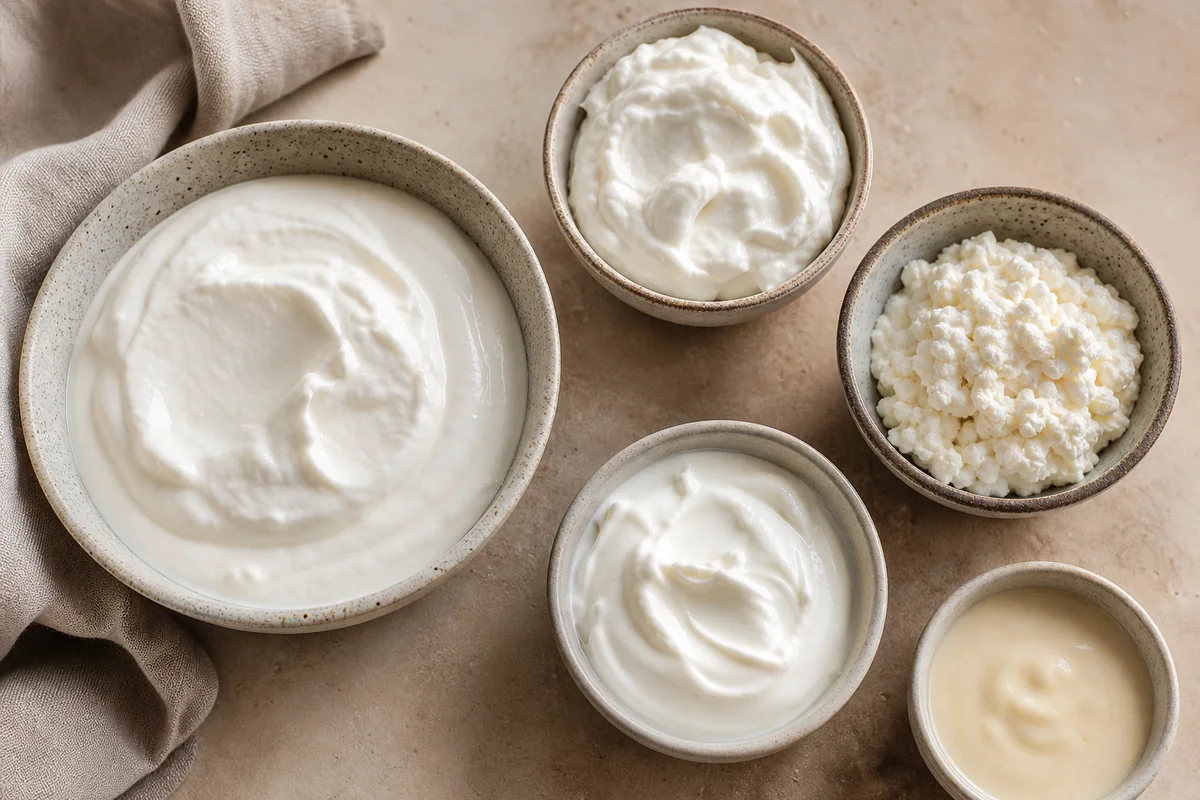
5 Best Fromage Blanc Substitutes Worth Trying
Ingredients
Equipment
Method
- Decide what you need: thick spread (use strained Greek yogurt or labneh) or a creamy filling (use sour cream, blended ricotta, or loosened cream cheese).
- Start with the listed ratio; if the substitute is looser than fromage blanc, drain/strain 20–30 minutes before using.
- If your substitute is thicker than fromage blanc, loosen gradually with 1–2 teaspoon milk per cup until the texture matches your dish.
- Taste and rebalance: add a pinch of salt for dairy depth, or add a tiny splash of lemon juice to sharpen tang if needed.
- For baking, mix until smooth (especially with ricotta) to avoid graininess in cheesecake-style textures.
Notes
- Use straining only when your yogurt texture is clearly runny; fromage blanc is usually spoonable and thick.
- If you’re swapping in baking, prioritize smoothness over flavor because texture changes are more noticeable than tang.
Tried this recipe?
Let us know how it was!
Carrie is a food writer and editor with more than 15 years of experience. She has worked for some of the biggest names in the food industry, including Bon Appétit, Food & Wine, and Martha Stewart Living.
As the Editor in Chief of EpicureDelight, Carrie oversees all of the content on the site. She also manages the team of contributing writers and editors, who help to create delicious recipes, helpful tips, and informative articles that you’ll find on the site.
A native of the Chicago area, Carrie is passionate about all things food. She loves trying new restaurants and experimenting with new recipes in her kitchen. She’s also a graduate of the Culinary Institute of America, so she knows a thing or two about food!



