
Manchego brings something specific to a dish - sheep's-milk tang, a firm, buttery texture, and a nutty-sweet depth that comes from 3 to 12 months of aging.
Made exclusively from Manchega sheep's milk in the La Mancha region of Spain, it carries roughly 30% fat, which gives it that characteristic richness.
Understanding what manchego cheese brings to a dish helps you pick a replacement that actually works for your recipe.
The swaps below are ranked by how closely they cover Manchego's key roles - grating, melting, serving on boards, and finishing crumbled dishes - with exact ratios and one-sentence limits per substitute so you can decide fast.
The single best all-purpose swap is Mahón - use it 1:1 by weight or volume, and expect a slightly tangier, sometimes peppery edge. For grating, Aged Asiago matches at 1:1. When finishing with high-salt impact, drop to ¾ cup Pecorino Romano per 1 cup Manchego and cut added salt by 25%.
5 Best Substitutes for Manchego Cheese to Try
Five substitutes cover every Manchego application - here's how they stack up side by side before the deep dives below.
| # | Substitute | Best For | Ratio | Key Note |
|---|---|---|---|---|
| 1 | Mahón | ✨ Both | 1:1 | Aged 3-6 months; slightly tangier |
| 2 | Pecorino Romano | 🍳 Cooking | ¾:1 | Aged 8-12+ months; very salty |
| 3 | Aged Asiago | 🍳 Cooking | 1:1 | Aged 3-12 months; melts cleanly |
| 4 | Parmigiano-Reggiano | 🍳 Cooking | ¾:1 | Aged 12-36 months; crystalline texture |
| 5 | Cotija | 🥗 Raw | 1:1 | Crumbly; aged añejo is firmer and saltier |
Common Mistakes When Swapping Manchego Cheese
Most swap problems come down to salt and moisture - two factors people underestimate until the dish is already over-seasoned or watery.
- Using Pecorino at a 1:1 ratio: Pecorino Romano is significantly saltier than Manchego. Drop to ¾ cup per 1 cup Manchego and reduce added salt in the recipe by ~25%.
- Expecting identical melt behavior: Manchego melts cleanly below 170-180°F. Choose a substitute that shares that melt point, like Mahón or Aged Asiago - not a 24-month Parmesan, which turns grainy.
- Swapping a young, fresh cow cheese for aged Manchego in baking: Young cheeses carry over 20% more moisture than aged Manchego, which throws off the texture of baked applications.
- Ignoring fat content differences: Manchego sits around 30% fat. Lower-fat substitutes won't give the same richness on a board, so taste and adjust before serving.
- Using the wrong grate size: Aged Manchego should be grated fine when used as a topping; if your substitute is softer, use a coarser grater and expect slightly different distribution.
- Using Cotija as a melt: Cotija doesn't melt smoothly at any temperature - avoid it for toast, grilled applications, or anything requiring even coverage above 150°F.
Getting the salt ratio right once saves you the dish. Every other adjustment is secondary.
1 - Mahón (Mahon)
Mahón is a Spanish semi-firm cow's-milk cheese from the island of Menorca, aged 3 to 6 months in most commercial varieties.
That aging window puts its texture very close to medium Manchego - slightly supple, with a rind and a paste that slices cleanly. Salt levels are similar, though some aged wheels carry a peppery edge from surface rubbing during aging.
For boards, sandwiches, and raw serving, Mahón is a straight 1:1 swap by weight or volume. The flavor difference is modest - slightly more tang, occasionally more pepper - so it reads as Manchego-adjacent rather than noticeably different to most guests.
It does not outperform Manchego in high-heat melt applications, so keep it below 180°F.
Mahón
Works for: cheese boards, sandwiches, room-temperature serving, light melting under 180°F
Skip if: you need a very neutral flavor - aged Mahón's pepper notes may not suit delicate dishes
2 - Pecorino Romano
Pecorino Romano is a hard, sharply salty sheep's-milk cheese from Italy, typically aged 8 to 12 months or longer.
It shares the sheep-milk base with Manchego, which gives it a similar underlying tang, but the salt content is noticeably higher - enough to shift a dish if you swap at full volume.
For grating and finishing, use ¾ cup Pecorino per 1 cup Manchego and cut any added salt in the recipe by roughly 25%.
It works well over pasta, roasted vegetables, or anything that benefits from a sharp, umami-forward finish.
Avoid it in applications where Manchego would be the dominant ingredient - like a cheese board or a grilled cheese - because the intensity can overpower other components.
3 - Aged Asiago
Aged Asiago, known as Asiago d'allevo, is a cow's-milk Italian cheese aged anywhere from 3 to 12 months. The flavor runs nutty and slightly sweet, without the sheep-milk tang that Manchego carries.
For grating into cooked dishes, it's the most frictionless 1:1 replacement on this list.
Aged Asiago
Works for: grating over pasta or soups, melting in cooked dishes, recipes needing nutty depth without strong salt
Skip if: the sheep-milk tang is essential to the dish's character - Asiago reads sweeter and milder
If you need it for melting rather than grating, pick a younger Asiago (3 to 6 months) to match Manchego's moisture level more closely.
Older wheels, especially anything past 9 months, behave more like Parmesan and can turn slightly grainy in high-heat melt applications.
4 - Parmigiano-Reggiano (Parmesan)
Parmigiano-Reggiano is a long-aged hard cow's-milk cheese, typically sold at 12 to 36 months for retail wheels. That extended aging creates a crystalline, granular texture from tyrosine clusters - something you won't find in medium-aged Manchego. The flavor is deeply savory, nuttier than Manchego, and noticeably saltier.
It works best in cooked and grated applications: over pasta, in risotto, or as a hard finishing grate.
Use ¾ cup per 1 cup Manchego to avoid over-salting the dish.
Reviewing the parmesan vs parmigiano reggiano comparison matters here if you're using a domestic Parmesan instead, since salt levels can vary between the two.
Don't reach for Parmigiano-Reggiano when you need a melting cheese - its crystalline structure resists smooth melt and leaves a gritty result on toast or in sauces.
5 - Cotija
Cotija is a Mexican cow's-milk cheese sold in two forms: fresco (young, moist, mild) and añejo (aged, firmer, saltier).
For substituting Manchego, aged Cotija añejo is the right pick - the texture is dry enough to crumble cleanly, and the salt level, while high, is in the same ballpark as a mature Manchego.
Use it 1:1 by volume when crumbling over salads, tacos, grain bowls, or roasted vegetables. If the rest of the dish already contains salt, reduce added salt by about 20%.
Cotija does not melt - not at 150°F, not at 200°F - so it has no role in toasts, grilled sandwiches, or baked dishes that need coverage.
Flavor and Texture Differences at a Glance
Manchego carries moderate salt, a nutty-sweet base note, and melts smoothly below 170-180°F - that combination is what you're trying to approximate with any swap.
Mahón tracks closest: similar melt point, slightly more tang, and the same firm-yet-supple bite that makes Manchego work on boards and in sandwiches. Pecorino Romano is the sharp end of the spectrum - higher salt, harder texture, best as a grated finish rather than a standalone piece. Aged Asiago sits in the middle: milder, sweeter, and cow-milk based, but it melts cleanly and handles grating roles without fuss.
Parmigiano-Reggiano pushes furthest into hard-cheese territory - crystalline, very savory, and not a melt candidate. Cotija lands as the crumble-only option: salt-forward, dry, and useful only in finishing roles.
Knowing how long manchego and its substitutes stay fresh helps if you buy multiple cheeses to test - some of these age quickly once opened.
Frequently Asked Questions
Yes. A vegetable-rennet Parmesan is the most common option and behaves identically to standard Parmigiano-Reggiano for salt adjustment purposes - use ¾ cup per 1 cup Manchego. Check the label to confirm vegetable or microbial rennet, since animal-rennet cheeses are not vegetarian by most definitions.
With Pecorino Romano or aged Cotija, reduce added recipe salt by about 25% and taste before adding more. Using ¾ cup instead of a full cup also limits the salt load in cooked and grated applications. Always salt to taste at the end rather than at the start.
Mahón and Aged Asiago (3-6 months) both melt smoothly below 170-180°F, which closely matches Manchego's melt behavior. Avoid Parmigiano-Reggiano and Cotija in melt applications - both resist smooth coverage and leave an uneven, grainy or crumbly result.
No dairy-free option replicates Manchego's sheep-milk fat structure precisely, but aged cashew-based hard cheeses come closest in firm texture and mild tang. Use them 1:1 by volume for boards or crumbling, and expect a less defined melt. Salt levels vary widely by brand, so taste before using.
Opened Manchego and most hard substitutes - Asiago, Parmigiano-Reggiano, Pecorino Romano - keep 3 to 6 weeks in the fridge when tightly wrapped in wax paper then plastic. Mahón, being slightly moister, is best used within 3 weeks. Cotija fresco is softer and should be used within 1 to 2 weeks once opened.
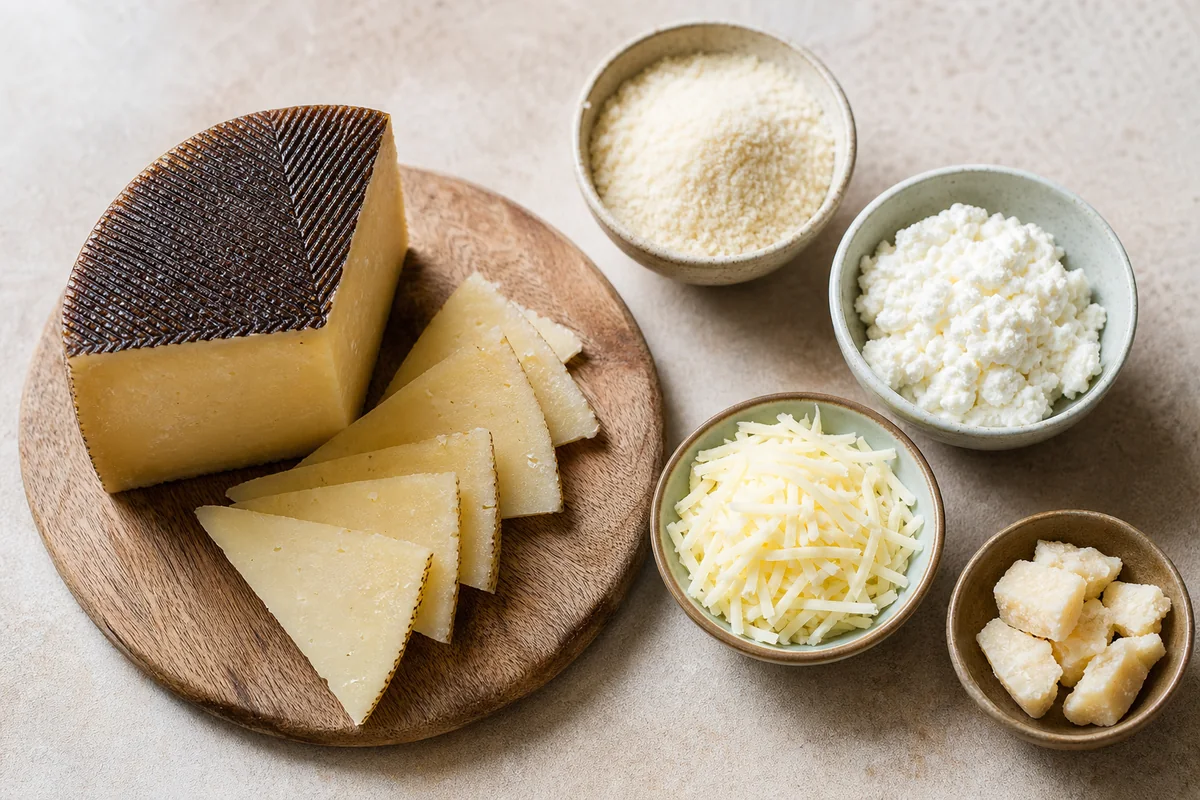
5 Best Manchego Cheese Substitutes (Closest Match)
Ingredients
Equipment
Method
- Choose substitute based on application: boards/sandwiches (Mahón), grating/finishing (Pecorino or Parmesan), melting (Aged Asiago), crumbling (Cotija).
- Adjust ratio: use 1:1 for Mahón/Aged Asiago/Cotija; use ¾ cup Pecorino or Parmesan per 1 cup Manchego for cooked dishes to offset salt.
- When using Pecorino or Cotija, reduce added salt in the recipe by about 25% and taste as you go.
- For melting applications, pick cheeses aged 3-6 months or labeled 'for melting'-avoid very hard, crystalline cheeses (12+ months) that will be grainy.
- If testing a new substitute, try a ¼ batch (test-batch) to check texture and salt, then scale up with adjustments.
Notes
- This WPRM block is a quick-swap cheat sheet - include ratios and salt notes for each substitute.
Tried this recipe?
Let us know how it was!
Carrie is a food writer and editor with more than 15 years of experience. She has worked for some of the biggest names in the food industry, including Bon Appétit, Food & Wine, and Martha Stewart Living.
As the Editor in Chief of EpicureDelight, Carrie oversees all of the content on the site. She also manages the team of contributing writers and editors, who help to create delicious recipes, helpful tips, and informative articles that you’ll find on the site.
A native of the Chicago area, Carrie is passionate about all things food. She loves trying new restaurants and experimenting with new recipes in her kitchen. She’s also a graduate of the Culinary Institute of America, so she knows a thing or two about food!



