
Sage has a very specific earthy, slightly sweet camphor edge. Get the swap wrong and your stuffing tastes flat or your roast chicken smells like a Mediterranean pizza.
The best sage substitute depends on how big a role sage plays. When it's the dominant herb in stuffing or a brown-butter pan sauce, you need something with real aromatic weight.
When it's just one note inside a seasoning blend, almost any savory herb will hold its place.
Fresh sage is more delicate than dried. A teaspoon of dried sage is closer in punch to a tablespoon of fresh, so factor that in before you measure anything.
Sage's earthy, piney-sweet character is hard to copy exactly, but dried thyme and marjoram come closest for stuffing and roasts. Rosemary works for piney punch if you use less. Italian seasoning and summer savory cover the savory base in blends and fillings. Tarragon is a last resort for light dishes only.
5 Best Sage Substitutes Ranked by Flavor Fit
Sage's earthy-pine character means the swap matters more than the ratio. The table below gives you a starting point for each substitute, whether you're working with a stuffing, a roast, or a sausage blend.
Most swaps land best at 1:1 for dried-to-dried, with one or two exceptions where you should pull back slightly.
| # | Substitute | Best For | Ratio | Key Note |
|---|---|---|---|---|
| 1 | Thyme (dried) | Both | 1:1 | Best all-purpose swap |
| 2 | Marjoram (dried) | Both | 1:1 | Softer, rounder warmth |
| 3 | Rosemary (dried) | Roasts | ¾:1 | Use less, add early |
| 4 | Italian Seasoning | Blends | 1:1 | Watch the salt level |
| 5 | Summer Savory (dried) | Fillings | 1:1 | Peppery savory punch |
Skip purely floral herbs like lavender here. They clash badly with the savory dishes sage typically anchors.
If your recipe is comparing Provençal herb blends rather than using a single herb, the blend approach below is your best path.
1. Thyme (Dried)
Dried thyme is the most reliable sage replacement in the pantry. It shares sage's savory-herbal depth and holds up well through long cooking in stuffing, roasted vegetables, and casseroles.
Use 1 teaspoon of dried thyme for every 1 teaspoon of dried sage. If your thyme is particularly pungent or recently opened, start with ¾ teaspoon and taste after simmering.
Thyme won't replicate sage's camphor-sweet top note, but the overall savory foundation stays intact.
- Best for: Stuffing, poultry, roasted root vegetables, casseroles
- Ratio: 1:1 dried-to-dried; for fresh sage, use 1 teaspoon dried thyme per 1 tablespoon fresh sage
- Tip: Add it at the same stage you'd add sage - early in cooking lets it bloom properly
- Flavor gap: Thyme is more lemony-herbal than piney-sweet, so it shifts the dish slightly
You can see how thyme performs in a live recipe by checking out roasting vegetables with thyme as the lead herb.
Skip if: you specifically need sage's minty-camphor aroma. Thyme won't replicate that top note no matter how much you add.
2. Marjoram (Dried)
Marjoram is sage's quieter cousin. It has the same warm, herbal character but without the sharp piney edge, which makes it ideal when you want the stuffing or poultry filling to taste rounded rather than pointed.
The flavor profile of marjoram sits closer to sage than thyme does in terms of sweetness, which is why it works so well in ground-meat and crumb-style fillings.
- Ratio: 1:1 dried marjoram to dried sage; reduce slightly if other delicate herbs are present
- Texture of flavor: Smoother and warmer than sage, less resinous
- Salt note: Marjoram can make a dish taste slightly less savory, so add a small pinch of extra salt after tasting
- Fresh-to-dried: Use 1 teaspoon dried marjoram per 1 tablespoon fresh sage called for
Skip if: your dish depends on sage's sharper piney-camphor edge. Marjoram is gentler and won't carry that aroma.
3. Rosemary (Dried)
Rosemary shares sage's evergreen, aromatic character more than any other common herb. That piney, woodsy note is the thing that makes both herbs work so well with roasted meats and root vegetables.
The problem is strength. Rosemary is more resinous than sage, and too much will overwhelm a dish fast.
Start at ¾ teaspoon of dried rosemary for every 1 teaspoon of dried sage, and add it early so heat softens the sharp edges. If you're ever unsure whether your rosemary is still at its best, understanding storing rosemary properly helps avoid the stale, dusty result that throws off any swap.
Rosemary works best in roasts, pan sauces, and root vegetable dishes. It's a poor fit for delicate crumb stuffing, where its resin note can turn aggressive.
Skip if: you're making a bread-based stuffing where sage was meant to be soft and subtle. Rosemary's resin will dominate.
4. Italian Seasoning
Italian seasoning is a practical fallback when sage is just one flavor note inside a larger blend. Most versions contain thyme, oregano, basil, and rosemary, so they cover the savory-herbal ground without any single herb screaming.
When Italian Seasoning Works
Works for: Recipes where sage blends with other herbs, sausage patties, tomato-based dishes, roasted potatoes, or any dish where a single herb flavor isn't the clear centerpiece
Skip if: Sage is the dominant solo herb (like in a brown-butter sage sauce) or your recipe is already heavily salted and the blend adds more sodium
- Ratio: Start at 1:1, but taste early since blend strength varies by brand
- Salt check: Many Italian seasoning blends contain salt - reduce added salt in the recipe by about ¼ teaspoon per teaspoon of blend used
- Best for: Sausage seasoning, pasta fillings, roasted vegetables, tomato sauces
- Blend gap: It won't deliver sage's distinct camphor note, but the savory backbone stays solid
For a deeper look at how herb blends compare, the Provençal versus Italian herb blend breakdown explains when one outperforms the other.
Skip if: your Italian seasoning has salt and the dish is already salt-heavy. You'll overcorrect and lose balance.
5. Summer Savory (Dried)
Summer savory doesn't get enough attention as a sage swap. It has a peppery, savory herbal punch that stands up in dense fillings and holds its character through long cooking, which is exactly what stuffing and sausage need.
If you want to explore other savory herb swaps beyond this list, there are several options worth knowing for bean dishes and grain-based fillings.
| Use | Ratio | Notes |
|---|---|---|
| Stuffing | 1:1 | Add early with the aromatics for best bloom |
| Sausage blend | 1:1 | Mix with fennel seed to round out the peppery edge |
| Bean dishes | 1:1 | Summer savory is traditional here; straightforward swap |
| Roast chicken | ¾:1 | Use slightly less; it's more assertive than sage at high heat |
- Flavor character: Peppery and herbal, slightly sharper than sage but in the same savory family
- Balancing tip: If the peppery note feels too forward, add a small pat of butter or a drizzle of olive oil to soften it
- Best for: Stuffing, sausage, bean dishes, pork roasts
Skip if: your recipe needs sage's softer sweetness. Summer savory's bite can feel harsher in delicate dishes.
Making Your Sage Substitute Taste Right
The swap is only half the job. How you handle the herb once it's in the pan is what separates a good result from a flat one. Bloom dried herbs in fat first - about 30 to 60 seconds in hot butter or oil before adding other ingredients pulls out more aroma and takes away that raw, dusty edge.
You can see this technique in action when roasting with thyme as the lead herb, where fat-blooming makes a real difference.
- Fresh vs dried intensity: If swapping dried herb for fresh sage, use about ⅓ the volume - 1 teaspoon dried equals roughly 1 tablespoon fresh, so adjust before you measure
- Bloom and salt together: Add a small pinch of salt when blooming the herb in fat. Salt helps the aromatic compounds open up faster and binds the herb note to the dish
- Stronger substitutes (rosemary, Italian seasoning): Start below the target amount, simmer, then taste. It's easier to add ¼ teaspoon more than to pull back once the resin note has taken over
Skip if: you can't taste the dish before serving. Without a final taste-check, you lose the chance to correct any mismatch in herb brightness.
Frequently Asked Questions
Dried marjoram is the closest match for stuffing. It has sage's warm herbal character without the sharp piney edge, so bread-based fillings stay rounded and savory. Use it at a 1:1 ratio.
No. Dried sage is more concentrated. Use about ⅓ the volume: 1 teaspoon dried sage replaces 1 tablespoon of fresh sage.
Dried thyme is the most reliable swap for poultry. It matches sage's savory depth and holds up through roasting without shifting the flavor profile significantly.
You likely used too much or skipped the fat-blooming step. Bloom dried herbs in hot butter or oil for 30 seconds before adding other ingredients to reduce harshness.
Many Italian seasoning blends contain added salt. Reduce the recipe's added salt by about ¼ teaspoon per teaspoon of blend, then taste before adding more.
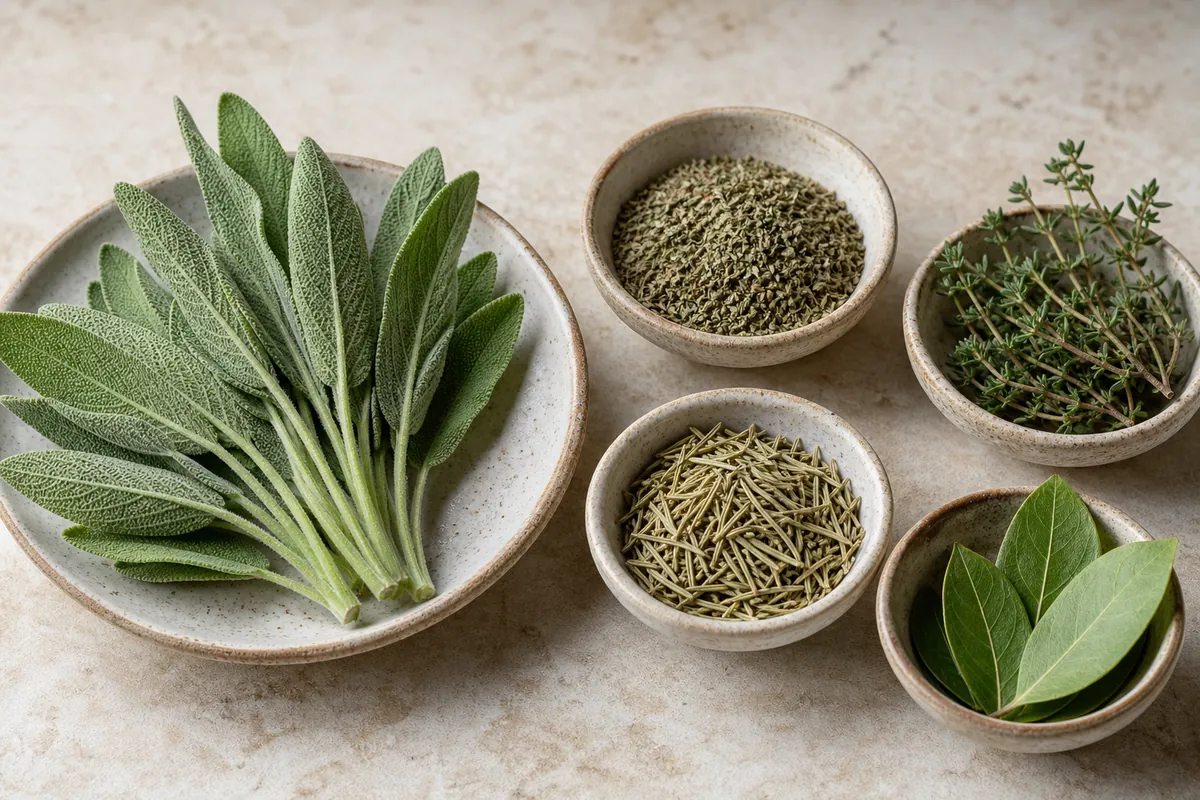
5 Best Sage Substitutes (Quick Swaps)
Ingredients
Equipment
Method
- Check whether your recipe calls for fresh or dried sage, then decide whether you’re keeping the swap as a dried herb or switching fresh-to-dried intensity.
- Start with the ratio from the WPRM ingredient list, then add a small pinch more only if the dish tastes bland after simmering.
- For roasted meats or pan sauces, bloom the dried herb in a tablespoon of hot fat (butter or oil) for 30–60 seconds before mixing into the dish.
- For stuffing and casseroles, stir the swap in with the other seasonings early so it hydrates and rounds out.
- Taste at the end and fine-tune: add salt to sharpen savory notes or a tiny pinch of sweetness (e.g., a few grains of sugar or a drop of honey) to soften sharpness.
Notes
- If your sage is fresh and you only have dried, reduce the dried herb slightly and rely on cooking time to distribute flavor.
- Herb blends vary by brand—use the ratio as a starting point and adjust after simmering.
Tried this recipe?
Let us know how it was!
Carrie is a food writer and editor with more than 15 years of experience. She has worked for some of the biggest names in the food industry, including Bon Appétit, Food & Wine, and Martha Stewart Living.
As the Editor in Chief of EpicureDelight, Carrie oversees all of the content on the site. She also manages the team of contributing writers and editors, who help to create delicious recipes, helpful tips, and informative articles that you’ll find on the site.
A native of the Chicago area, Carrie is passionate about all things food. She loves trying new restaurants and experimenting with new recipes in her kitchen. She’s also a graduate of the Culinary Institute of America, so she knows a thing or two about food!



