Air Fryer Lemon Pepper Chicken Breasts deliver a golden, zesty crust and a juicy interior in exactly 18 minutes at 400°F. The circulating heat seals the seasoning into the surface while keeping moisture locked inside the meat.
The defining technique here is pounding. Bringing each breast to a uniform ¾-inch thickness before seasoning eliminates the thick-end/thin-end problem that causes dry chicken - even heat reaches every part at the same rate.
This recipe is part of our complete air fryer chicken collection, which covers everything from wings to thighs using the same high-heat circulating method. Each recipe in that hub uses a variation of the same pounding and high-heat principle.
Air Fryer Lemon Pepper Chicken Breasts are cooked at 400°F for 18 minutes after pounding to even thickness, producing a caramelized lemon pepper crust and juicy interior every time. The whole process takes 28 minutes from prep to table.
Why This Recipe Works
Pounding each breast to a consistent ¾-inch thickness means the air fryer's circulating heat reaches the thickest point and thinnest point simultaneously - the breast hits 165°F at the center before the edges overcook to 185°F.
Lemon pepper seasoning caramelizes against the olive oil coating at 400°F, forming a lightly crisped crust in the first 9 minutes before you flip; that crust locks moisture in for the second half of the cook.
- Even thickness eliminates hot spots: A pounded breast cooks from edge to center at the same rate, removing the main reason air-fried chicken breast goes dry.
- 400°F circulating air creates crust without drying: High heat sets the exterior in the first few minutes while the interior finishes at a lower effective temperature.
- Lemon zest brightens the crust and adds aromatic oils: Fresh zest releases citrus oils that bloom under heat, adding depth beyond what dried lemon pepper alone delivers.
- Resting 5 minutes redistributes juices before cutting: Cutting immediately after the fryer causes juice to run out on the cutting board; resting keeps it in the meat.
What You Need
This recipe uses the same lean, high-heat rub approach as our crispy air fryer chicken wings - oil to carry the seasoning, a dry spice blend for the crust, and nothing else between you and properly cooked chicken. If you prefer dark meat, the same rub works on crispy air fryer chicken thighs with a slightly longer cook time.
- 4 boneless skinless chicken breasts (pounded to ¾-inch)
- 2 tablespoons lemon pepper seasoning
- 1 teaspoon garlic powder
- ½ teaspoon kosher salt
- 1 teaspoon fresh lemon zest
- 2 tablespoons olive oil
- Fresh parsley (optional garnish)
Ingredient Details
- Lemon Pepper SeasoningCheck the label - many brands already include salt. If yours does, reduce or skip the additional ½ teaspoon kosher salt to avoid over-salting.
- Fresh Lemon ZestZest one medium lemon directly into the spice mix. Dried lemon zest can substitute but delivers about 60% of the aromatic intensity.
- Olive OilActs as both the binder for the spice crust and a conductor for heat transfer on the surface. Avocado oil is a suitable swap at the same quantity.
- Garlic PowderUse powder, not garlic salt - you want the flavor without adding more sodium to an already-seasoned rub.
- Chicken BreastsAim for breasts in the 6-8 oz range. Larger breasts (10+ oz) should be butterflied and then pounded rather than pounded flat from full thickness.
Ingredient Swaps
The base formula is flexible - the core requirement is even thickness and a dry rub that adheres through the oil. For a bolder profile, the spicy chicken sandwich uses cayenne and smoked paprika instead of lemon pepper; for a cheese-forward crust at the same temperature, air fryer parmesan crusted chicken applies dijon mustard and a parmesan-panko mix to the same pounded breast.
- Greek seasoning for lemon pepper: Use 2 tablespoons of Greek seasoning (oregano, thyme, garlic) when you want a Mediterranean profile instead of citrus-forward.
- Avocado oil for olive oil: Higher smoke point makes it marginally better at 400°F for crust formation, though the taste difference is minimal.
- Chicken tenders for breasts: Reduce cook time to 10-12 minutes total; tenders are already thin enough that pounding is unnecessary.
- Lime zest for lemon zest: Delivers a slightly sharper citrus note - works well if you're serving the chicken over rice with a Latin-inspired side.
Lemon Pepper Seasoning vs. Greek Seasoning
Works for: Lemon pepper when you want a bright, citrus-forward crust that pairs with salads and light sides
Skip if: You're serving with roasted vegetables or a heartier side - Greek seasoning integrates better with those flavors
Pounded Breast vs. Bone-In Breast
Works for: Pounded boneless breast when you need a 28-minute cook with consistent results across all 4 pieces
Skip if: You want richer flavor and don't mind a 35-40 minute cook time - bone-in breasts deliver more depth but require temperature monitoring at the bone
Instructions
The total cook is 18 minutes at 400°F, but the first step - pounding - determines everything that follows. Even thickness is not optional for reliable results.
- Pound to ¾-inch thickness: Place each breast between two sheets of plastic wrap and pound to a uniform ¾-inch thickness with a meat mallet or the flat side of a rolling pin. Work from the center outward.
- Preheat the air fryer: Run the air fryer at 400°F for 3 minutes before adding any food - a preheated basket starts the crust immediately on contact.
- Build the seasoning mix: Combine 2 tablespoons lemon pepper seasoning, 1 teaspoon garlic powder, ½ teaspoon kosher salt, and 1 teaspoon fresh lemon zest in a small bowl. Coat each breast with olive oil on all sides, then press the spice mix firmly onto both surfaces.
- First cook - 9 minutes: Arrange breasts in a single layer in the basket with no overlap. Cook at 400°F for 9 minutes without opening the basket.
- Flip and finish: Flip each breast with tongs and cook 8-9 more minutes. Pull when an instant-read thermometer reads 165°F at the thickest point.
- Rest before slicing: Transfer to a cutting board and rest for 5 minutes. The internal temperature will climb to 168-170°F during resting, and the juices will redistribute through the meat.
What to Serve With It
Bright lemon pepper chicken pairs best with sides that either complement the citrus or provide a neutral contrast. Our refreshing cabbage salads are a natural match - the crisp acidity mirrors the lemon in the crust. If you want something more filling, the recipes in our low-carb side dishes collection pair well without competing with the lemon flavor.
| Side Dish | Prep | Why It Works | How to Serve |
|---|---|---|---|
| Lemon herb rice | Easy | Echoes the citrus notes without competing with the crust | Spoon alongside sliced chicken; add extra zest on top |
| Roasted asparagus | Easy | High-heat roasting at 400°F matches the cook method and time | Cook in the same air fryer batch if basket space allows |
| Shaved cabbage slaw | Easy | Raw crunch and mild acidity balance the warm, zesty chicken | Pile slaw next to sliced chicken; no dressing needed beyond lemon juice |
| Garlic mashed cauliflower | Medium | Low-carb neutral base absorbs the lemon pepper pan juices | Serve under the sliced breast as a base instead of a side |
| Cucumber tomato salad | Easy | Fresh and cooling contrast to the hot, crusted chicken | Dress with olive oil and red wine vinegar; serve chilled alongside |
For a meal-prep format, slice the cooked chicken and layer it over greens with a lemon vinaigrette - it holds well for 3 days refrigerated. The same sliced chicken works alongside air fryer coconut chicken or honey garlic drumsticks if you're building a mixed protein prep week.
Store and Reheat
Cooked chicken breasts keep in an airtight container in the refrigerator for up to 4 days. Slice before storing - thinner pieces reheat more evenly and faster than a whole breast. For longer storage, wrap individual slices in plastic and freeze for up to 3 months. If you're batch-cooking alongside other proteins, air fryer barbecue chicken and similar air fryer proteins follow the same 4-day refrigerator window.
| Method | Time | Best For |
|---|---|---|
| Air fryer at 375°F | 4 min | Restoring the crust; best texture result |
| Oven at 350°F | 10 min | Reheating multiple servings at once without drying |
| Microwave covered | 90 sec | Speed when crust texture is not a priority |
- Always add 1 teaspoon of water to the container before microwaving to create steam and prevent the surface from drying out.
- In the air fryer, place slices in a single layer - stacked slices reheat unevenly and the crust on the bottom piece stays soft.
- Pull from the freezer to the refrigerator the night before - thawing overnight produces a better reheat texture than thawing from frozen.
- Reheat to 165°F internal if using a thermometer - the slices are thin enough that 4 minutes in the air fryer reliably clears that threshold.
Leftover slices fold into next-day meals without reheating - use them cold over a salad, tucked into a wrap, or alongside crispy air fryer buffalo chicken bites when you want bold contrast in a mixed protein lineup.
Frequently Asked Questions
Won't chicken breast dry out in the air fryer?
Not when pounded to even thickness and pulled at exactly 165°F. Dry chicken breast is caused by uneven thickness (thin ends overcook to 185°F before the thick center is done) or overcooking past 170°F - both problems this recipe directly addresses.
Do I have to pound the chicken?
Yes - it's the single non-optional step. An unpounded breast has a 1¼-inch thick end and a ½-inch thin end, which means the thin end hits 190°F while the thick end is still at 155°F. Pounding takes 2 minutes and eliminates that problem entirely.
Can I use bone-in chicken breasts?
You can, but the cook time increases to 35-40 minutes and you cannot pound them to even thickness. Bone-in breasts work best at 380°F rather than 400°F to allow the heat to reach the bone without burning the surface.
What's the right internal temperature?
Pull at 165°F measured at the thickest point with an instant-read thermometer. The temperature will rise to 168-170°F during the 5-minute rest - that carryover is factored into the cook time in this recipe.
Can I marinate the chicken first?
A dry brine works better than a wet marinade for air frying. If you want to prep ahead, coat the pounded breasts in the dry spice mix (without the oil) and refrigerate uncovered for up to 8 hours - the salt draws moisture out and then back in, seasoning the interior while keeping the surface dry for better crust formation.
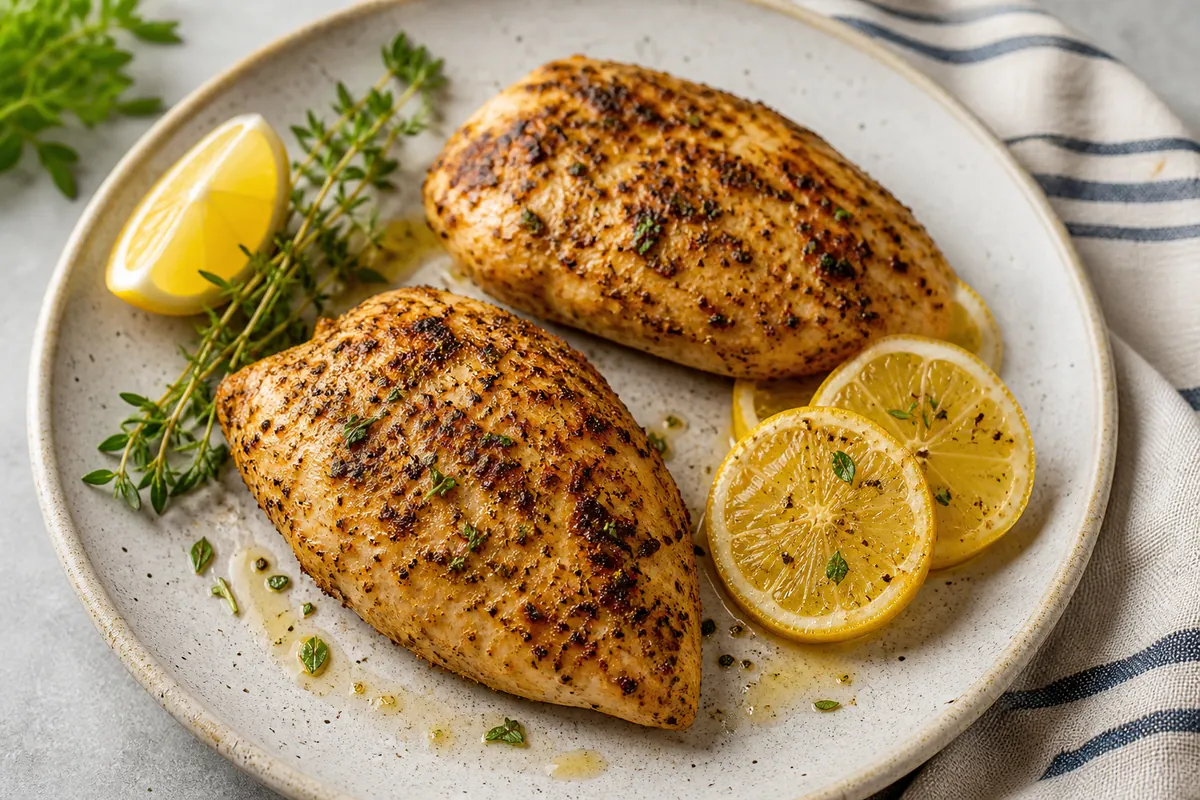
Air Fryer Lemon Pepper Chicken Breasts
Ingredients
Method
- Pound each chicken breast between two sheets of plastic wrap to a uniform ¾-inch thickness using a meat mallet or rolling pin.
- Preheat air fryer to 400°F (200°C) for 3 minutes.
- Mix lemon pepper seasoning, garlic powder, salt, and lemon zest in a small bowl. Coat breasts on all sides with olive oil, then press the seasoning mixture firmly onto both sides.
- Place breasts in a single layer in the air fryer basket. Cook at 400°F for 9 minutes.
- Flip each breast and cook 8–9 more minutes until an instant-read thermometer reads 165°F at the thickest point.
- Rest on a cutting board for 5 minutes before slicing. Internal temperature will rise 3–5°F during resting.
Notes
- Pound to ¾-inch uniform thickness — prevents dry edges and raw centers
- Pat dry before coating — wet surface steams instead of sears
- Zest goes in the rub; squeeze juice over after cooking only
- Pull at 165°F internal temp — carryover adds 2–3°F
- Rest 5 minutes before slicing to retain juices
Tried this recipe?
Let us know how it was!
Carrie is a food writer and editor with more than 15 years of experience. She has worked for some of the biggest names in the food industry, including Bon Appétit, Food & Wine, and Martha Stewart Living.
As the Editor in Chief of EpicureDelight, Carrie oversees all of the content on the site. She also manages the team of contributing writers and editors, who help to create delicious recipes, helpful tips, and informative articles that you’ll find on the site.
A native of the Chicago area, Carrie is passionate about all things food. She loves trying new restaurants and experimenting with new recipes in her kitchen. She’s also a graduate of the Culinary Institute of America, so she knows a thing or two about food!