
Basmati rice has a specific personality in the pot - long, separate grains with a faint floral scent that lifts the whole dish. When you're missing it, the swap you pick depends on which of those qualities matters more to your recipe.
Basmati rice substitute choices split roughly into two camps: aromatic long-grain types that get close to the floral note, and neutral long-grain types that give you grain separation without any real fragrance.
Neither camp will perfectly copy basmati, but each solves a different problem. Understanding cooking basmati rice well helps you figure out exactly what you're trying to replace.
One thing worth knowing before you start: check your pantry honestly. If basmati is stored well, how long basmati rice lasts can surprise you - older stock may still be fine.
The closest basmati rice substitutes are jasmine and Texmati rice, both long-grain varieties that cook up with separate, fluffy grains. Long-grain white, converted, and brown rice all work at a 1:1 dry-weight ratio - with tradeoffs in aroma, texture, and cook time.
5 Best Basmati Rice Substitutes (with Ratios)
Every option below swaps at the same dry-weight ratio, so measuring is straightforward. The differences show up in aroma, firmness, and how forgiving each variety is if your timing slips.
| # | Substitute | Best For | Ratio | Key Note |
|---|---|---|---|---|
| 1 | Jasmine Rice | Both | 1:1 | Slightly sweeter aroma |
| 2 | Texmati Rice | Both | 1:1 | Closest cook behavior |
| 3 | Long-Grain White | Both | 1:1 | Neutral, rinse well |
| 4 | Converted (Parboiled) | Both | 1:1 | Firmer, stays separate |
| 5 | Brown Long-Grain | Both | 1:1 | Longer cook, chewier bite |
1. Jasmine Rice
Jasmine is the first place most cooks turn, and for good reason. It cooks up with long, mostly separate grains and a light aromatic note - not basmati's exact floral signature, but close enough for pilafs, stir-fries, and everyday rice bowls.
The aroma difference is real, though. Jasmine leans sweet and perfumed where basmati is drier and more subtle.
If you want to read up on how that aroma actually plays in a dish, the breakdown of jasmine rice flavor is worth a quick look before committing.
- Ratio: 1:1 dry weight, no adjustment needed
- Aroma change: Sweeter, more perfumed than basmati's dry floral note
- Texture tweak: Reduce water by 2 tablespoon per cup to keep grains drier and more separate
- Skip if: The exact basmati fragrance is central to the dish (e.g., traditional biryani)
2. Texmati Rice
Texmati is an American-grown hybrid of long-grain and basmati rice, and it behaves more like basmati in the pot than almost anything else you'll find at a standard grocery store. Grain length, separation, and cook time are all comparable.
You may notice the aroma is a bit quieter than imported basmati, but the texture match is hard to beat. For anyone who needs alternatives to jasmine rice and basmati at the same time, Texmati covers both gaps reasonably well.
Texmati vs. True Basmati
Works for: pilaf, rice dishes where grain separation matters, any recipe that doesn't depend on imported basmati's exact fragrance
Skip if: the recipe is aroma-forward (like a traditional biryani where the floral note is the point)
- Ratio: 1:1 dry weight, same simmering time as basmati
- Cooking tweak: Rinse once, then cook as you would basmati - the timing tracks closely
- Watch: Don't mistake "popcorn" aroma (which appears briefly when cooking) for basmati's floral note - it fades
3. Long-Grain White Rice
Plain long-grain white rice is the most neutral swap on this list. It has no real fragrance and a slightly starchier surface than basmati, but with proper rinsing it cooks up fluffy and separate.
Think of it as the blank-canvas option - it carries sauce and seasoning well, and it's almost always in stock. If you want guidance on cooking white rice to keep grains from clumping, that covers the pantry-storage side too.
| Use | Ratio | Notes |
|---|---|---|
| Pilaf or side dish | 1:1 | Rinse until water runs clear; rest 8 min after cooking |
| Stir-fry base | 1:1 | Cook slightly drier; day-old rice works best |
| Stuffed vegetables | 1:1 | Slightly undercook so grains firm up during baking |
- Ratio: 1:1 dry weight
- Rinse tip: Rinse 2-3 times until the water is mostly clear - this reduces surface starch significantly
- Fluff tip: Rest covered for 8-10 minutes off heat, then fluff with a fork (don't stir mid-cook)
- Skip if: You need any aromatic quality - this rice won't bring fragrance to the dish
4. Converted (Parboiled) Long-Grain Rice
Converted rice has been partially cooked under pressure before milling, which gelatinizes the starch inside each grain. That process makes it more resistant to mushiness - great news if you're prone to overcooked rice or if the pot will sit on low heat for a while.
The grains are firmer and slightly drier than basmati after cooking, but they stay impressively separate. If you want to know more about cooking brown rice versus converted rice textures, the comparison is useful context.
Converted Rice in Practice
Works for: buffet dishes, make-ahead rice, any recipe where you need grains that stay separate even after reheating
Skip if: you want the soft, tender, almost delicate chew that good basmati delivers fresh off the stove
- Ratio: 1:1 dry weight; follow package timing (it may need 1-2 extra minutes vs. basmati)
- Rinse: Optional - surface starch is already lower due to parboiling, so a single rinse is enough
- Rest tip: Rest 5 minutes covered before serving; the grains firm up nicely as they steam through
- Skip if: The recipe needs ultra-tender basmati-style mouthfeel
5. Brown Long-Grain Rice
Brown long-grain rice keeps the bran layer intact, which means more chew, a nuttier flavor, and a cook time that's roughly 35-45 minutes instead of basmati's 15-18. It works as a basmati swap when you have time and want a more filling, whole-grain result - but it's a different eating experience.
If the dish relies on delicate, airy grains, this one will feel noticeably heavier.
- Ratio: 1:1 dry weight, but increase water by about ¼ cup per cup of rice
- Rinse/soak: Rinse thoroughly to remove husk dust; soak for 30 minutes if you want to shorten cook time by about 10 minutes
- Rest/steam: Rest covered for 10 minutes off heat - brown rice benefits more from this step than white rice does
- Skip if: Your recipe needs basmati-speed cooking; brown rice takes significantly longer and won't rush
Making Basmati Rice Substitutes Work
Getting the substitute right is half technique. The most common mistake is lifting the lid too early or stirring the rice while it simmers - both release steam and disrupt grain separation.
Resting is where most of the separation actually happens, so treat it as part of the cook, not an afterthought.
- Rest every time: Pull the pot off heat and leave it covered for at least 5 minutes - 8 to 10 is better for long-grain white and converted varieties
- Water control: If the result is sticky, reduce water by 2 tablespoon the next batch rather than stirring more; stirring breaks grains and releases starch
- Fluff with a fork: Use a fork, not a spoon, to separate grains after resting - a spoon compresses and clumps what you've worked to separate
Frequently Asked Questions
Texmati or jasmine rice are the closest matches for grain separation. Both cook up long and fluffy at a 1:1 dry-weight swap with minimal technique adjustment.
Yes, jasmine rice swaps 1:1 by dry weight. The aroma is sweeter and less dry than basmati's, but texture and grain separation are close enough for most dishes.
Not exactly - converted rice is firmer and has no floral aroma. It does stay separate reliably, which makes it useful when texture matters more than fragrance.
Rinse until the water runs mostly clear before cooking, and never stir mid-cook. Reduce water by 2 tablespoon per cup if stickiness persists on the next batch.
Both. Add about ¼ cup extra water per cup of brown rice and expect 35-45 minutes of cook time instead of basmati's 15-18 minutes.
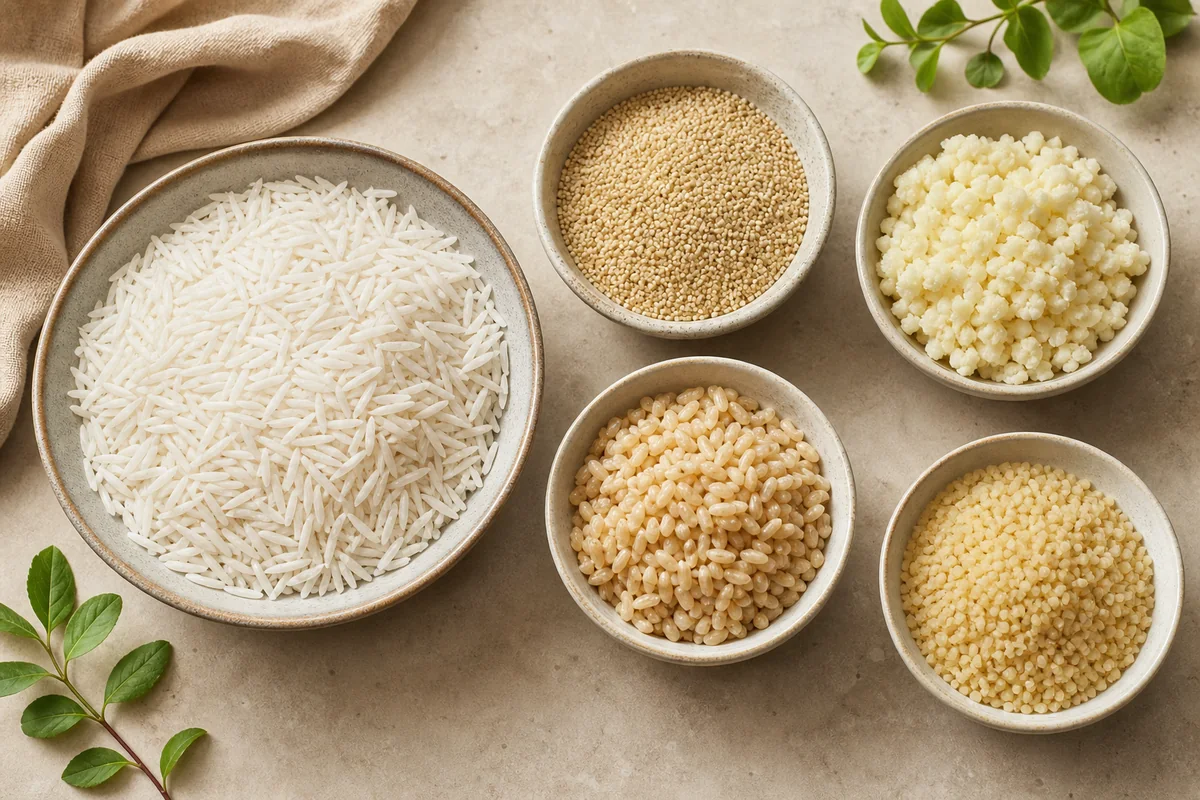
5 Best Basmati Rice Substitutes (with Ratios)
Ingredients
Equipment
Method
- Identify the goal of your dish (separate fluffy grains vs. neutral grains vs. firmer texture).
- Weigh your basmati rice and substitute using the 1:1 ratio listed for the rice you chose.
- Rinse the substitute rice until the water runs mostly clear for better grain separation (especially for long-grain swaps).
- Cook according to the substitute's packaging timing cues, then rest 5-10 minutes before fluffing.
- If your result is too sticky, reduce water slightly next time; if too firm, add a small splash of hot water and steam briefly.
Notes
- Ratios are by dry weight (use a kitchen scale if possible).
- Resting time affects separation-fluff after resting, not immediately.
Tried this recipe?
Let us know how it was!
Carrie is a food writer and editor with more than 15 years of experience. She has worked for some of the biggest names in the food industry, including Bon Appétit, Food & Wine, and Martha Stewart Living.
As the Editor in Chief of EpicureDelight, Carrie oversees all of the content on the site. She also manages the team of contributing writers and editors, who help to create delicious recipes, helpful tips, and informative articles that you’ll find on the site.
A native of the Chicago area, Carrie is passionate about all things food. She loves trying new restaurants and experimenting with new recipes in her kitchen. She’s also a graduate of the Culinary Institute of America, so she knows a thing or two about food!



