
Beaufort has a personality. That nutty, almost sweet alpine finish is hard to fake, but a handful of cheeses come close enough that your gratin or fondue pot won't miss a beat.
This guide covers the best beaufort cheese substitutes, ranked by flavor closeness and how each one behaves under heat.
The key split is melt versus grate. Beaufort is famously smooth when melted, so if you're making a hot dish, you want a cheese that flows rather than seizes.
For grating over pasta or salads, a harder, sharper option can work just fine with a small ratio tweak.
The closest Beaufort cheese substitute is Comté, used at a 1:1 ratio. It shares Beaufort's nutty alpine profile and melts with similar smoothness. Gruyère is the best all-purpose backup for melting and baking. For grating only, Parmesan works at ¾:1 to account for its sharper salt.
5 Beaufort Cheese Substitutes Ranked by Flavor and Meltability
Getting the right swap means knowing whether your recipe leans on Beaufort for taste, texture, or both. The table below covers all five options at a glance.
| # | Substitute | Best For | Ratio | Key Note |
|---|---|---|---|---|
| 1 | Comté | Both | 1:1 | Closest alpine flavor match |
| 2 | Gruyère | Melt | 1:1 | Smooth melt, earthy finish |
| 3 | Emmental | Melt | 1:1 | Milder; boost with pepper |
| 4 | Aged Gouda | Both | 1:1 | Sweeter, caramel-nut depth |
| 5 | Parmesan | Grate | ¾:1 | Saltier; reduce added salt |
1. Comté
Comté sits in the same alpine hard-cheese family as Beaufort, which makes it the most intuitive swap.
If you want to understand exactly why it works so well, it helps to have read up on tasting beaufort cheese - both share that same slow-building nuttiness that deepens when heated.
It melts cleanly and develops a similar golden crust in a gratin. We prefer it sliced thin for stovetop sandwiches or grated coarsely for baked dishes.
- Ratio: 1:1 - no adjustment needed
- Best dishes: gratins, croque-monsieur-style melts, cheese boards
- Taste note: Slightly more assertive nuttiness than Beaufort, but in the same flavor direction
- Tip: Use younger Comté (under 12 months) if you want a milder, milkier result closer to Beaufort
Skip if: your dish needs a very delicate cheese - Comté aged over 18 months can taste more pronounced than Beaufort's softer finish.
2. Gruyère
Gruyère is the workhorse here. It melts evenly, browns without burning, and holds up beautifully in baked dishes - everything you'd want from a Beaufort stand-in.
If you're exploring the best gruyere cheese alternatives, you'll notice it often appears on substitute lists precisely because it performs so reliably under heat.
- Ratio: 1:1 - matches Beaufort's volume and fat content closely
- Texture: Grated Gruyère melts more evenly than sliced in baked dishes
- Flavor vs. Beaufort: Slightly earthier and more savory; less of Beaufort's delicate sweet finish
- Tip: For fondue-style dishes, add a small squeeze of lemon to balance Gruyère's stronger tang
Skip if: you need Beaufort's subtle, sweet nut finish - Gruyère pushes a bit more savory and can taste more distinct in simple dishes.
3. Emmental/Emmentaler
Emmental is the mild-mannered Swiss option. It melts well and has a gentle nuttiness, but it lacks Beaufort's depth on its own.
Think of it as a reliable base that needs a small flavor push - a pinch of white pepper or a tiny extra pinch of salt can close that gap considerably.
If you're already working with a recipe that calls for Swiss-style cheeses, you may find the broader guide on alternatives to swiss cheese useful for mixing options.
Emmental
Works for: cheese blends, fondues, gratins where other ingredients carry flavor
Skip if: the cheese is the main flavor driver and you need Beaufort's distinct nuttiness
- Ratio: 1:1 - straightforward swap by weight or volume
- When it works best: Mixed with a stronger cheese (like a small amount of aged Gouda) to add body
- Flavor boost: Add freshly cracked black pepper and a scrape of nutmeg to bring it closer to Beaufort's alpine warmth
Skip if: your recipe is simple - melted Emmental on bread alone will taste noticeably milder than Beaufort.
4. Aged Gouda
Aged Gouda doesn't taste like Beaufort, but it fills a similar role. It brings caramel-nut depth, melts beautifully, and gets a gorgeous golden crust in the oven.
The difference is sweetness - Gouda tilts toward butterscotch where Beaufort stays savory.
A crack of black pepper or a splash of vinegar in the surrounding dish keeps that sweetness in check. For more ideas on how aged Gouda fits into cheese swaps, the roundup of alternatives to comte cheese overlaps in several places.
- Ratio: 1:1 - no volume adjustment needed
- Flavor direction: Sweeter and richer than Beaufort; caramel-nut rather than savory-nut
- Best uses: Baked pasta, roasted vegetable melts, toasted open-face sandwiches
- Balance tip: Add a small acid element (white wine, lemon, Dijon) to counteract Gouda's sweetness in savory dishes
Skip if: you need the most "alpine" result - Gouda's sweetness can redirect the flavor of the whole dish.
5. Parmesan
Parmesan is an emergency swap, not a like-for-like replacement. It's sharper, saltier, and doesn't melt into a smooth pool - it gets dry and granular when overheated.
But for grating over pasta, risotto, or a finished dish, it delivers real savory punch in a smaller amount. If you need a deeper look at when parmesan substitutes make sense, there's a full breakdown worth checking.
| Use | Ratio | Notes |
|---|---|---|
| Grated over pasta | ¾:1 | Parmesan - reduce added salt by about ¼ tsp |
| Blended into a sauce | ½:1 + mild cheese | Mix with Emmental or Gruyère to restore body |
| Baked topping (gratin) | ½:1 | Layer under a melt-friendly cheese; don't use alone |
- Best use: Grated finish on hot dishes, soups, or baked pasta
- Salt adjustment: Cut added salt in the dish by at least ¼ teaspoon before tasting
- Combination tip: Mix ½ Parmesan + ½ Emmental or Gruyère to get sharpness with a smoother melt
Skip if: you need a smooth, stretchy melt - Parmesan alone will turn grainy and dry rather than flowing.
Making Beaufort Cheese Substitutes Work (Ratios, Cut, and Taste Checks)
The fastest decision rule is this: if heat is involved, pick a Swiss-style alpine cheese (Comté, Gruyère, or Emmental) and grate it rather than slice it for the most even melt.
For a dish like creamy potato gratin where the cheese needs to bubble into the layers, that grating step genuinely matters.
If you're finishing a cold dish or sprinkling over something already cooked, aged Gouda or Parmesan at a reduced ratio both work cleanly.
- Cut and texture: Grate hard cheeses on a coarse box grater for baked dishes; they melt faster and more evenly than hand-torn chunks or slices
- Salt check: Always taste after the cheese melts - saltier substitutes (Parmesan, aged Gouda) can push a dish over without warning, so hold back on any added salt until after heating
- Blending trick: For the closest Beaufort profile, mix two-thirds Emmental with one-third Comté - you get the smooth melt from Emmental and the nutty depth from Comté without either dominating
Frequently Asked Questions
Comté is the closest match for melting - same alpine family, same nutty profile, and it flows smoothly under heat. Use it at a 1:1 ratio with no other adjustments.
Yes, 1:1 works perfectly. Grate it rather than slice it for the most even melt, and expect a slightly more savory result than Beaufort delivers.
It works only for grating - use ¾ of the amount Beaufort calls for and cut added salt in the dish. It won't melt smoothly, so skip it for gratins or fondues.
Comté grated finely is the closest for sprinkling - it keeps Beaufort's nutty finish without going sharp. Aged Gouda also works but adds a sweeter note.
Hold all added salt until after the cheese melts, then taste and adjust. Stronger cheeses like Parmesan or aged Gouda release more salt under heat than they seem to raw.
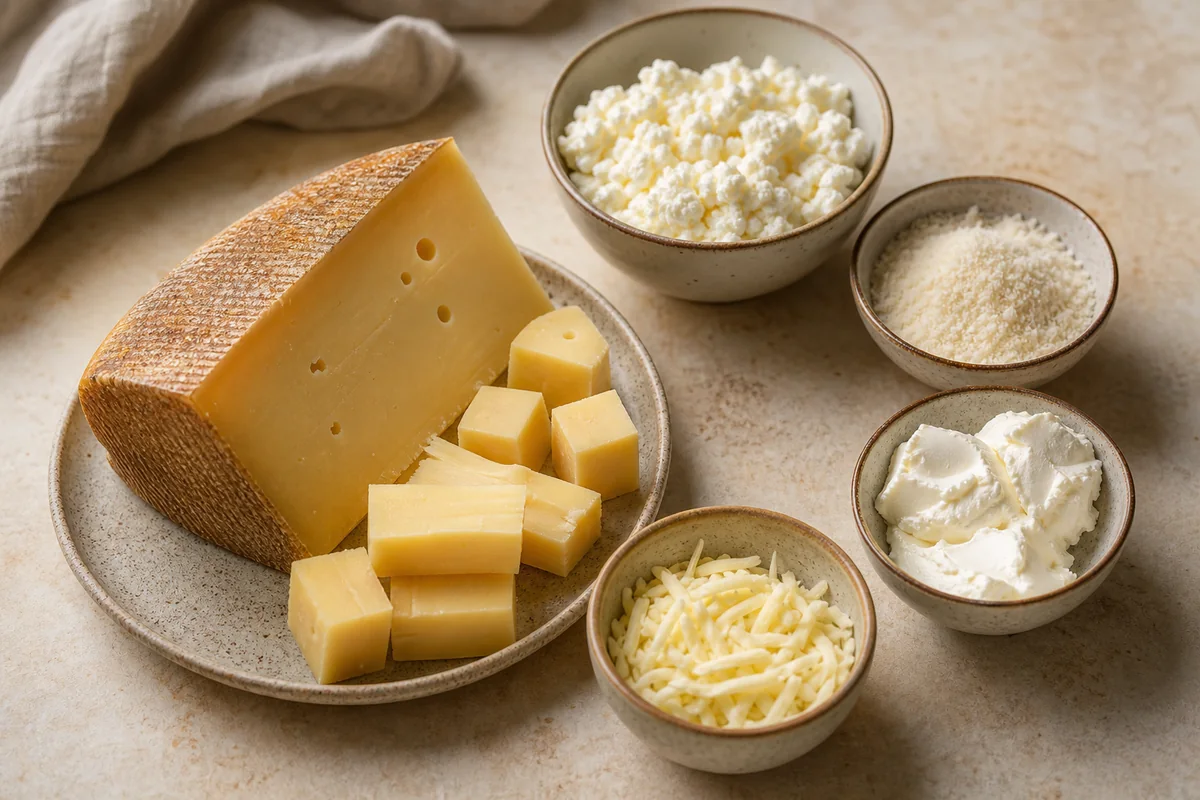
5 Best Beaufort Cheese Substitutes (Closest Match)
Ingredients
Equipment
Method
- Identify your use: melting/gratin (choose a Swiss-style hard cheese) vs. sprinkling/grating (choose an aged hard cheese like Comté or Parmesan).
- Start with the listed ratio (use 1:1 for most swaps; use ¾:1 for Parmesan).
- If the substitute is milder (like Emmental), increase perceived flavor with black pepper, a tiny pinch of salt, or a splash of lemon at the end.
- If the substitute is sharper/saltier (like Parmesan), reduce any added salt in the dish and taste after heating.
- For best texture, match the cut: slice for stovetop melts, grate for even melt in baked dishes, and keep rind/fine bits only if your dish tolerates stronger flavor.
Notes
- All substitutions assume a similar hard-cheese texture; adjust salt and intensity by taste after the dish heats.
Tried this recipe?
Let us know how it was!
Carrie is a food writer and editor with more than 15 years of experience. She has worked for some of the biggest names in the food industry, including Bon Appétit, Food & Wine, and Martha Stewart Living.
As the Editor in Chief of EpicureDelight, Carrie oversees all of the content on the site. She also manages the team of contributing writers and editors, who help to create delicious recipes, helpful tips, and informative articles that you’ll find on the site.
A native of the Chicago area, Carrie is passionate about all things food. She loves trying new restaurants and experimenting with new recipes in her kitchen. She’s also a graduate of the Culinary Institute of America, so she knows a thing or two about food!



