
That savory, briny depth in a good bouillabaisse or seafood risotto? It almost always comes from fish stock.
Without it, the dish can taste flat and one-dimensional. The good news: the right fish stock substitute can cover you completely, as long as you match the replacement to what your recipe actually needs.
Not every substitute works the same way. Some bring brine and shellfish aroma (great for soups and pasta sauces), while others add sea-forward umami without any strong seafood smell (better for delicate braises).
Understanding that gap between salinity and umami is how you pick the right one.
The best fish stock substitutes are clam juice (briny, 1:1), shrimp stock (deep seafood flavor, 1:1), vegetable stock with kombu (umami, 1:1), white miso diluted in water (¾:1), and chicken stock with lemon (mild, 1:1). Match your pick to the dish's required flavor intensity.
5 Best Fish Stock Substitutes (Start Here)
Most of these swaps use a 1:1 ratio. The table below shows where each one shines and what it costs you in flavor.
| # | Substitute | Best For | Ratio | Key Note |
|---|---|---|---|---|
| 1 | Clam Juice | Both | 1:1 | Briny, dilute if salty |
| 2 | Shrimp Stock | Both | 1:1 | Strain well before using |
| 3 | Veg Stock + Kombu | Both | 1:1 | Steep 10 min, then remove |
| 4 | Mushroom Broth + Seaweed | Both | 1:1 | Add lemon at the end |
| 5 | White Miso + Water | Sauces | ¾:1 | Dissolve warm, cut salt |
Chicken stock with lemon is the go-to emergency option and is covered in detail below. It doesn't appear in the table because it sits closer to "last resort" than "substitute."
1. Clam Juice
Clam juice is the most direct swap. It has real shellfish brine and enough mineral depth to hold up in soups, pasta sauces, and seafood stews.
The briny ocean base in clam juice is close enough to fish stock that most people won't notice the difference.
The one thing to watch: bottled clam juice is saltier than most homemade fish stocks. Taste before you season anything.
- Ratio: Use 1:1 in any recipe calling for fish stock.
- If too salty: Cut it with 2-3 tablespoons of water per cup and taste again before adding more.
- Add brightness: Finish with a small squeeze of lemon to lift the flavor if it tastes flat.
- Best uses: Chowders, seafood pasta, bouillabaisse, pan sauces for fish.
Skip if: you're cooking for someone with a shellfish allergy.
2. Shrimp Stock
Shrimp stock brings the deepest seafood character of any substitute here. It's the best call for risotto and thick soups where you need the stock to carry flavor through the whole dish.
The intensity can catch you off guard if you use commercial shrimp stock. Start at 1:1, then simmer the dish an extra 2-3 minutes to mellow the aroma before tasting.
- Ratio: 1:1, but strain through a fine-mesh sieve first if the stock looks cloudy.
- Intensity fix: If the shrimp flavor is too strong, add a splash of water and simmer 2 minutes longer.
- Gritty texture: Always strain twice; shrimp shells leave fine sediment that can grit up a sauce.
- Best uses: Risotto, bisque, chowder, seafood paella.
Skip if: your recipe calls for a clear, delicate broth where shrimp aroma would overpower other ingredients.
3. Vegetable Stock + Kombu
This combination works because kombu (dried kelp) steeps into the stock and releases glutamates, giving it a sea-forward umami that plain vegetable stock simply doesn't have. It's plant-based and works in nearly every fish stock application.
Steep the kombu in warm stock (about 140-160°F) for 10 minutes, then pull it out. If you leave it in too long, the stock turns slightly slimy.
This is also a good time to explore choosing dried kelp varieties if you're new to working with seaweed.
- Ratio: 1:1; use one 4-inch piece of kombu per 2 cups of stock.
- Temperature: Keep stock warm, not boiling, while steeping. Boiling kombu turns it bitter.
- Remove promptly: Pull kombu at 10 minutes; 15+ minutes gives a slimy, over-extracted texture.
- Finishing move: Add a small squeeze of lemon after steeping if the dish needs more brightness.
Skip if: you don't have kombu, or you find seaweed flavor off-putting even in small amounts.
4. Mushroom Broth + Seaweed
Mushroom broth is a better call than plain vegetable stock when you want deep, savory body but don't need the dish to taste overtly like seafood. Add a small strip of dried wakame or kombu for a sea-forward edge.
Fishy Brine (Clam Juice / Shrimp Stock)
Works for: seafood soups, mussel-style broths, pasta alle vongole
Skip if: recipe needs earthy body without strong shellfish aroma
Earthy Umami (Mushroom Broth + Seaweed)
Works for: braised fish, gentle risotto, miso-adjacent sauces
Skip if: your dish needs strong briny seafood notes (e.g., mussel or clam broths)
Use at a 1:1 ratio. Strain the broth if you soaked dried mushrooms, since the soaking liquid can carry a muddy taste.
A squeeze of lemon at the end sharpens everything.
Skip if: the dish centers on shellfish and needs real briny salinity that mushrooms can't fake.
5. White Miso + Water
White miso diluted in water is the fastest way to build umami depth for sauces and reductions. It won't taste like Japanese food if you use it in small amounts.
The key is dissolving it in warm water, not boiling water, so the miso keeps its flavor. If you ever need to swap the miso itself, swapping white miso has good options covered.
| Use | Ratio | Notes |
|---|---|---|
| Sauces / reductions | ¾ cup miso water : 1 cup stock | Miso is salty; cut added salt by half |
| Soups / braises | ½ cup miso water + ½ cup veg stock | Blends depth without overpowering |
| Risotto | ¾:1 throughout cooking | Add in small ladlefuls; taste as you go |
- Dissolve correctly: Whisk 1 tablespoon miso into 1 cup of warm (not boiling) water until smooth.
- Salt correction: Miso is already salty. Taste the dish before adding any extra salt.
- Best uses: Pan sauces, cream-based fish sauces, risotto, braising liquids.
Skip if: you're avoiding soy or fermented ingredients.
6. Chicken Stock + Lemon
Chicken stock is mild and doesn't carry any seafood brine on its own. The bouillon versus stock tradeoff matters here too: bouillon cubes can be oversalty and may mask the lemon you add.
Stick with low-sodium stock if you can.
The lemon is not optional. Without it, chicken stock in a fish dish just tastes like the wrong broth.
- Ratio: 1:1, then add 1 teaspoon of lemon juice per cup of stock at the end.
- Salt check: Add a pinch of salt if the dish tastes flat after the lemon goes in.
- Simmer longer: Give it an extra 5 minutes over medium heat so the stock integrates with the other flavors.
- Best uses: Fish braises, quick weeknight sauces, chowder when nothing else is available.
Skip if: you're aiming for authentic seafood broth with real oceanic character.
Making Fish Stock Substitutes Work (Fast Fixes)
Getting the swap right is mostly about two corrections: salinity and intensity. Start with the right substitute for your dish type, then taste after the first simmer.
For some context on what you're actually trying to replicate, understanding the stored broth's flavor baseline helps calibrate how much you need to correct. Most adjustments are minor.
- Salinity correction: If the substitute tastes too salty (common with clam juice and miso), add water 1 tablespoon at a time. If it tastes flat, add a small pinch of salt or a drop of soy sauce.
- Intensity correction: If the dish lacks seafood depth, stir in a quarter teaspoon of fish sauce or an extra 5-minute steep with a kombu strip. Both methods work without making the dish taste fishy.
- Acid and timing: Add lemon juice in the last 2 minutes of cooking only. Added too early, it fades and leaves a dull sourness instead of brightness.
Frequently Asked Questions
Clam juice is the closest match for soups. Use it at a 1:1 ratio and dilute with a splash of water if it tastes too salty before adding to your pot.
Yes, but steep a piece of kombu in the stock first for 10 minutes. That step adds sea umami and keeps the risotto from tasting like a plain vegetable dish.
Add water 1 tablespoon at a time and stir between additions. A small squeeze of lemon can also shift perception away from saltiness without watering down the dish.
Only if the dish tastes flat or heavy. Add lemon juice in the last 2 minutes of cooking; miso already carries enough savory intensity that early acid tends to muddy the flavor.
Yes, in a pinch. Add lemon juice and a pinch of salt at the end to compensate for the missing brine. It won't taste identical, but it won't ruin the dish either.
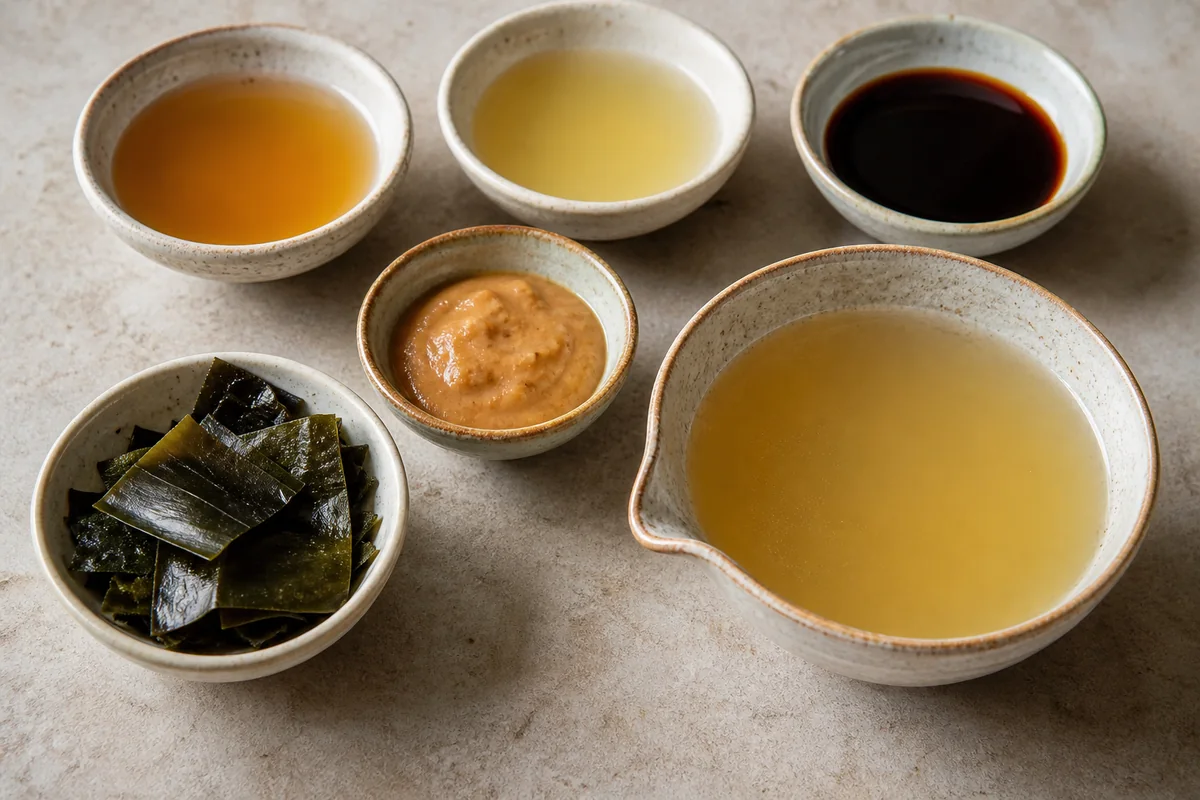
5 Best Fish Stock Substitutes (Tested)
Ingredients
Method
- Match the substitute to your dish: use a briny seafood option for soups/seafood sauces, and use kombu or miso for gentler bases.
- Swap using the listed ratio, then adjust intensity: if it tastes flat, add a bit more kombu/seafood concentrate or a small amount of miso.
- Adjust salinity last: taste after simmering/steeping, then add a pinch of salt or a splash of water to correct oversalting.
- If the dish needs “fishy” aroma, add a small lemon splash or a few drops of fish-sauce-style seasoning (sparingly) at the end.
- Simmer sauces 2–5 minutes longer with the substitute so the flavors meld and the stock tastes less watery.
Notes
- Taste and correct salinity at the end; many substitutes (clam juice, miso) are already salty.
- For risotto and sauces, let the substitute simmer briefly so it reduces into the dish.
Tried this recipe?
Let us know how it was!
Carrie is a food writer and editor with more than 15 years of experience. She has worked for some of the biggest names in the food industry, including Bon Appétit, Food & Wine, and Martha Stewart Living.
As the Editor in Chief of EpicureDelight, Carrie oversees all of the content on the site. She also manages the team of contributing writers and editors, who help to create delicious recipes, helpful tips, and informative articles that you’ll find on the site.
A native of the Chicago area, Carrie is passionate about all things food. She loves trying new restaurants and experimenting with new recipes in her kitchen. She’s also a graduate of the Culinary Institute of America, so she knows a thing or two about food!



