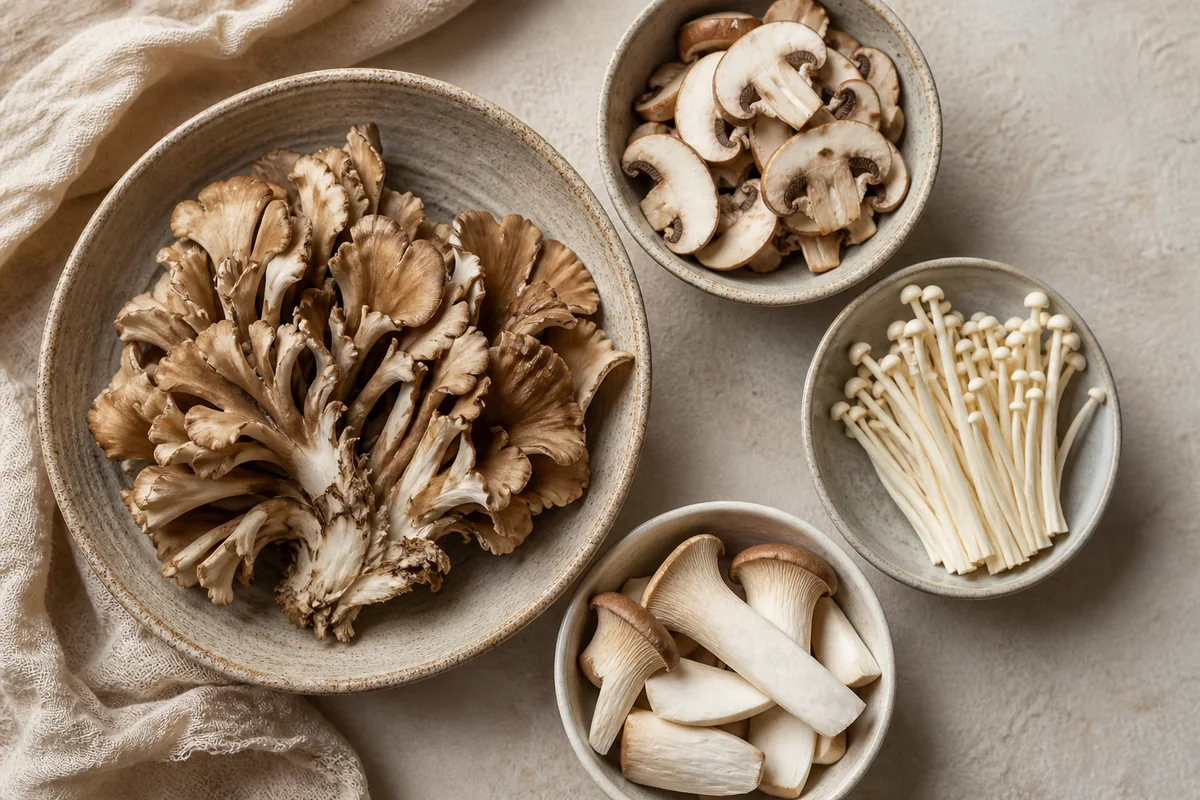
Maitake mushrooms have this dense, layered texture that falls somewhere between a pulled pork bite and a roasted cauliflower floret. No other single ingredient replicates that exactly, but several come close enough to save your recipe.
A good maitake mushroom substitute should match either the chewy, fibrous bite or the deep savory browning, depending on what your dish actually needs.
Maitake adds a meaty, earthy bite and deep browning when seared. The best swaps are oyster mushrooms for tender savory pull, king oyster for firm chew, shiitake for bold umami, porcini for intense flavor depth, and cremini/button when you need a neutral base with seasoning support.
Best Maitake Mushroom Swaps for Any Recipe
The five substitutes below cover every cooking style: high-heat searing, slow roasting, stir-frying, and meatless baking. Each one excels in specific conditions, so match the swap to your method, not just your pantry.
| # | Substitute | Best For | Ratio | Key Note |
|---|---|---|---|---|
| 1 | Oyster mushrooms | Sauté / Roast | 1:1 | Sear hot, add sauce after |
| 2 | King oyster mushrooms | Roast / Stir-fry | ¾:1 | Slice into ribs, brown first |
| 3 | Shiitake mushrooms | Sauté / Braise | 1:1 | Remove stems, slice thin |
| 4 | Porcini (dried) | Sauces / Braises | ½:1 | Use soaking liquid in sauce |
| 5 | Cremini / button | Any method | 1:1 | Add umami booster always |
1. Oyster Mushrooms
Oyster mushrooms are the most accessible swap here, and they earn it. Their mild, delicate savory notes won't replicate maitake's earthy depth, but the tender, slightly chewy texture comes close enough in most sautés and roasts.
The key is heat. Get your pan genuinely hot before the mushrooms go in.
They release a lot of moisture, and crowding them will steam them soft instead of browning the edges.
Oyster vs. Maitake
Works for: quick sautés, pasta, grain bowls, any dish where tender bite is the goal
Skip if: your recipe depends on maitake's dry, flaky pull-apart texture, which oyster can't replicate
- Pan temp: Use medium-high to high heat and let the pan preheat for 60 seconds before adding oil.
- Batch size: Cook in two batches if you have more than 2 cups. Crowding kills browning.
- Timing: Add garlic or sauce only after edges are golden, not before.
- Seasoning: A small splash of soy sauce at the end deepens the flavor toward maitake's earthy baseline.
If you're looking at other swapping away from oysters in another recipe, that's worth a separate read.
2. King Oyster Mushrooms
King oyster is the closest textural match maitake has. The thick, dense stem behaves like a small piece of firm meat when seared, and it holds its shape even after extended cooking.
Slice the stem into long, flat planks rather than rounds. Rounds tend to stay rubbery in the center.
- Knife cut: Slice lengthwise into ¼-inch planks or score the surface in a crosshatch before searing.
- Sear method: Press lightly with a spatula during the first minute so the cut face makes full contact with the pan.
- Don't simmer early: Brown the pieces fully first, then add any braising liquid so texture doesn't turn spongy.
- Flavor gap: King oyster is mild. Add a few drops of tamari or a pinch of mushroom powder to match maitake's earthiness.
King oyster also holds up well in leftover stir-fry dishes without turning mushy on reheating.
Skip if: your recipe needs the fluffy, pull-apart frond texture of maitake. King oyster stays ribbed and firm throughout.
3. Shiitake Mushrooms
Shiitake brings the boldest umami of any fresh mushroom swap. The flavor is woodsy and assertive, which is an advantage if your dish leans on maitake as the primary flavor driver.
Fresh shiitake works well here, but dried and rehydrated shiitake is even closer to maitake's concentrated depth. Remove the stems either way.
They're fibrous and don't soften even with long cooking.
- Stems: Discard or save for stock. Don't cook them into the main dish.
- Slicing: Cut caps into ¼-inch slices so you get browned edges rather than steamed centers.
- Seasoning: Shiitake is already strong, so hold back on soy sauce or mushroom powder until you taste.
- Rehydration: Soak dried shiitake in warm water for 20 minutes, then squeeze out excess before slicing.
If you want more options in this flavor category, the page on bold umami mushroom swaps covers several directions.
Skip if: you or your guests are sensitive to shiitake's distinctively strong, almost smoky flavor. Start with half the amount and build up.
4. Porcini Mushrooms (Dried)
Dried porcini is a flavor-forward swap rather than a texture match. A small amount goes a long way.
Half the weight of dried porcini replaces a full portion of maitake and still delivers an intense, woodsy presence in sauces, braises, and grain dishes.
| Use | Ratio | Notes |
|---|---|---|
| Pasta sauce | ½:1 | Porcini + 2 tablespoon soaking liquid per serving |
| Braised grains | ½:1 | Add strained soaking liquid to cooking water |
| Stir-fry | ½:1 | Rehydrate fully, pat dry, sear fast on high heat |
Porcini's soaking liquid is almost as useful as the mushroom itself. Strain it through a fine-mesh sieve or a coffee filter to catch the grit, then stir 2 to 3 tablespoons into your sauce in place of plain water or extra stock.
If you're curious which dried mushroom picks work best in different applications, that page maps it out well.
- Rehydration: Use warm, not boiling, water. Boiling can make the texture rubbery.
- Grit removal: Always strain the soaking liquid. Grit settles at the bottom of the bowl, so pour slowly.
Skip if: your dish is already well-seasoned with soy, miso, or stock. Porcini soaking liquid is concentrated and can push salt levels over quickly.
5. Cremini or Button Mushrooms
These are the emergency swap. Cremini and button mushrooms are mild and neutral, which means they won't carry a dish the way maitake does.
But they are everywhere, inexpensive, and easy to prep.
The real work happens in the seasoning. A cremini seared with a minced garlic clove and a splash of tamari at the end tastes significantly more interesting than a plain sauté.
Mushroom powder is another strong option, adding that earthy background without extra liquid.
Cremini / Button
Works for: any recipe where maitake plays a supporting role rather than the star, including soups, risottos, and stuffed dishes
Skip if: your recipe needs maitake's woodsy, distinctively deep flavor as the main event, these need too much support to get there
- Layer size: Spread in a single layer in the pan. Overlapping even slightly leads to steaming, not browning.
- Umami boost: Add 1 teaspoon soy sauce or tamari per cup of mushrooms, or ¼ teaspoon mushroom powder per cup.
- Cook time: Give them a full 6 to 8 minutes over medium-high heat before moving them.
When storing leftovers, storing cooked mushrooms properly keeps the texture from breaking down overnight.
Making Maitake Substitutes Work
The single biggest mistake with mushroom substitutes is adding liquid too early. Browning first is what builds the savory depth that people associate with maitake.
Any mushroom simmered in sauce from the start will taste flat. The earthy complexity of this woodsy ingredient comes largely from Maillard browning, not raw flavor.
If you understand that, every substitute on this list performs better.
- Prep first: Pat mushrooms dry before they hit the pan. Surface moisture prevents browning and leads to steamed, soft results.
- Brown before sauce: Get a solid golden crust on all cut surfaces before adding wine, stock, or any liquid.
- Adjust seasoning at the end: If the substitute tastes mild, add a small pinch of mushroom powder or a few drops of tamari after browning, not before, so it doesn't burn.
Shiitake's bold earthy flavor profile means it needs less seasoning support than cremini, so always taste before adding umami boosters.
Frequently Asked Questions
King oyster mushrooms sliced into lengthwise planks are the closest match. Sear them on high heat until golden, and they develop a firm, satisfying chew similar to maitake.
Yes, but slice them thin. King oyster's density means thick cuts need an extra 2 to 3 minutes more than maitake would at the same heat.
Soak in warm water for 20 minutes, then strain the liquid through a fine-mesh sieve before using. Grit settles at the bowl's bottom, so pour the liquid off slowly.
Use a 1:1 swap and season aggressively. A teaspoon of soy sauce or a quarter teaspoon of mushroom powder per cup bridges most of the flavor gap.
You usually need to adjust. Milder substitutes like cremini need an added umami booster, while stronger ones like shiitake may need a slight seasoning reduction to avoid overpowering the dish.
5 Best Maitake Mushroom Substitutes (Tested)
Ingredients
Equipment
Method
- Choose your goal: “meaty chew” (king oyster), “tender savory” (oyster), or “extra umami” (shiitake/porcini).
- Prep like maitake: break into bite-size pieces for stir-fries, or slice and sear on high heat for roasts.
- Measure by the swap ratio in the table above, then adjust: if the substitute is milder, add salt/umami; if stronger, reduce seasoning.
- For dried mushrooms, rehydrate fully and use some of the soaking liquid to replace lost flavor.
- Cook until browned (not just softened) so the substitute develops the same savory depth.
Notes
- For best texture, cook the substitute until it browns before adding sauces.
- If a swap tastes “flat,” the fix is usually salt + one umami booster (soy/tamari, garlic, or mushroom powder).
Tried this recipe?
Let us know how it was!
Carrie is a food writer and editor with more than 15 years of experience. She has worked for some of the biggest names in the food industry, including Bon Appétit, Food & Wine, and Martha Stewart Living.
As the Editor in Chief of EpicureDelight, Carrie oversees all of the content on the site. She also manages the team of contributing writers and editors, who help to create delicious recipes, helpful tips, and informative articles that you’ll find on the site.
A native of the Chicago area, Carrie is passionate about all things food. She loves trying new restaurants and experimenting with new recipes in her kitchen. She’s also a graduate of the Culinary Institute of America, so she knows a thing or two about food!