
Savoy cabbage has a softness that most other cabbages don't. Its crinkled leaves wilt quickly, stay mild, and add gentle sweetness without turning a dish bitter.
Finding a good savoy cabbage substitute means thinking about three things: how soft the finished leaf needs to be, how much moisture it will release, and whether your dish needs a neutral flavor or can handle something with a little more edge.
The best swap depends on the recipe. A quick stir-fry needs something that softens fast.
A filling needs a leaf that won't water down the stuffing. A baked dish or braise can handle something firmer, as long as you prep it right.
Savoy cabbage is tender, mild, and gently sweet. The best swaps are napa cabbage (closest tender bite), green cabbage (firmer, needs thin slicing), bok choy (great for stir-fry), young kale (massage first), and green cabbage with an oil finish for mouthfeel.
5 Best Savoy Cabbage Substitutes (Texture-Matched Picks)
Each substitute below is matched to specific cooking situations. The table gives you a fast scan.
The sections below give you the prep details you actually need.
| # | Substitute | Best For | Ratio | Key Note |
|---|---|---|---|---|
| 1 | Napa Cabbage | Both | 1:1 | Dry-sauté for fillings |
| 2 | Green Cabbage | Both | 1:1 | Slice very thin |
| 3 | Bok Choy | Cooked | 1:1 | Add stems before leaves |
| 4 | Young Kale | Cooked | ¾:1 | Massage with salt first |
| 5 | Green Cabbage + Oil | Cooked | 1:1 | Fat finish mimics softness |
1. Napa Cabbage
Napa cabbage is the most natural swap for savoy. It has a tender bite, a mild sweetness, and this pale, delicate leaf cooks at roughly the same speed.
Use it at a straight 1:1 ratio in almost any recipe that calls for savoy.
- For stir-fries: Slice thin and cook just 2-3 minutes over high heat. It softens fast.
- For fillings: Dry-sauté napa for 1-2 minutes before mixing in. It releases a lot of water and will make stuffing soggy if you skip this step.
- For braises: Add toward the end of cooking. It breaks down quicker than savoy in long braises.
- For wraps: Blanch one large outer leaf for 30 seconds. It folds well and won't crack.
If you need to think through other options for napa, choosing a different mild leaf can also work when neither savoy nor napa is available.
Skip if: Your recipe needs thick, structural leaves that hold shape through long simmering. Napa and savoy both soften quickly, which is great for most dishes but not for long-braised stuffed cabbage rolls.
2. Green Cabbage (Finely Shredded)
Green cabbage is the sturdier swap. It has more fiber than savoy, so the texture after cooking stays slightly firmer.
That's not always a problem, but you do need to adjust your prep. This dense, waxy leaf holds up well in baked dishes and longer braises where savoy might go too soft.
Savoy vs. Green Cabbage
Works for: braises, casseroles, sautéed sides, and any dish with 8+ minutes of cook time
Skip if: you need the leaf to soften fully within 3-4 minutes of light cooking
- Slice thin: Cut ribbons no wider than 2-3mm. Thicker cuts stay chewy.
- Massage option: For raw or lightly cooked applications, rub with a pinch of salt for 30 seconds to soften the fibers before cooking.
- Pre-cook for baking: Sauté for 3-4 minutes before adding to a baked dish. It won't soften enough in the oven on its own.
- Oil helps: A small drizzle of olive oil in the sauté pan closes the texture gap between green and savoy.
Skip if: You want savoy's very delicate, quickly-softening texture. Green cabbage can get close, but it won't fully replicate that melt-in-the-mouth quality.
3. Bok Choy (Stems First, Leaves Last)
Bok choy works well in stir-fries and quick braises where you want a mild, fresh-tasting green. Its flavor is close to savoy-clean, slightly sweet, and not bitter.
The key difference is structure. Stems need more time than leaves, so you cook them separately.
The crisp, watery stalk takes about 3-4 minutes over medium-high heat. Add the leaves only in the last 60-90 seconds.
If you add everything at once, the leaves overcook while the stems stay tough.
- Slice stems: Cut into 1cm pieces on a diagonal for faster, more even cooking.
- Chop leaves roughly: Large pieces are fine; they wilt fast.
- Use baby bok choy: Baby varieties are milder and more tender, closest to savoy's softness.
Skip if: Your recipe needs uniformly shredded cabbage. Bok choy's stems and leaves cook at different rates, so it doesn't work well when everything needs to be the same texture throughout.
4. Kale (Young, Massaged)
Kale is not the first choice here, but it works when you need a leafy green and nothing else is available. Young kale has less bitterness than mature curly kale.
Still, it won't behave exactly like savoy. It's tougher, slightly more bitter, and takes longer to soften.
Massaging is non-negotiable. Rub the leaves with a small pinch of salt for 30-60 seconds.
You'll feel them soften under your hands. After massaging, other leafy green picks can also be compared side-by-side if you want to see how kale stacks up against similar options.
- Remove stems: Kale stems stay tough even after cooking. Use leaves only.
- Short cook time: Keep heat high and time short. Two to three minutes in a hot pan is enough.
- Use ¾ the amount: Kale is more assertive, so a little less keeps the flavor balanced.
- Best for: Baked casseroles, pasta, and grain bowls. Skip for delicate fillings or leaf-wrapping.
Skip if: You need savoy's delicate, mild softness for quick fillings or anything where the green needs to disappear into the dish.
5. Cabbage + Oil Finish (Savoy-Style Mouthfeel)
This is a method swap, not a different vegetable. If you only have standard green cabbage, a small amount of fat at the end of cooking closes the texture gap considerably.
| Use | Ratio | Notes |
|---|---|---|
| Sautéed side dish | 1:1 + ½ teaspoon oil | Add oil in last 60 seconds, toss off heat |
| Stir-fry base | 1:1 + ½ teaspoon sesame oil | Finish after removing from heat |
| Baked casserole | 1:1 + ½ teaspoon butter | Dot on top before final 5 minutes of baking |
| Filling (dumplings) | 1:1 + ¼ teaspoon oil | Mix in after dry-sautéing; don't add during cooking |
The fat coats the cooked cabbage and gives it a slightly silkier mouthfeel. Use butter for mild dishes and neutral oil or sesame oil for Asian-style ones.
Stop cooking the moment the cabbage is just tender. Overcooking at this stage makes it mushy and dull.
When storing stir-fried greens, note that oil-finished cabbage keeps its texture better overnight than plain sautéed cabbage.
Skip if: You need a very clean, bright flavor. The fat finish adds a subtle richness that can mute lighter seasonings.
Savoy Cabbage Substitute in Cooking: Quick Rules That Work
Most swaps fail for one of three reasons: the cabbage is sliced too thick, cooked too long, or added to the dish wet. Thin slicing and a quick, hot finish solve two of those problems immediately.
The third, moisture, comes down to prep. If you understand this soft, crinkled leaf's natural moisture level, you can manage any substitute more confidently.
For raw or lightly dressed dishes, always pick napa or skip to milder leafy swap options rather than forcing green cabbage or kale into an application they don't suit.
- Prep rule: Slice substitutes to 2-3mm ribbons. Thicker cuts cook unevenly and stay tough in the center.
- Time rule: Add your substitute 1-2 minutes later than you would savoy. Most swaps take slightly longer to reach the same softness.
- Moisture rule: For fillings and dumplings, always dry-sauté your substitute first, then drain on paper towel before mixing in.
Frequently Asked Questions
Napa cabbage is the closest. It softens at a similar speed and has the same mild sweetness. Bok choy is a strong second if you add stems first and leaves last.
Yes, but pre-cook it briefly first. Napa releases a lot of water in the oven and can make a baked dish soggy if added raw.
Dry-sauté your substitute for 1-2 minutes before mixing it into any filling. Then spread it on paper towel and press out remaining moisture before combining.
Napa cabbage outer leaves work best. Blanch briefly, then wrap. Green cabbage leaves also hold shape well but need a longer blanch to stay pliable.
Yes. Add 2-3 extra minutes and slice it thinner than you would savoy. Green cabbage is denser and won't soften at the same rate.
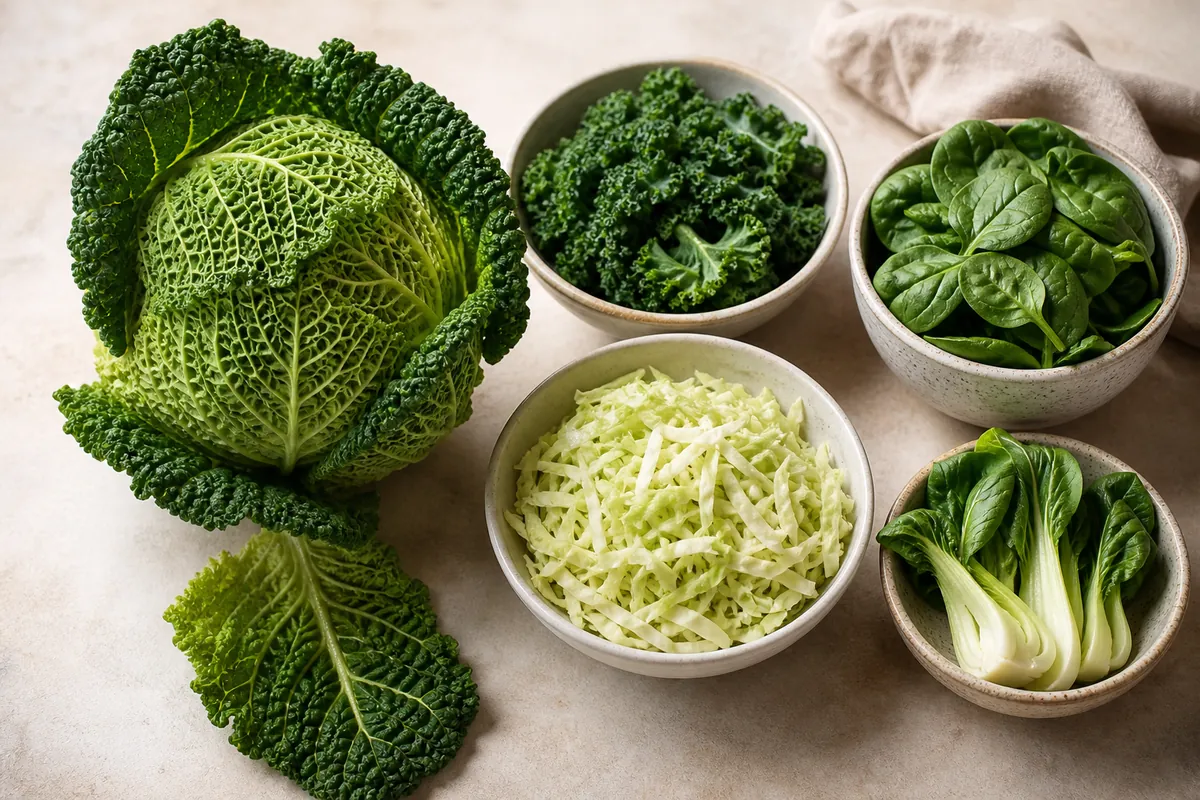
5 Best Savoy Cabbage Substitutes (Honest Picks)
Ingredients
Method
- Decide your end goal: tender/juicy (go napa), sturdy leaf (go bok choy), or hearty chew (go green cabbage or kale).
- Use the listed ratio. For firmer options, trim to thin ribbons or small pieces so they cook at the same speed as savoy.
- Prep for texture: massage kale with a pinch of salt for 30–60 seconds, or thin-slice green cabbage and sauté until just tender.
- Cook/assemble according to your recipe. Taste near the end—if it’s bland, add salt; if it’s too firm, cook 1–3 minutes more.
- If your substitute releases extra water (often napa), dry-sauté 1–2 minutes before using in fillings.
Notes
- Best results come from matching moisture and tenderness.
- Thin slicing and short finishing time prevent mushiness.
Tried this recipe?
Let us know how it was!
Carrie is a food writer and editor with more than 15 years of experience. She has worked for some of the biggest names in the food industry, including Bon Appétit, Food & Wine, and Martha Stewart Living.
As the Editor in Chief of EpicureDelight, Carrie oversees all of the content on the site. She also manages the team of contributing writers and editors, who help to create delicious recipes, helpful tips, and informative articles that you’ll find on the site.
A native of the Chicago area, Carrie is passionate about all things food. She loves trying new restaurants and experimenting with new recipes in her kitchen. She’s also a graduate of the Culinary Institute of America, so she knows a thing or two about food!



