
Guar gum is one of those quiet workhorse ingredients that does a lot without drawing attention. A small amount turns a thin sauce into something cohesive, keeps ice cream smooth, or holds a gluten-free dough together.
When you run out, the right guar gum substitute depends on what the gum is actually doing: thickening a hot liquid, stabilizing an emulsion, or building a gel that holds its shape when cool.
Not all swaps behave the same way. Starch-based options need heat to activate, while gums like xanthan thicken quickly at low doses.
Pick by role first, then by ratio.
Guar gum thickens and smooths without changing flavor. The best swaps are xanthan gum (no heat needed), tapioca starch or arrowroot (glossy, clean finish), cornstarch (classic slurry), potato starch (silky sauces), or gelatin when you need a set gel structure.
5 Best Guar Gum Swaps (Texture-Matched)
Each substitute below is matched to what guar gum actually does in a dish. Use the table to scan ratios fast, then read the section for the swap that fits your recipe.
| # | Substitute | Best For | Ratio | Key Note |
|---|---|---|---|---|
| 1 | Xanthan Gum | Both | 1:1 | No heat needed; add slowly |
| 2 | Tapioca Starch | Cooking | 1:2 | Simmer until translucent |
| 3 | Cornstarch | Cooking | 1:3 | Must reach boiling simmer |
| 4 | Arrowroot Powder | Cooking | 1:2.5 | Clear finish; don't over-boil |
| 5 | Potato Starch | Cooking | 1:2.5 | Silky body; brief simmer only |
1. Xanthan Gum
Xanthan gum is the most direct swap here. It thickens at room temperature, needs no boiling, and holds stable viscosity through temperature changes.
If your recipe is gluten-free or cold-process, this is usually the first option to reach for.
One thing to know about this powder-form stabilizer is that it clumps fast if you dump it straight into liquid. Whisk it into a dry ingredient first, or blend into cold liquid, then let it rest 2-5 minutes before judging thickness.
- Ratio: Use 1:1 in place of guar gum; start with slightly less and adjust
- Mixing: Combine with a dry ingredient first to prevent clumping
- Timing: Rest 2-5 minutes after blending; viscosity continues to build
- Best uses: Salad dressings, gluten-free batters, smoothies, ice cream bases
Skip if: you need a clear, glossy sauce finish. Xanthan can give a slightly cloudy appearance; arrowroot looks cleaner in that case.
2. Tapioca Starch
Tapioca starch produces a smooth, slightly glossy body when simmered properly. It works especially well in fruit pie fillings and thick sauces where you want that translucent, cohesive finish rather than a starchy-looking result.
If you're comparing starch vs. gum thickening, tapioca sits in the middle: it thickens more like a starch but looks closer to a gum-thickened result.
It is sensitive to underheating. The sauce needs to reach a proper simmer and turn translucent before you pull it off the heat.
- Ratio: Use 2 parts tapioca starch for every 1 part guar gum
- Method: Mix into cold liquid first, then bring to a simmer while stirring
- Visual cue: Thickening is done when the sauce turns translucent and coats a spoon
- Best uses: Pie fillings, fruit sauces, gravies, stir-fry sauces
Skip if: your recipe won't reach a simmer. Tapioca needs sustained heat to fully hydrate and thicken; an underheated base stays thin and slightly starchy.
3. Cornstarch Slurry
Cornstarch is what most cooks reach for first, and it works well for sauces, gravies, and fillings. The key difference from guar gum is that it must reach a rolling simmer to thicken fully.
Always mix it into cold water first to make a slurry, then whisk that into your hot base.
Guar Gum
Works for: cold or room-temp thickening, emulsion stabilizing, baked goods
Skip if: you need a clear, heat-set gloss without any gel feel
Cornstarch
Works for: hot sauces, gravies, stir-fry glazes, pie fillings
Skip if: the liquid is acidic or the dish will be reheated multiple times
One thing this mild thickener handles that cornstarch doesn't is cold-process stabilizing. Cornstarch thins back out if overhandled after it sets, especially with reheating.
- Ratio: Use 3 parts cornstarch for every 1 part guar gum
- Method: Whisk into cold water first, then stir into hot liquid while simmering
- Avoid: Over-stirring after it sets; it can thin out
Skip if: the recipe is acidic, like a tomato or citrus-heavy sauce. Arrowroot is a more stable option there.
4. Arrowroot Powder
Arrowroot is the go-to when you want a clean, glossy finish. Unlike cornstarch, it produces a clearer result and holds up better in mildly acidic recipes.
The clear, neutral starch is especially good in fruit sauces and glazes where cloudy thickening would show.
- Ratio: Use 2.5 parts arrowroot for every 1 part guar gum
- Method: Mix into cold liquid, then heat just to a simmer and pull immediately
- Visual cue: The sauce turns glossy and slightly translucent when ready
- Best uses: Fruit glazes, light gravies, clear Asian sauces, berry fillings
The fine white powder also stores well when kept dry and sealed, so it's a good pantry backup. Skip if: you're trying to replicate a stretchy, elastic guar gum texture. Arrowroot is smooth and clear, not gel-elastic.
5. Potato Starch
Potato starch thickens quickly and gives sauces a silky, smooth body. It activates fast once the liquid heats up, which is useful when you don't want to simmer for long.
| Use | Ratio | Notes |
|---|---|---|
| Silky sauces | 1 part guar : 2.5 potato starch | Whisk into cold base, heat until glossy |
| Gravies | 1 part guar : 2.5 potato starch | Brief simmer only; avoid extended boiling |
| Pie fillings | 1 part guar : 2 potato starch | Lower ratio gives a lighter set |
The fine, dry starch works best when stirred into cold liquid first. Once the sauce hits the right temperature, it thickens fast and glosses up quickly.
- Ratio: Use 2.5 parts potato starch for every 1 part guar gum
- Method: Whisk into cold base, then bring to heat and simmer briefly
- Activation cue: Sauce turns glossy and coats a spoon cleanly when ready
- Best uses: Gravies, sauces, Korean and Japanese-style glazes
Skip if: the recipe requires a long, slow simmer. Potato starch can break down and thin out if boiled aggressively or cooked for too long after thickening.
Making Guar Gum Substitutes Work (Without Texture Surprises)
The first step is matching the substitute to guar gum's actual job in your recipe. A pourable sauce needs a different swap than a set-gel dessert, and a stabilized smoothie needs a different approach than a baked loaf.
Once you know the role, the ratio from the table is your starting point, not a fixed rule.
For most starch-based swaps, mixing into cold liquid before heating prevents lumps. The smooth, neutral gum option skips the heating step entirely, which is useful for cold-process recipes like salad dressings or no-bake fillings.
If you're working with gelatin, look at gel-set alternatives to understand when a firm set is actually what you need versus a pourable thickness.
- Start cold: Whisk starch or gum into cold liquid before adding heat; this distributes it evenly and prevents clumping during activation
- Adjust in small increments: If the texture is too thin after resting, add the substitute in small pinches and re-check after 2 minutes before adding more
- Respect the simmer limit: For all starch-based swaps, pull off heat once the sauce glosses and coats; extended boiling causes thinning on most starches
Frequently Asked Questions
Xanthan gum is the best no-heat option. Use it at a 1:1 ratio, whisk into cold liquid, and let it rest 2-5 minutes to reach full viscosity without any simmering.
Mix xanthan gum into a dry ingredient first, then add that blend to your liquid. Adding it directly to liquid causes it to clump before it can disperse.
All three need heat to fully activate. A rolling simmer works for cornstarch; arrowroot and potato starch need only a brief simmer and can thin out if boiled too long.
Arrowroot is the most acid-stable starch substitute and works better than cornstarch in tomato or citrus-based sauces. Xanthan gum also holds up well in acidic conditions.
Gelatin is not a direct baking swap. It sets by chilling and produces a firm gel structure, so it only works when the recipe's goal is a set, sliceable texture.
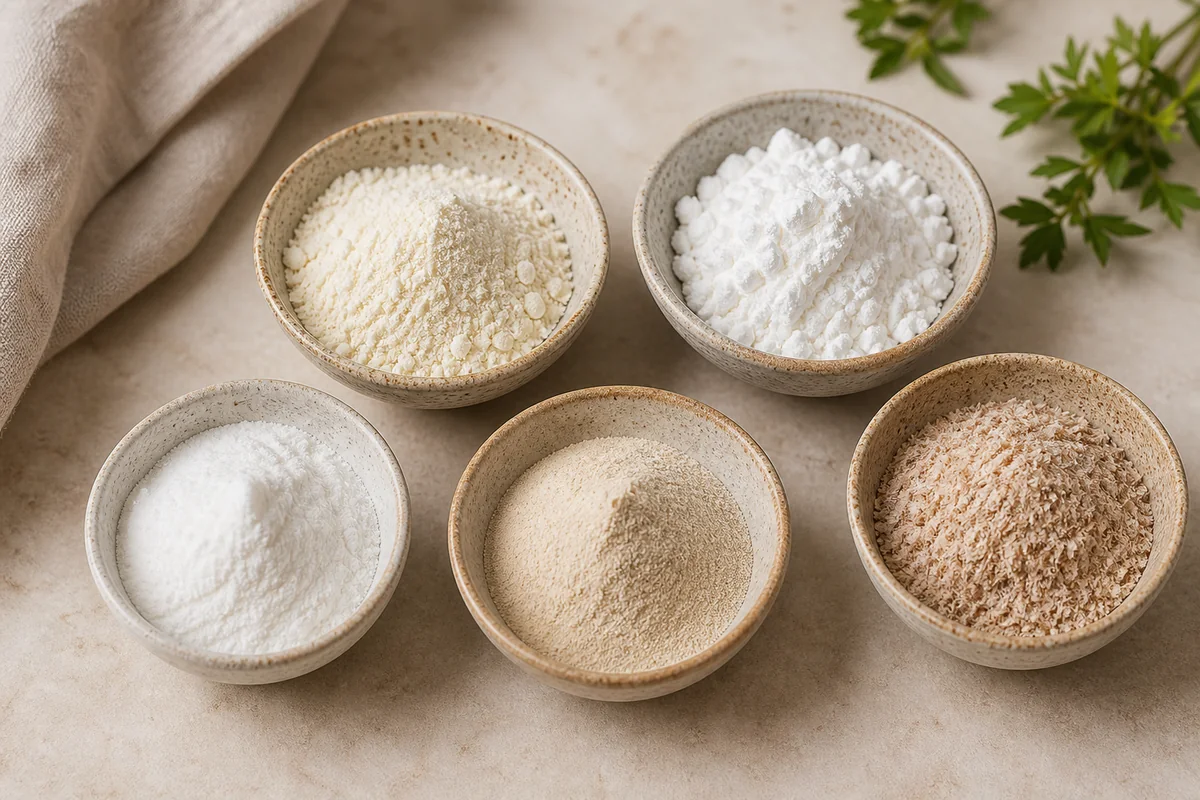
5 Best Guar Gum Substitutes (Flavor-Matched)
Ingredients
Equipment
Method
- Identify guar gum’s job in your recipe: smooth thickening, gel structure, or stabilizing an emulsion.
- Start with the ratio for your chosen substitute, then mix thoroughly into cold liquid (or bloom gelatin) before heating.
- Apply heat as required: cornstarch/arrowroot/potato starch must reach boiling simmer to fully activate thickening.
- If the mixture looks too thick, thin with water/broth; if too thin, add a small pinch in 10–15 second increments and re-check.
- Let it rest 2–5 minutes after thickening—some gums and starches continue to set and smooth as they cool.
Notes
- Guar gum is typically used in very small amounts for smooth thickening; starch substitutes often need more and require heat to activate.
- For best results, blend substitutes into cold liquid first to reduce lumps, then heat/simmer until the texture matches your target.
Tried this recipe?
Let us know how it was!
Carrie is a food writer and editor with more than 15 years of experience. She has worked for some of the biggest names in the food industry, including Bon Appétit, Food & Wine, and Martha Stewart Living.
As the Editor in Chief of EpicureDelight, Carrie oversees all of the content on the site. She also manages the team of contributing writers and editors, who help to create delicious recipes, helpful tips, and informative articles that you’ll find on the site.
A native of the Chicago area, Carrie is passionate about all things food. She loves trying new restaurants and experimenting with new recipes in her kitchen. She’s also a graduate of the Culinary Institute of America, so she knows a thing or two about food!



