
That moment when you slice open a ripe camembert and the center nearly runs-that's the texture and tang you're trying to match. Finding the right substitute for camembert cheese means deciding what matters more: the bloomy rind flavor, the molten melt when baked, or just that soft, spoonable creaminess.
Some swaps nail the look and melt. Others are purely about getting a creamy, tangy spread on the table fast.
The best camembert cheese alternative depends on how you use it. Brie is the closest all-around swap. Triple-cream wins for spoonable creaminess. Munster adds more funk. Cream cheese blended with sour cream is the emergency pantry fix when rind cheeses aren't available.
5 Camembert Substitutes That Match Texture and Melt
Knowing what makes camembert cheese distinct before you swap helps you avoid the most common mistake-choosing a cheese that looks right but falls flat on flavor or melt. The table below covers the five strongest options.
| # | Substitute | Best For | Ratio | Key Note |
|---|---|---|---|---|
| 1 | Brie | Both | 1:1 | Closest rind-cheese swap |
| 2 | Coulommiers | Both | 1:1 | Slightly lighter tang |
| 3 | Triple-cream cheese | Both | 1:1 | Buttery, not tangy |
| 4 | Munster | Both | 1:1 | Funkier, slice thin |
| 5 | Cream cheese + sour cream | Serving | ¾:1 | Spread only, no rind |
1. Brie
Brie is the best all-around camembert cheese alternative you can find at most supermarkets. It has the same bloomy white rind, a similarly soft paste, and it melts at nearly the same rate when baked.
Brie vs. Camembert
Works for: baking whole, cheese boards, warm dips, serving with fruit or crackers
Skip if: you need sharper, more barnyard tang-Brie tends to run milder and more buttery
If you want to track how long your swap will stay good after baking, knowing baked brie's shelf life helps you plan portions correctly.
- Flavor: Milder, more buttery than camembert, with a gentler mushroom note
- Texture: Identical gooey melt when warm; soft and spreadable at room temp
- Best use: Direct 1:1 swap for baking, boards, and warm appetizers
- Prep tip: Score the top rind before baking to help it open evenly
Skip if: you're building a board around pungent, assertive cheese flavors.
2. Coulommiers
Coulommiers is sometimes called "baby camembert," and that nickname is not far off. It is a soft, bloomy-rind cheese with a creamy center and a mild, slightly mushroomy tang that sits just a half-step below camembert in intensity.
- Flavor similarity: Very close to camembert, slightly sweeter and less pungent
- Spread/slice performance: Spreads beautifully at room temp; slices cleanly when cold
- Bake behavior: Melts well and holds its rind shape during baking, same as camembert
Skip if: you want the same strong aroma camembert gives a warm dish-Coulommiers is a touch lighter on that front.
3. Triple-Cream Cheese
When your priority is maximum creaminess, triple-cream is the pick. Cheeses like Saint-André or Brillat-Savarin have more fat than camembert, so the mouthfeel is almost cloud-like compared to a standard bloomy rind.
If you're weighing this against Brie and want to know how each handles different recipes, the guide on cream cheese in dairy recipes covers how fat content changes texture in cooked dishes.
- Flavor: Mild, sweet, and deeply buttery - tang is minimal
- Texture: Softer than camembert; nearly spoonable even when slightly chilled
- Best use: Cheese boards, crostini, or baked en croûte where creaminess is the goal
- When to skip it: Any dish where camembert's tang is the flavor anchor
Skip if: rind character and tangy bite are what you're after.
4. Munster
Munster is not a timid swap. It has a soft, yielding texture similar to camembert, but its orange-washed rind produces a funkier, more assertive flavor that can catch people off guard if they expect something mild.
Munster as a Swap
Works for: baked dishes, grilled sandwiches, boards where bold flavor is welcome
Skip if: you're making a delicate flavor board or pairing with mild crackers - the funk can dominate
For recipes where managing stronger flavors is the challenge, tips on using cream cheese for creaminess alongside a bolder cheese can help balance a dish.
- Flavor: Tangy, earthy, and noticeably funky - especially near the rind
- Texture: Soft and supple, melts cleanly in baked applications
- Best use: Baked dishes, French onion-style applications, and rustic bread boards
- Pairing rule: Offset Munster's punch with sweet fruit, honey, or fig jam on the board
Skip if: your guests are expecting camembert's gentle, approachable flavor.
5. Cream Cheese + Sour Cream Blend
This is the emergency swap when a bloomy-rind cheese is simply not on the shelf. It does not replicate the rind or the funk, but it delivers a creamy, tangy spread that works surprisingly well for appetizers and dips.
Adjusting the ratio is where this swap gets interesting. Start with 3 parts full-fat cream cheese to 1 part sour cream, then taste and add more sour cream in half-tablespoon increments until the tang feels right.
If you need to go further with the tanginess, exploring alternatives to sour cream in a cake gives context for how different acidic dairy products behave when mixed.
- Blending ratio: 3 parts cream cheese : 1 part sour cream, blended smooth
- Texture goal: Soft, spreadable, and slightly loose - chill briefly if it gets too soft
- Best use: Cold spreads, dips, and crostini toppings; not ideal for whole-baked presentation
- Skip for baking: The blend separates under direct oven heat and loses its texture
Skip if: you need the visual of a whole wheel baked in parchment.
Making the Swap Work (Serving and Baking Tips)
The single biggest thing that separates a good swap from a bad one is temperature management. Nearly every soft cheese on this list performs better - spreads cleaner, melts more evenly - when it is handled right before it hits the table or the oven.
For more on how soft cheeses behave differently when mascarpone in dairy recipes is involved, that guide is worth a look if you're adapting a recipe.
- Room-temp readiness: Pull your substitute out of the fridge 30-45 minutes before serving so the paste softens fully - cold cheese from the fridge will feel dense and rubbery on a cracker
- Baking heat: Most bloomy-rind swaps (Brie, Coulommiers, Munster) bake well at 375°F for 12-15 minutes - check at 10 minutes since thinner wheels melt faster than camembert
- Balancing tang: If your swap is too mild, stir in ½ teaspoon white wine vinegar or add a squeeze of lemon to the serving plate - a drizzle of honey works if the swap runs funkier than expected
Frequently Asked Questions
Brie is the closest option - same bloomy rind, similar melt, and easy to find. Serve it at room temperature and it will spread almost identically to camembert.
Brie and Coulommiers both melt cleanly and hold their rind structure in the oven. Triple-cream melts beautifully too, though it can run more liquid at high heat.
Not directly - cream cheese gets dense and loses texture under oven heat. Use it only as a cold spread or mixed dip, not as a baked-whole replacement.
Stir in a small amount of sour cream or add ½ teaspoon white wine vinegar before serving. A few drops of lemon juice also sharpens mild cheeses quickly.
Sweet pairings cut through funk effectively - fig jam, sliced pear, or a drizzle of honey all work. Mild, slightly sweet crackers also help tone down the sharpness.
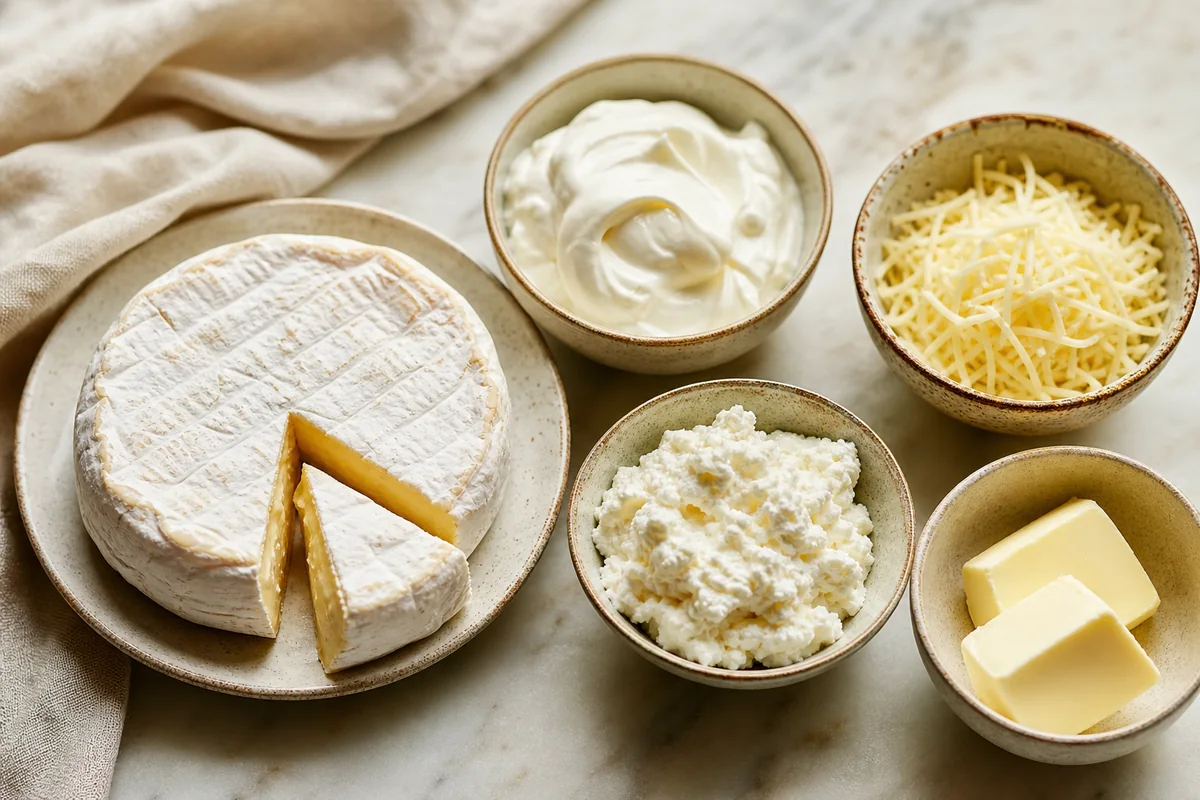
5 Best Camembert Cheese Substitutes (Pantry Swaps)
Ingredients
Equipment
Method
- Decide how you’re using it: serve at room temp (spreading/slicing) or bake until melty.
- Choose the closest match from the list: Brie or Coulommiers for the closest rind-cheese feel; triple-cream for maximum creaminess.
- If your substitute is milder or less tangy (cream cheese/mascarpone), boost brightness by stirring in a small amount of sour ingredient (like sour cream) before serving.
- If your substitute is softer than camembert (triple-cream/cream-cheese blend), keep it chilled until serving so it slices cleanly.
- Taste after prep and pair strategically: add fruit or honey for sharper/funkier swaps (Munster) to balance the bite.
Notes
- If you need the rind tang, prioritize bloomy-rind swaps (Brie, Coulommiers).
- For the spoonable center in a pinch, blend cream cheese with sour cream for tang and looseness.
Tried this recipe?
Let us know how it was!
Carrie is a food writer and editor with more than 15 years of experience. She has worked for some of the biggest names in the food industry, including Bon Appétit, Food & Wine, and Martha Stewart Living.
As the Editor in Chief of EpicureDelight, Carrie oversees all of the content on the site. She also manages the team of contributing writers and editors, who help to create delicious recipes, helpful tips, and informative articles that you’ll find on the site.
A native of the Chicago area, Carrie is passionate about all things food. She loves trying new restaurants and experimenting with new recipes in her kitchen. She’s also a graduate of the Culinary Institute of America, so she knows a thing or two about food!



