
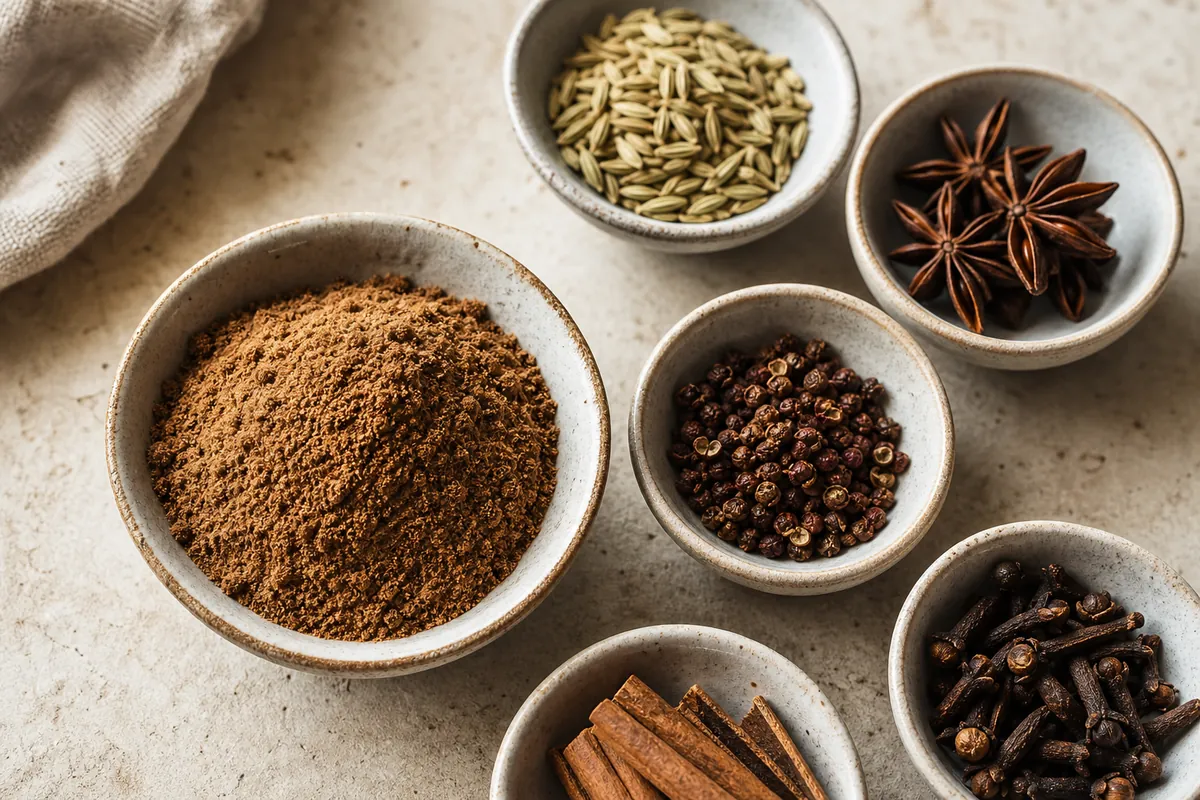
Chinese five spice powder has a way of making a dish smell exactly right before it even hits the heat. That dark, faintly sweet, slightly licorice-edged aroma is the work of five spices: star anise, cloves, Chinese cinnamon, Sichuan pepper, and fennel seeds.
Losing that is real, but a good substitute can get you close.
The best Chinese five spice powder substitute is a DIY blend using star anise, cinnamon, cloves, fennel, and black pepper. For a single-ingredient swap, allspice handles baked goods well, and garam masala saves savory dishes in a pinch. Use a 1:1 ratio for most swaps unless noted.
What Makes Five Spice Hard to Replace
The challenge is not any single flavor. It is the combination: warm spice, floral anise, mild heat, and a faint bitterness all at once.
Most pantry spices cover one or two of those notes, not all four together.
That means every substitute below trades something away. We call those tradeoffs out directly so you know what to expect before you start cooking.
The Best Chinese Five Spice Powder Substitutes
1. Homemade Five Spice Blend
If you have star anise and ground cinnamon in your cabinet, you are already most of the way there. This is the closest match because you are rebuilding the original rather than approximating it.
A basic formula: 1 teaspoon ground star anise, 1 teaspoon ground cinnamon, ¼ teaspoon ground cloves, ½ teaspoon ground fennel seeds, ¼ teaspoon black pepper (or Sichuan pepper if you have it). Grind, mix, and use 1:1 in place of store-bought five spice.
- Missing star anise: Double the fennel seeds. The anise note shrinks but does not vanish.
- Missing Sichuan pepper: Black pepper works. Skip white pepper; it reads soapy here.
- For baking: Drop the pepper to ⅛ teaspoon so the heat does not spike in a sweet context.
Skip if you have none of the five original spices. At that point, a different substitute is a better call.
2. Allspice
Allspice is one berry, but it genuinely carries cinnamon, clove, and nutmeg in a single note. For a Chinese five spice powder substitute in baking, it is the most reliable single-ingredient option.
Allspice
Works for: Spiced cakes, cookies, glazed pork, duck, slow-braised dishes
Skip if: The recipe depends on the licorice-anise note; allspice has none of that
Use it 1:1. In savory dishes, add a small pinch of ground fennel alongside it.
That closes the gap noticeably.
3. Garam Masala
Garam masala sounds like a stretch, but the overlap is real. Both blends are built on warm spices, both use cloves and cinnamon as a backbone, and both are meant to perfume rather than scorch.
The main difference is that garam masala skews warmer and less sweet, with no anise flavor at all. It also often includes cumin and cardamom, which shift the dish toward South Asian territory.
- Ratio: Use ¾ teaspoon garam masala for every 1 teaspoon five spice called for.
- Best dishes: Braises, marinades, stir-fry sauces, and slow-roasted meats.
- Add-on: A small pinch of ground star anise alongside it pulls the flavor closer to the original.
Skip if your dish is a dessert or a delicate tea-smoked preparation. The cumin in garam masala does not translate well into sweet contexts.
4. Star Anise Alone
Sometimes the recipe only really needs one note from five spice: the anise. Slow-cooked pork belly, red-braised duck, and clay pot dishes often use five spice precisely for that deep licorice hit.
Star anise, used in a warm spice blend, provides exactly what those dishes are built around.
You can read more about using swapping whole star anise if you are working with the whole pod form rather than ground.
Skip if the recipe calls for a dry rub. Solo star anise is too one-dimensional as a coating spice.
5. Cinnamon and Cloves
This two-spice combo is the fastest fix when you have no anise-flavored spice at all. It handles baking applications especially well, covering the warm-sweet dimension of five spice with nothing unusual required.
| Use | Ratio | Notes |
|---|---|---|
| Baked goods | ¾ teaspoon cinnamon + ¼ teaspoon cloves per 1 teaspoon five spice | Add a pinch of nutmeg for extra depth |
| Savory marinades | ½ teaspoon cinnamon + ¼ teaspoon cloves + ¼ teaspoon black pepper | Pepper adds the missing bite |
| Glazes | Equal cinnamon and cloves, ½ teaspoon total per 1 tsp | Reduce sugar slightly; cloves intensify sweetness |
Skip if your dish is a classic Cantonese or Shanghainese preparation. The absence of fennel and star anise will read immediately to anyone familiar with the original.
6. Baharat
Baharat is a Middle Eastern spice blend that shares more with five spice than most cooks realize. It uses allspice, cloves, cinnamon, and black pepper, plus coriander and paprika.
The warmth profile is close. The smoke note is not present in five spice but is not disruptive either.
This is a good best Chinese five spice powder substitute when you want something with complexity and you are not chasing authenticity in a specific regional dish. Use it at a ¾:1 ratio.
- Works well in: Roast chicken, lamb, braised short ribs, and spiced rice.
- Less ideal for: Noodle soups and dishes where five spice is a background note only.
If you find yourself reaching for warm spice blends often, browsing through other warm-spiced alternatives can open up more options for your spice drawer.
Which Substitute Fits Your Dish
Different recipes need five spice for different reasons. A marinade needs the anise-forward warmth.
A cake needs the sweet spice depth. A braise needs both.
- Baking (cakes, cookies, quick breads): Allspice or cinnamon-clove mix.
- Pork, duck, and beef braises: Homemade blend or garam masala with star anise added.
- Dry rubs: Homemade blend only. Single spices are too thin as a rub coating.
- Glazes and sauces: Allspice or baharat, depending on what is on hand.
- Noodle soups and stocks: Star anise alone, or the homemade blend with full anise content.
Frequently Asked Questions
Yes. It works as a swap for allspice or mixed spice in baking, though the anise note will come through. Use about ¾ teaspoon five spice for every 1 teaspoon called for.
Allspice is the closest because it naturally combines clove, cinnamon, and nutmeg-like warmth in one spice. It misses the anise note but handles sweet and savory dishes reasonably well.
No. Mixed spice is a British baking blend without star anise or Sichuan pepper. Five spice is more complex and more assertive, particularly in savory cooking.
In baking, yes. Pumpkin pie spice has cinnamon, ginger, cloves, and nutmeg, which cover the sweet warmth well. It has no anise flavor, so savory dishes will taste noticeably different.
Combine 1 teaspoon ground star anise, 1 teaspoon cinnamon, ¼ teaspoon cloves, ½ teaspoon fennel, and ¼ teaspoon black pepper. Stir and use immediately or store in a sealed jar for up to three months.
Tried this recipe?
Let us know how it was!
Carrie is a food writer and editor with more than 15 years of experience. She has worked for some of the biggest names in the food industry, including Bon Appétit, Food & Wine, and Martha Stewart Living.
As the Editor in Chief of EpicureDelight, Carrie oversees all of the content on the site. She also manages the team of contributing writers and editors, who help to create delicious recipes, helpful tips, and informative articles that you’ll find on the site.
A native of the Chicago area, Carrie is passionate about all things food. She loves trying new restaurants and experimenting with new recipes in her kitchen. She’s also a graduate of the Culinary Institute of America, so she knows a thing or two about food!



