
Coconut nectar has a mild caramel sweetness and a dark, pourable consistency that sits somewhere between honey and a light molasses. It's less sharp than maple syrup and far less sweet than agave, which makes it a flexible sweetener in both sauces and baked goods.
Finding a solid coconut nectar substitute means matching two things at once: sweetness level and body.
Most swaps work fine in glazes, dressings, and baked goods. A few need minor ratio tweaks because their sweetness is stronger per spoon.
Coconut nectar is a low-glycemic, mildly caramel sweetener with a dark, pourable consistency. For baking and glazes, coconut sugar syrup is the closest match. Honey and maple syrup are reliable pantry swaps. Agave nectar works when you need lighter flavor. Brown sugar syrup and simple syrup handle last-resort situations.
5 Best Coconut Nectar Substitutes (That Actually Work)
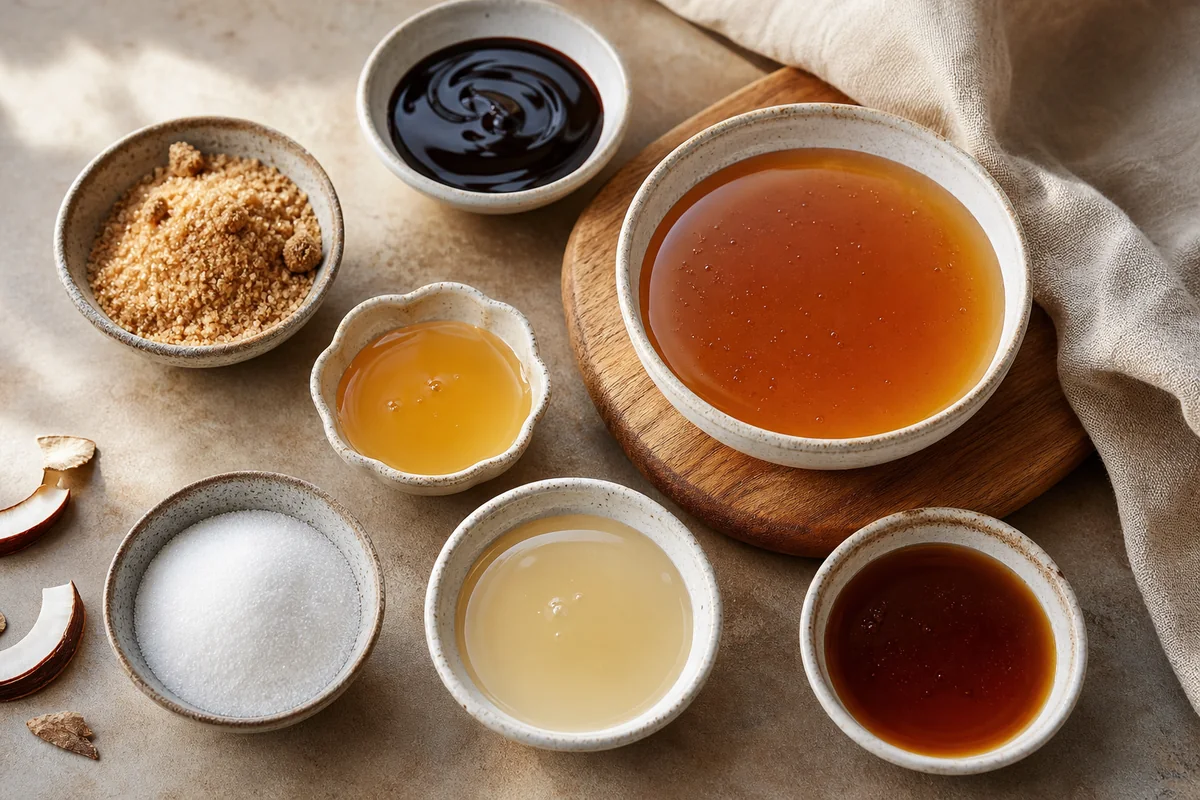
Every swap below is sorted by how close it lands on flavor and consistency. The table gives you the quick reference, and each section below it covers the real-world adjustments.
| # | Substitute | Best For | Ratio | Key Note |
|---|---|---|---|---|
| 1 | Coconut Sugar Syrup | Both | 1:1 | Closest flavor and body |
| 2 | Honey (mild) | Both | 1:1 | Floral notes; browns faster |
| 3 | Maple Syrup | Both | 1:1 | Woodsy aroma; great in glazes |
| 4 | Agave Nectar | Both | ¾:1 | Sweeter per spoon; very neutral |
| 5 | Brown Sugar + Water | Both | ¾:1 | Pantry staple; caramel-forward |
1. Coconut Sugar Syrup
Dissolve coconut sugar in warm water (roughly 2 parts sugar to 1 part water), and you get a syrup that sits squarely in the same flavor family as coconut nectar. The caramel depth and mild earthiness stay intact.
If you want to know more about how this dark sweetener behaves before you pick your swap, that comparison helps clarify expectations.
Simmer the dissolved syrup for 3 to 5 minutes if you need it slightly thicker for drizzling.
- Flavor: Mild caramel with earthy, almost butterscotch notes, very close to coconut nectar
- Thickness: Starts thin; simmer 3-5 minutes to match coconut nectar's body for sauces or drizzles
- Best uses: Baking, salad dressings, marinades, and dessert glazes
Skip if: your recipe is a very delicate fruit dessert where even mild caramel notes will compete with the main flavor.
2. Honey (Mild Honey)
Mild honey, like clover or acacia, is one of the most practical swaps here. It has floral sweetness notes that are noticeably different from coconut nectar's caramel quality, and it browns faster at high heat.
Keep that in mind for glazes or roasted vegetables where color matters.
- Ratio: 1:1 in most recipes; reduce by 1-2 tablespoons per cup if you want slightly less sweetness
- Texture: Slightly thicker than coconut nectar; thin with 1 teaspoon warm water if needed for drizzling
- Best uses: Marinades, salad dressings, granola, muffins, and sauces served warm
- Heat note: Watch the pan closely above medium heat; honey can scorch 2-3 minutes faster than coconut nectar
Skip if: you need a near-neutral sweetness or the floral note will clash with your dish's other aromatics.
3. Maple Syrup
Maple syrup is a confident swap when you're okay with a flavor shift. It brings warm, woodsy notes that this tree-tapped syrup is known for, and those notes can take over a dish if the other flavors are delicate.
In sauces and glazes, the warmth often works beautifully alongside ginger, soy, or mustard.
Use pure maple syrup, not pancake syrup, which is mostly corn syrup with artificial flavoring.
Maple Syrup in Savory Glazes
Works for: sauces, grain bowls, roasted vegetables, and anything with warm spice
Skip if: the dish needs a subtle coconut sweetness or a neutral background flavor
- Ratio: 1:1; no adjustment needed for most baking and sauce applications
- Sweetness: Comparable to coconut nectar, so no reduction required in most cases
- Thickness tip: Grade B (darker) maple syrup is slightly more viscous and closer to coconut nectar's body
- Best uses: BBQ glazes, oatmeal, vinaigrettes, and spiced baked goods
Skip if: your recipe specifically needs coconut-style aroma. Maple will take the dish in a clearly different direction.
4. Agave Nectar
Agave is sweeter than coconut nectar per spoon, but its flavor is nearly neutral. That makes it useful when you want sweetness without any caramel or floral competition.
For anyone also weighing plant-based sweetener swaps more broadly, agave often appears there too as a baseline option.
- Sweetness: Higher than coconut nectar; start at ¾ the amount and taste before adding more
- Viscosity: Pourable and smooth, very close to coconut nectar's consistency, no thinning needed
- Ratio: ¾:1 as a starting point; use 1:1 only if you want a noticeably sweeter result
- Best uses: Cold drinks, smoothies, raw dressings, light marinades, and fruit-based desserts
Skip if: your recipe relies on caramelization for flavor depth. Agave is less browning-friendly than honey or coconut nectar.
5. Brown Sugar + Water
This is the pantry rescue. Combine 2 parts brown sugar with 1 part warm water, stir until fully dissolved, and you have a pourable syrup with genuine caramel depth.
The result has a sugar-to-sugar flavor comparison worth understanding if you're curious how brown sugar differs from coconut sugar in the finished dish.
Stir constantly over low heat to prevent graininess. Don't rush it.
| Use | Ratio | Notes |
|---|---|---|
| Glazes and sauces | 2:1 sugar to water | Simmer 5 min for glossy, thick consistency |
| Baking (liquid) | 3:2 sugar to water | Slightly thinner; mix into batter directly |
| Drizzle / topping | 1:1 sugar to water | Thin syrup; use right away before it sets |
- When to use: Any baked good, glaze, or marinade that can handle caramel-forward sweetness
- To thin: Add warm water 1 teaspoon at a time after mixing; taste between each addition
- Graininess fix: Stir continuously over low heat until fully smooth before pulling from the burner
Skip if: your recipe depends on clean coconut sweetness. This swap goes caramel-forward and won't mimic coconut character.
Making Coconut Nectar Substitutes Work
Sweetness and thickness are the two variables that change most between swaps. Getting both right usually means one small adjustment per substitute, not a recipe overhaul.
If the syrup-vs-sugar tradeoff is relevant to your recipe, that context helps with ratios too. For anyone also working through swapping out warm syrups in the same dish, the logic runs parallel.
- Thickness adjustment: If your substitute is thinner than coconut nectar, simmer it for 3-5 minutes over medium-low heat to concentrate it. This works well for honey, agave, and simple syrup.
- Sweetness balancing: Agave is the only swap here that consistently reads sweeter. Start at ¾ the called-for amount, taste, and add more. All other swaps work at 1:1 without adjustment for most recipes.
- Flavor-matching choices: For coconut-forward flavor, coconut sugar syrup is the only real option. For neutral sweetness, agave or simple syrup. For warm caramel notes, brown sugar syrup or maple syrup.
Frequently Asked Questions
Yes. Coconut sugar syrup swaps 1:1 in most baked goods. If your syrup is slightly thinner than coconut nectar, simmer it for 3-5 minutes before measuring to match the body.
Agave is noticeably sweeter per spoon. Start at ¾ of the called-for amount and taste before adding more to avoid over-sweetening.
Coconut sugar syrup is the closest for flavor. Honey and maple syrup both perform well in glazes and handle heat reliably at 1:1.
Simmer the substitute in a small saucepan over medium-low heat for 3-5 minutes, stirring occasionally. Pull it off the heat once it coats a spoon lightly.
Simple syrup or agave nectar are your cleanest options. Add a small pinch of coconut extract to simple syrup if the recipe depends on any coconut aroma.
5 Best Coconut Nectar Substitutes (Honest Picks)
Ingredients
Equipment
Method
- Choose the closest substitute based on whether you need coconut flavor (coconut sugar syrup) or just sweetness (agave, honey, maple).
- Swap using the listed ratio; for agave, start slightly lower (¾:1) because it can taste sweeter per spoon.
- If the substitute is thinner than coconut nectar, simmer 3-5 minutes (or reduce in the pan) to thicken for drizzling.
- If it tastes too strong, dilute with 1 teaspoon warm water at a time, then taste again.
- For baked goods and glazes, give it 1-2 minutes to set and re-check sweetness after it heats.
Notes
- Use coconut sugar syrup when you want the coconut note to stay in the background.
- Use agave for lighter flavor but adjust for higher sweetness.
- For runny substitutes, reduce/simmer briefly to match thickness before mixing into sauces or batter.
Tried this recipe?
Let us know how it was!
Carrie is a food writer and editor with more than 15 years of experience. She has worked for some of the biggest names in the food industry, including Bon Appétit, Food & Wine, and Martha Stewart Living.
As the Editor in Chief of EpicureDelight, Carrie oversees all of the content on the site. She also manages the team of contributing writers and editors, who help to create delicious recipes, helpful tips, and informative articles that you’ll find on the site.
A native of the Chicago area, Carrie is passionate about all things food. She loves trying new restaurants and experimenting with new recipes in her kitchen. She’s also a graduate of the Culinary Institute of America, so she knows a thing or two about food!



