
Hispi cabbage has a particular personality: tender, a little sweet, and it wilts into silkiness well before most other cabbages would. Finding a good hispi cabbage substitute means deciding whether you're chasing that fast cook time, that gentle bite, or just the leafy cabbage base the dish needs.
The good news is that several common greens get you close. Some match the texture almost exactly.
Others need a small prep tweak to avoid ending up chewy or mushy.
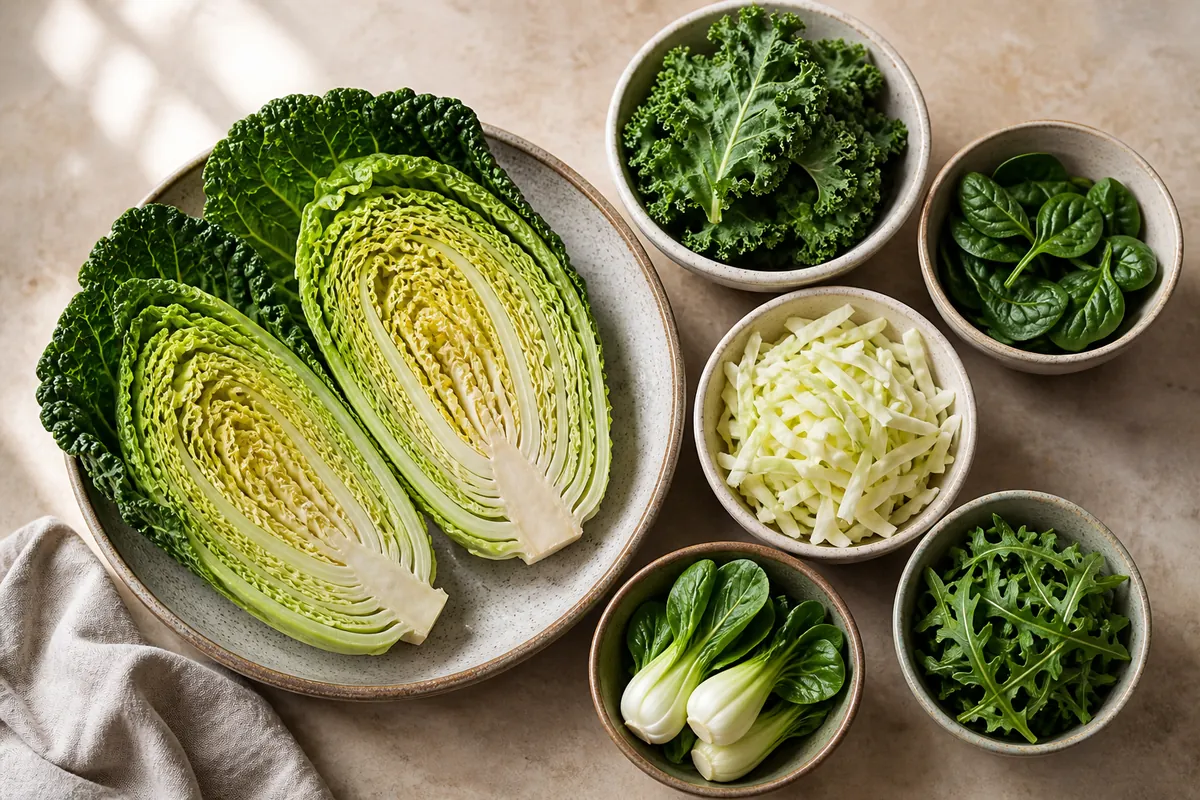
Savoy cabbage is the closest match for hispi's tender leaves and gentle flavor. Napa cabbage works when speed matters most. For structure, use thin-sliced green cabbage. Kale and collard greens cover nutrient-dense swaps. Broccoli works in a pinch for crunch.
5 Best Hispi Cabbage Substitutes Ranked by Texture
Every substitute below fills a different role. Savoy and napa are the closest matches for tender, quick-cooking leaves.
Green cabbage, kale, and collard greens give you more structure. Use the table to spot the right one for your dish, then read the section to know exactly how to prep it.
| # | Substitute | Best For | Ratio | Key Note |
|---|---|---|---|---|
| 1 | Savoy Cabbage | Both | 1:1 | Closest leaf texture |
| 2 | Napa Cabbage | Both | 1:1 | Cut 25% cook time |
| 3 | Green Cabbage | Both | 1:1 | Slice very thin |
| 4 | Kale | Cooked | ¾:1 | Massage before cooking |
| 5 | Collard Greens | Cooked | ¾:1 | Remove thick ribs |
1. Savoy Cabbage
Savoy is the swap that requires the least adjustment. Its leaves are naturally loose and tender, and a crinkled, mild leaf cooks at nearly the same pace as hispi when sliced or shredded.
The flavor is a touch more assertive, but most dishes won't notice.
Use it at a 1:1 ratio. For stir-fries or quick braises, watch the pan after the first 2 minutes because savoy softens fast.
Savoy Cabbage
Works for: stir-fries, quick braises, roasted wedges, stuffed leaf dishes
Skip if: you want a very mild, almost sweet-neutral flavor-savoy can taste more cabbage-forward than hispi
- Ratio: 1:1 by weight or volume
- Slicing: Shred thin or cut into wedges matching your hispi prep
- Cook time: Match hispi timing exactly; check 1 minute early to avoid over-softening
- Best uses: Stir-fries, pan-roasted wedges, quick braises
2. Napa Cabbage
Napa is the easiest tender swap when you're short on time. Its leaves are thinner than hispi's, so the window between "just right" and "mushy" is narrower.
For those exploring best stir-fry leaf options, napa is a natural starting point.
- Ratio: 1:1, but slice thinner than you would hispi
- Cook time: Reduce by about 25%-check texture early and pull from heat while leaves still have a slight bite
- Water content: Napa releases more liquid; drain or pat dry before stir-frying to prevent a watery pan
- Best uses: Stir-fries, quick soups, light braises
- Skip if: your recipe relies on firm crunch-napa softens faster than hispi
3. Green Cabbage
Green cabbage is firmer and denser than hispi, but storing it correctly means you likely have one on hand already. The key to making it work is thin slicing, which brings the cook time and texture much closer to hispi's tender leaves.
- Ratio: 1:1 by volume after slicing
- Cutting: Quarter the head, remove the core, slice crosswise at 3-4mm maximum
- Cook time: Start 2-3 minutes shorter than you'd cook hispi; test frequently
- Flavor note: Slightly more peppery than hispi; a pinch of sugar balances it in braises
- Skip if: you're cooking whole leaves-green cabbage needs far more time than hispi's tender leaf sets
4. Kale
Kale delivers a more earthy, slightly bitter flavor compared to hispi's sweetness. Baby kale or young torn leaves are the better pick here, as mature kale can stay tough even after cooking.
If fresh hardy greens are what you have, baby kale is the version to reach for.
- Ratio: Use ¾ the amount called for, as kale is more intense in flavor
- Soften first: Massage briefly with a pinch of salt, then steam for 1-3 minutes before adding to the dish
- Cook time: Shorter than hispi-1-2 minutes in a hot pan is usually enough after pre-softening
- Balance: A small squeeze of lemon or a drizzle of honey at the end cuts the bitterness
- Skip if: you need the same mild sweetness-kale reads earthy and can turn bitter if undercooked
5. Collard Greens
Collard greens are chewier than hispi, but young, tender leaves narrow the gap considerably. The thick ribs are the main obstacle.
Leave them in and the dish will feel tough; remove them and cut thin ribbons and collards become a workable swap.
Aim for ribbons no wider than 5mm. A short steam before finishing in the pan helps too.
For those weighing tender cabbage-leaf picks, savoy is still gentler, but collards work when that's all you have.
Collard Greens
Works for: pan dishes, quick braises, grain bowls, or anywhere you want leafy volume
Skip if: you don't have time to remove the thick stems-unprepared ribs make the dish chewy
- Ratio: ¾:1 by volume-collards are heartier, so a little less goes further
- Prep: Strip leaves from ribs entirely; stack and slice into thin ribbons
- Cook time: Blanch 1 minute, then finish in the pan for 2-3 minutes over medium-high heat
- Flavor: Earthy and slightly vegetal; a splash of apple cider vinegar brightens the final dish
Making a Hispi Cabbage Substitute Work (Fast Rules)
The single most common mistake with any of these swaps is carrying over the same cook time you'd use for hispi. Hispi is unusually tender, and most substitutes need a different approach to avoid becoming either mush or leather.
A useful habit is to check how long delicate leaves last before you prep, so you're working with the freshest version and not a limp head that cooks even faster than expected.
- Start shorter: Begin 20-30% under your planned cook time, then add 1-2 minute increments only if needed. This applies to every substitute on this list.
- Slice thin consistently: For savoy, green cabbage, and collards, 3-5mm slices are the target. Thick cuts mean uneven cooking and the outer leaves turn soft before the center finishes.
- Finish with acid or a pinch of sweetness: Hispi has a clean, lightly sweet flavor. A small squeeze of lemon or half a teaspoon of honey at the end pulls most substitutes into closer alignment with what the dish expects.
Frequently Asked Questions
Savoy cabbage is the closest match. Use it at a 1:1 ratio, slice to the same thickness as hispi, and check the texture about 1 minute early.
Yes, but slice it to 3-4mm and reduce cook time by 2-3 minutes. Thick slices stay tough; thin ones soften close to hispi's texture.
Reduce by about 25%. Napa softens faster than hispi, so pull it from heat while there's still a slight bite remaining.
Baby kale works in both, but it tastes more earthy and less sweet than hispi. Massage it with salt first and use a ¾:1 ratio.
Add a small squeeze of lemon juice or half a teaspoon of honey at the end of cooking. Both cut sharpness and mimic hispi's clean, mild finish.
5 Best Hispi Cabbage Substitutes for Home Cooks
Ingredients
Equipment
Method
- Match the role: if you need tender leaves with mild sweetness, start with savoy or napa; if you need structure, use thin-sliced green cabbage.
- Convert using the table ratios (e.g., 1:1 for savoy/napa; use ¾:1 for kale/collards/mustard).
- Pre-prep for softness: slice thin for green cabbage, remove thick ribs for collards, and tear/kindly massage kale.
- Adjust cook time: start ~20–30% shorter than your hispi plan, then add 1–2 minutes only if needed.
- Taste-finish: add a small pinch of salt and a splash of acid or sweetness at the end to mimic hispi’s clean, lightly sweet flavor.
Notes
- If your recipe uses whole leaves, choose savoy or napa; for shredded use any thin-sliced swap.
- Most substitutes benefit from cutting smaller than you think—this compensates for texture differences.
Tried this recipe?
Let us know how it was!
Carrie is a food writer and editor with more than 15 years of experience. She has worked for some of the biggest names in the food industry, including Bon Appétit, Food & Wine, and Martha Stewart Living.
As the Editor in Chief of EpicureDelight, Carrie oversees all of the content on the site. She also manages the team of contributing writers and editors, who help to create delicious recipes, helpful tips, and informative articles that you’ll find on the site.
A native of the Chicago area, Carrie is passionate about all things food. She loves trying new restaurants and experimenting with new recipes in her kitchen. She’s also a graduate of the Culinary Institute of America, so she knows a thing or two about food!



