
That sharp, fermented tang kefir brings to pancake batter or a marinade is hard to fake. But a good kefir substitute gets you close, as long as you match the three things kefir actually does: add acidity, supply moisture, and sometimes provide enough thickness to affect texture.
Different recipes need different things from it.
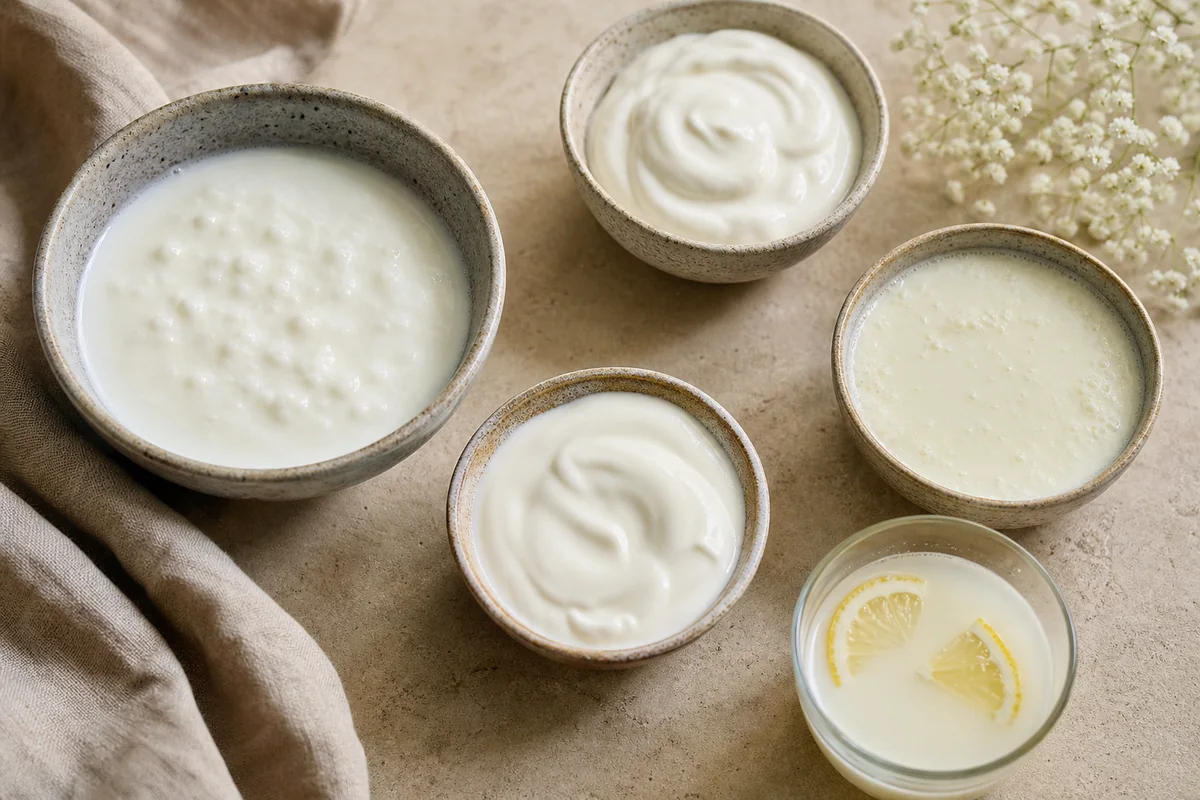
The best kefir swaps match tang, thickness, and baking lift. Buttermilk and thinned Greek yogurt are the closest for baking. Milk plus lemon juice works fast when nothing else is available. Sour cream fits richer batters and sauces. Use a 1:1 ratio for most swaps, then adjust thickness by adding milk one tablespoon at a time.
Best Kefir Substitutes (Quick Swap Table)
Each option below matches one or more of kefir's roles, acidity for lift, moisture for batter, or thickness for body. Scan the table to pick your swap, then read the section for how to apply it correctly.
| # | Substitute | Best For | Ratio | Key Note |
|---|---|---|---|---|
| 1 | Greek Yogurt, thinned | Both | 1:1 | Whisk thin with milk |
| 2 | Buttermilk | Baking | 1:1 | Best for lift + tang |
| 3 | Milk + Lemon Juice | Baking | 1:1 | Acidity only, not body |
| 4 | Plain Yogurt, thinned | Both | 1:1 | Dilute to right pour |
| 5 | Sour Cream, thinned | Cooking | ¾:1 | Richer, reduce slightly |
If your recipe uses leavening alternatives, check whether the acidity level of your swap is strong enough to trigger a full rise. A swap that nails tang but falls short on acid can leave quick breads a little flat.
Kefir keeps longer than you might expect, similar to this thick fermented dairy, but once it's gone, these swaps cover every baking and cooking need.
5 Best Kefir Substitutes Ranked by Role
1. Greek Yogurt, Thinned
Greek yogurt is the closest thing to kefir in flavor profile. It has the same cultured tang and a similar dairy base.
The problem is thickness: full-fat Greek yogurt is spoonable, not pourable. Whisk in whole milk or water, one tablespoon at a time, until it flows like kefir.
This strained, tangy dairy is already acidic enough to react with baking soda, so it works well in pancakes, muffins, and quick breads without any adjustment beyond thinning.
Greek Yogurt (Thinned)
Works for: pancakes, muffins, cakes, marinades, salad dressings
Skip if: you need a true pourable cultured drink-use buttermilk instead
- Ratio: Start 1:1, then add 1-3 tablespoon milk per cup until consistency pours freely
- Tang match: Very close to kefir; full-fat versions taste richest
- Limitation: Low-fat Greek yogurt can turn slightly grainy in hot sauces-use full-fat when cooking over heat
2. Buttermilk
Buttermilk is the go-to for any baking recipe where kefir's acidity does the heavy lifting. It pours like kefir, reacts with baking soda immediately, and produces an even, tender crumb.
The fat content is lower than kefir, so batters may be slightly less rich. Add 1 teaspoon of neutral oil per cup if you want to compensate.
- Baking lift: Reacts with baking soda identically to kefir-no adjustment needed
- Tang level: Slightly milder than kefir but close enough for cakes and breads
- Texture: Thinner than Greek yogurt; if a recipe needs body, this pours too freely for spoonable uses
- Skip if: Your recipe needs a thick, cultured topping or dip-buttermilk won't hold that texture
This tart cultured liquid goes off faster than kefir, so use it within its window once opened.
3. Milk + Lemon Juice
Mix 1 cup of whole milk with 1 tablespoon of lemon juice. Stir, then let it sit for 5 minutes.
The milk curdles slightly and the acid level rises to match kefir's sourness. It is the fastest swap when you have no cultured dairy at all.
This works best in batters where acidity matters more than body. If your recipe needs a thicker pour, reduce the milk by 2 tablespoon and use the rest as-is.
- Best for: Pancakes, waffles, quick bread batters, muffins
- Souring ratio: 1 tablespoon lemon juice per 1 cup milk, always
- Substitute for vinegar: White vinegar works at the same ratio if lemon juice is out-see souring acid options for more detail
- Skip if: You need kefir's cultured dairy body-this swap delivers acidity only, not fermentation texture
4. Plain Yogurt, Thinned
Plain yogurt has kefir's tang without the pour. Whole-milk plain yogurt gives the best flavor match.
The challenge is calibrating thickness for the specific recipe.
| Use | Ratio | Notes |
|---|---|---|
| Pancakes / waffles | ¾ cup yogurt + ¼ cup milk | Thin to pourable; whisk well |
| Muffin / cake batter | 1:1 yogurt, no dilution | Slight extra tang; works well |
| Salad dressings | 1:1 yogurt + 2 tablespoon water | Whisk until smooth before adding oil |
| Marinades | 1:1, no dilution needed | Thickness helps it cling to meat |
- Best uses: Dressings, batters, pancakes, marinades-anywhere kefir is a moisture and tang source
- Caveat: Low-fat yogurt can separate slightly in hot liquid; whisk constantly if adding to a warm sauce
- Skip if: The recipe needs a truly runny pour-through texture-use buttermilk or thinned Greek yogurt instead
5. Sour Cream, Thinned
Sour cream has more fat than kefir and a slightly less sharp tang. It needs thinning before it behaves like kefir in a batter.
Whisk it with milk or water until it reaches a pourable, yogurt-like consistency.
Sour Cream (Thinned)
Works for: rich cakes, muffins, creamy sauces, savory dips, dense quick breads
Skip if: you need maximum acid lift-use buttermilk or milk + lemon juice instead
Understanding dairy fat differences helps here, since sour cream runs higher in fat than kefir and can make a crumb denser if you use too much.
- Ratio: Use ¾ cup sour cream thinned with 2-3 tablespoon milk per 1 cup kefir called for
- Flavor impact: Richer and creamier than kefir-works well in chocolate cake, carrot cake, and savory sauces
- Acidity: Lower than buttermilk; add a squeeze of lemon juice if your recipe needs strong acid activation
- Storage note: Check this tangy dairy's shelf life before using-sour cream can develop off-flavor faster than kefir once opened
Making Your Kefir Substitute Work
Getting a swap right comes down to three levers: tang level (how acidic the substitute is), thickness (how it pours and behaves in batter), and reaction time (how fast it activates baking soda). Nail all three and your recipe won't know the difference.
Miss one and you may get a flat loaf or a curdled sauce.
- Adjust acidity first: If your substitute tastes milder than kefir, stir in 1 teaspoon lemon juice per cup. This matters most in quick breads that rely on baking soda for lift.
- Fix thickness before mixing: Add milk or water in 1-tbsp increments and stir between each addition. Stop when the substitute pours at roughly the same speed as heavy cream.
- Let it rest before baking: After mixing your substitute into the batter, wait 3-5 minutes so the acid can start reacting with any leavener in the recipe. Skipping this step is the most common reason baked goods come out dense.
Frequently Asked Questions
Yes, buttermilk swaps 1:1 for kefir in virtually every baked good. It has similar acidity and reacts with baking soda the same way, so your rise and crumb will be on point.
Buttermilk is the most reliable option for both. Thinned Greek yogurt is a close second and produces a slightly richer result.
Whisk whole milk into full-fat Greek yogurt one tablespoon at a time until it pours freely. Most recipes need 2-4 tablespoons per cup of yogurt.
For baking, yes-the acidity level is similar and it activates leaveners well. For eating or drinking, no-it lacks kefir's cultured flavor and body.
Not directly-sour cream is much thicker and richer than kefir. Thin it with 2-3 tablespoons of milk per cup and use ¾ cup per 1 cup of kefir called for.
5 Best Kefir Substitutes (Tested Swaps)
Ingredients
Equipment
Method
- Decide what you need kefir to do: add tang (acid), add moisture, or provide a thicker cultured texture.
- Use the ratio from the table: start with 1:1 swaps for most yogurt/buttermilk options.
- If the substitute is thicker than kefir, whisk in water or milk a tablespoon at a time until it pours like kefir.
- For baking, let the batter sit 3–5 minutes so the acid can react with baking soda (if your recipe uses it).
- Taste the mixture (especially batters) and adjust sweetness/salt if the tang feels stronger or weaker than kefir.
Notes
- For recipes that rely on kefir’s cultured tang, prioritize buttermilk or yogurt + a souring boost.
- Texture matters: kefir is more pourable than Greek yogurt unless you thin it.
Tried this recipe?
Let us know how it was!
Carrie is a food writer and editor with more than 15 years of experience. She has worked for some of the biggest names in the food industry, including Bon Appétit, Food & Wine, and Martha Stewart Living.
As the Editor in Chief of EpicureDelight, Carrie oversees all of the content on the site. She also manages the team of contributing writers and editors, who help to create delicious recipes, helpful tips, and informative articles that you’ll find on the site.
A native of the Chicago area, Carrie is passionate about all things food. She loves trying new restaurants and experimenting with new recipes in her kitchen. She’s also a graduate of the Culinary Institute of America, so she knows a thing or two about food!



