
That sweet-tangy-spiced character in mango chutney is harder to fake than most people expect. Jam alone gets you the sweetness.
Vinegar alone gets you the tang. But the spice layer, usually ginger and chili and sometimes a trace of cinnamon, is what makes a mango chutney substitute feel complete rather than flat.
The five swaps below cover everything from baking glazes to cheese boards to savory sauces. Each one addresses all three flavor components: fruit sweetness, acid tang, and spice warmth.
Mango chutney is sweet fruit + vinegar tang + warm spice. The best substitutes rebuild all three layers. Apricot jam with lime and ginger is the closest pantry build. Pineapple chutney is the best jar swap for savory dishes. For baking, use mango preserves plus a splash of vinegar.
5 Best Mango Chutney Replacements (Closest Match)
Every substitute below is ranked by how fully it replicates mango chutney's three-part profile. Scan the table first, then read each section for the adjustment details that make the swap actually work.
| # | Substitute | Best For | Ratio | Key Note |
|---|---|---|---|---|
| 1 | Apricot jam + lime + ginger | Both | 1:1 | Add tang and spice manually |
| 2 | Pineapple chutney | Savory | 1:1 | Brighter, sharper than mango |
| 3 | Mango preserves + vinegar | Baking | 1:1 | Add acid or it stays too sweet |
| 4 | Mango salsa (drained) | Both | 1:1 | Drain well, season for spice |
| 5 | Sweet chili sauce + tamarind | Savory | ¾:1 | Thinner and sweeter-use less |
If your dish needs a chunky texture and your substitute is smooth, stir in a few small fruit pieces or use a chunkier jar option before serving.
1. Apricot Jam + Lime + Ginger
This is the best pantry build when you want something that actually mimics chutney's layered flavor. Apricot jam matches mango's stone-fruit sweetness well, and it takes on spice adjustments easily.
For glazes, sandwich spreads, and baked goods, this trio performs nearly as well as the real thing.
- Flavor match: Apricot is the closest non-mango fruit to mango chutney's base sweetness
- Build it: Start with 1 tablespoon apricot jam, add 1 teaspoon fresh lime juice, and stir in ½ teaspoon grated ginger
- Use 1:1 as a direct swap in glazes, marinades, sandwiches, and cheese boards
- Best uses: Baked chicken glaze, grilled pork marinade, brie pairings, scone spreads
- Tang check: If the mix tastes flat, add lime juice in ¼ teaspoon increments until sharp
If you find yourself reaching for apricot jam often, swapping out the apricot base is also worth knowing when your jam jar runs low.
Skip if: You need this to taste mango-forward. Apricot leads here, so the fruit identity is different even if the structure matches.
2. Pineapple Chutney
Pineapple chutney is a jarred swap that keeps the same spiced-fruit structure as mango chutney. The flavor trade is brightness over warmth: pineapple runs a little sharper and more acidic than mango, especially in savory sauces and marinades.
Most grocery stores carry a spiced pineapple version, which gets you closer to mango chutney's warm-spice note without extra steps.
Pineapple Chutney
Works for: savory glazes, grilled meat marinades, curry sauces, wraps
Skip if: you're serving it on a cheese board where mango's mellow sweetness matters
- Ginger boost: Add a pinch of ground ginger if your pineapple chutney tastes flat on spice
- Tang fix: If the chutney is milder than your mango version, stir in ½ teaspoon apple cider vinegar
- Texture note: If the jar is thicker than you need, thin with 1 teaspoon warm water
The spiced fruit tang in mango chutney is what pineapple chutney gets closest to among all jarred alternatives.
Skip if: Your dish depends on mango's tropical sweetness. Pineapple is brighter and slightly sharper, and that gap shows in sweeter applications.
3. Mango Preserves + Vinegar
Mango preserves keep the fruit identity intact, which matters most in baking. They behave like chutney in terms of body and moisture, so a loaf or glaze won't turn out differently textured.
The one thing they can't do alone is provide tang.
Stir in 1 teaspoon white wine vinegar or fresh lemon juice per tablespoon of preserves before using. That acid addition is the difference between a sweet spread and something that reads like chutney.
If a recipe already has lemon or acid in it, reduce the added vinegar to ½ teaspoon to avoid over-souring.
Skip if: You can't add any acid to the recipe. Preserves alone land sweet and one-dimensional compared to chutney.
4. Mango Salsa (Drained)
Fresh or jarred mango salsa gives you bright mango flavor and decent tang without any building required. The main issue is liquid: undrained salsa is too watery to act as a spread or glaze base.
Drain it through a fine sieve for 5 minutes and press gently to remove excess juice before swapping it in.
- Draining method: Fine mesh sieve, 5 minutes, gentle press-discard the liquid
- Best uses: Cheese boards, quick chicken marinades, tacos, grilled fish topping
- Spice adjustment: Add ¼ teaspoon ground ginger or a pinch of chili flakes to mimic chutney's warm spice
- Texture note: Salsa stays chunky-blend briefly if you need a smoother consistency
Skip if: You need a smooth, spreadable texture. Salsa has visible chunks and can bake unevenly in loaves or pastry.
5. Sweet Chili Sauce + Tamarind
Sweet chili sauce is the emergency option when you have nothing else. It's thinner and sweeter than chutney, so use 3 tablespoon where a recipe calls for 4, then correct from there.
Tamarind concentrate adds the sour-fruity depth that chutney has and sweet chili sauce lacks.
Sweet Chili Sauce + Tamarind
Works for: dipping sauces, quick marinades, stir-fry glazes, rice dishes
Skip if: your dish needs chutney's chunky body or warm spice from ginger and cinnamon
- Tang fix: Stir in ½ teaspoon tamarind concentrate or apple cider vinegar per 3 tablespoon of sweet chili sauce
- Ratio start: Use ¾ of the chutney amount called for, then taste before adding more
- Works well for: Glazing roasted cauliflower, dressing a noodle salad, quick dipping sauce for samosas
- Spice gap: Add a small pinch of ground ginger if the mix tastes chili-sweet but not warmly spiced
When storing leftover chutney isn't an option, this two-ingredient backup keeps a savory dish on track without a grocery run.
Skip if: Your recipe depends on warm spice notes like ginger or cinnamon. Sweet chili reads as chili-sweet, not spiced-fruit.
Making Mango Chutney Substitutes Work
The biggest failure mode with any of these swaps is letting sweetness dominate. Choosing a tangy fruit base from the list above gives you a head start, but the acid correction step is what separates a flat-tasting substitute from one that holds up in a real dish.
- Start with the ratio: Use 1:1 for all jam and preserve swaps; drop to ¾:1 for sweet chili sauce, which is already thinner and sweeter than chutney
- Add acid to correct tang: Stir in fresh lemon juice, lime juice, or white wine vinegar in ¼ teaspoon increments until the substitute sharpens and lifts-do this before the substitute goes into the dish
- Fix spice last: Ground ginger is the fastest spice adjustment; add a pinch at a time and taste, then thicken with a small spoon of jam or preserves if the swap is too loose for your application
Frequently Asked Questions
Yes, but add acid. Plain jam swaps 1:1 by volume, but stir in 1 teaspoon of lemon juice or vinegar per tablespoon or it will taste too sweet and one-dimensional.
Too sweet: add acid in ¼ teaspoon increments (lime juice or white wine vinegar). Too sharp: stir in a small amount of honey or extra jam to balance.
Mango preserves mixed with a splash of vinegar or lemon juice work best. They hold moisture and body in loaves and glazes without making the bake too wet.
Yes, for most savory uses. Drain it well first and add a pinch of ginger to restore spice warmth. Avoid it in baked applications where texture consistency matters.
Skip it when your recipe needs warm spice (ginger, cinnamon) or a chunky texture. Sweet chili sauce is smooth and chili-forward, not spiced-fruit like true chutney.
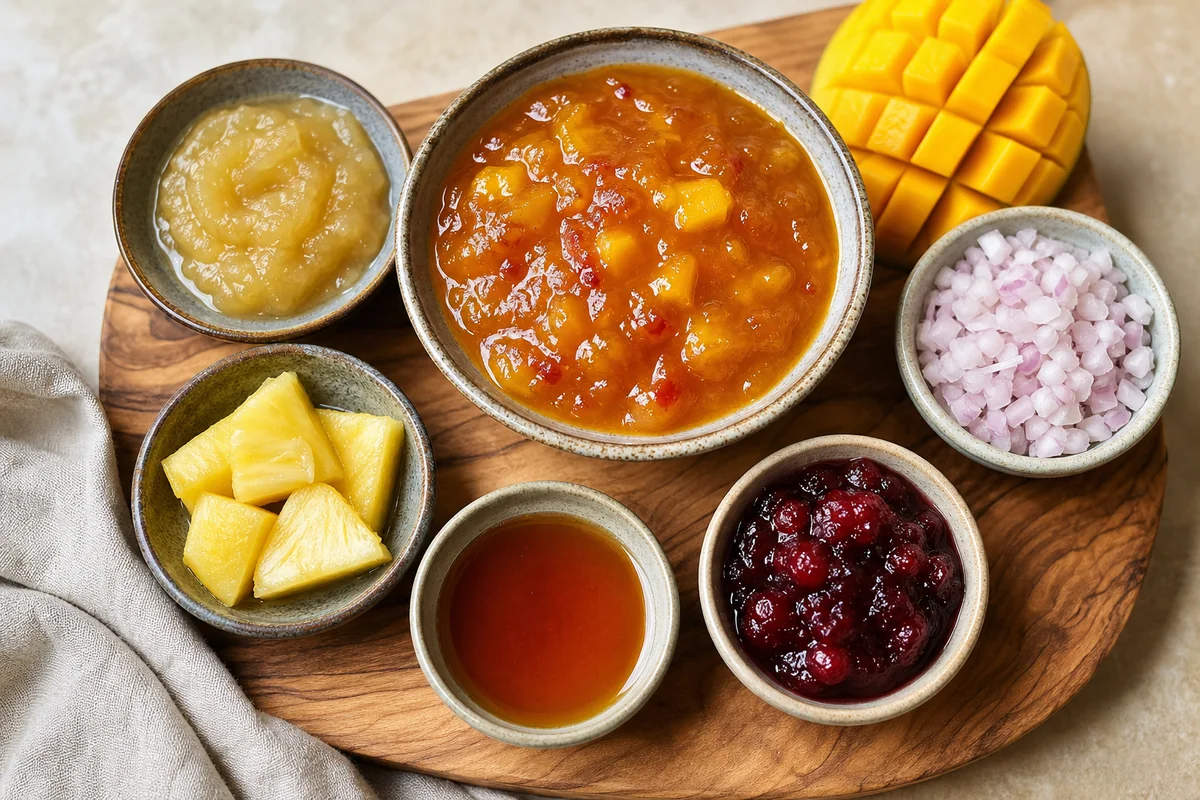
5 Best Mango Chutney Substitutes (Closest Match)
Ingredients
Equipment
Method
- Identify your dish: marinade/sauce, glaze, sandwich/cheese board, or baking (cakes/biscuits/loaves).
- Pick the substitute that matches the role: jam-preserve for baking texture, chutney for flavor, salsa/chili sauce for quick savory tang.
- Use the listed ratio; for jams/preserves, stir in lime/lemon or vinegar to recreate chutney’s tang.
- Adjust spice last: add grated ginger, a pinch of chili, or a small amount of curry powder if your original chutney was strongly spiced.
- Taste-test before committing: it should read sweet + tangy + warm; if flat, add acid (citrus/vinegar) by small increments.
Notes
- If the substitute is watery (salsa), drain 5–10 minutes before using.
- If the substitute is too sweet, boost tang with lime/lemon or vinegar rather than adding more salt/spice.
Tried this recipe?
Let us know how it was!
Carrie is a food writer and editor with more than 15 years of experience. She has worked for some of the biggest names in the food industry, including Bon Appétit, Food & Wine, and Martha Stewart Living.
As the Editor in Chief of EpicureDelight, Carrie oversees all of the content on the site. She also manages the team of contributing writers and editors, who help to create delicious recipes, helpful tips, and informative articles that you’ll find on the site.
A native of the Chicago area, Carrie is passionate about all things food. She loves trying new restaurants and experimenting with new recipes in her kitchen. She’s also a graduate of the Culinary Institute of America, so she knows a thing or two about food!



