
Stewed tomatoes do three things at once: they add body, a mild sweetness from brief cooking, and enough acidity to balance a long braise. Swapping them out without thinking costs you one of those three.
The right stewed tomatoes substitute depends on what your recipe actually leans on.
If the dish needs visible chunks, go diced. If it needs smooth, glossy thickness, go crushed or passata.
Acidity matters too. Some substitutes are sharper, some are flat.
A small pinch of sugar or a short simmer often fixes both.
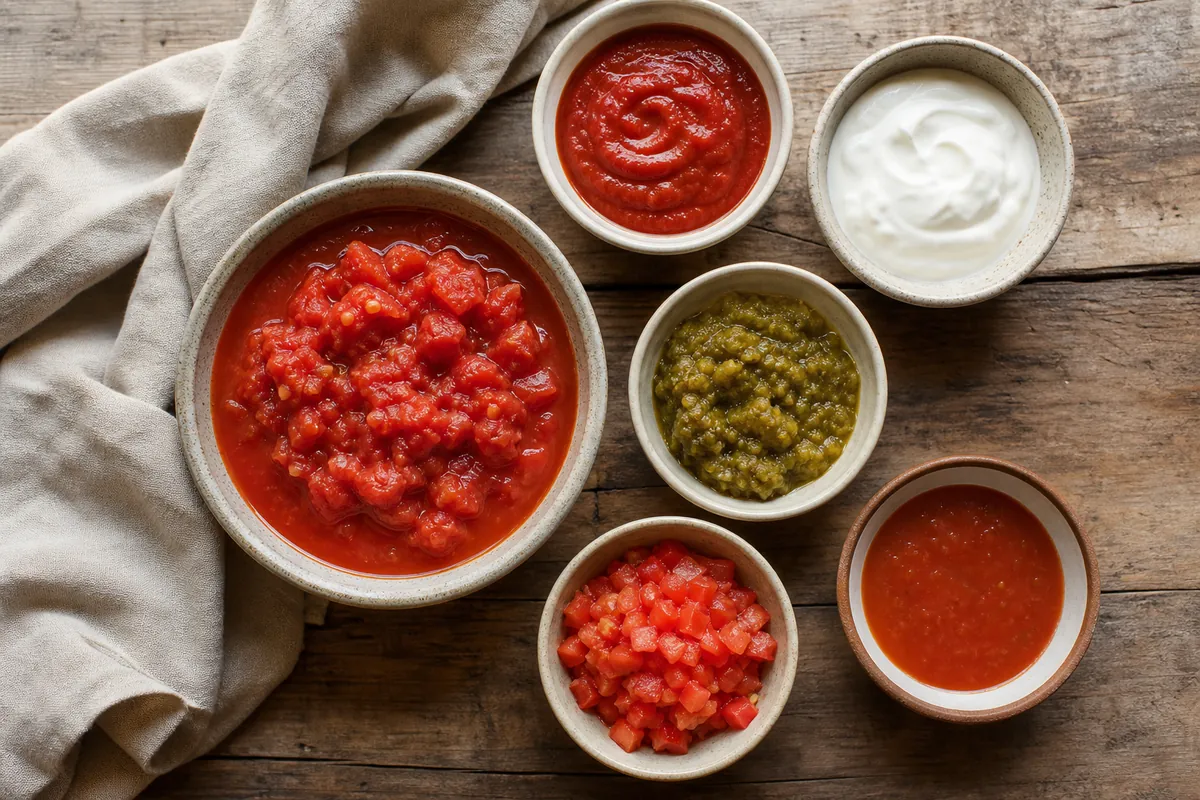
Stewed tomatoes add body, mild sweetness, and soft chunkiness to braises and sauces. For the closest swap, use crushed tomatoes simmered 5-10 minutes. For chunk-dependent dishes, use canned diced tomatoes. For smooth sauces, tomato sauce or passata works well. In an emergency, tomato paste whisked with water gives stewed-style thickness fast.
5 Best Stewed Tomatoes Substitutes Ranked by Texture
There's no single right answer here. The table below maps each swap to its texture and the ratio you need.
Pull from it as you read each section.
| # | Substitute | Best For | Ratio | Key Note |
|---|---|---|---|---|
| 1 | Crushed Tomatoes | Both | 1:1 | Simmer 5-10 min to thicken |
| 2 | Canned Diced Tomatoes | Chunky | 1:1 | Drain excess liquid first |
| 3 | Tomato Sauce | Smooth | 1:1 | Reduce 8-15 min for body |
| 4 | Passata | Smooth | 1:1 | Simmer 6-12 min to concentrate |
| 5 | Tomato Paste + Water | Both | 1:3 | Whisk well, season after |
1. Crushed Tomatoes
Crushed tomatoes are the closest pantry match for stewed tomatoes in most cooked dishes. The texture is semi-smooth with small soft pieces, which is near enough to stewed that most recipes won't show the difference.
They work well in chili, pasta sauces, and braised meats. The mildly cooked base of stewed tomatoes is easy to replicate by adding a pinch of sugar and reducing briefly.
- Thickness fix: Simmer uncovered 5-10 minutes, stirring every 2 minutes
- Acidity fix: Add a pinch of sugar if the tomatoes taste sharp after reducing
- Ratio: Use 1:1 with no adjustment needed beyond simmering
Skip if: Your recipe needs visible tomato chunks. Crushed tomatoes are smoother than stewed and won't give you that.
2. Canned Diced Tomatoes
When the recipe depends on tomato pieces, diced tomatoes are the answer. They hold their shape through long braises and stay chunky in baked pasta or stews where mouthfeel matters.
The one catch is liquid. Canned diced tomatoes sit in juice, which can thin a sauce if you pour the whole can in.
- Drain first: Pour off about 2-3 tablespoon of the liquid before adding to the pan
- Simmer step: Cook 8-10 minutes so the tomatoes soften toward stewed texture
- Partial blend: For a half-chunky result, blend ⅓ of the can and stir it back in
- Seasoning: Diced tomatoes are often less seasoned, so taste and add salt early
If you want to know more about swapping tomato bases in cooked dishes, that page covers a wider set of options.
Skip if: You want a smooth, pourable sauce. Diced tomatoes will always leave pieces behind.
3. Tomato Sauce
Tomato sauce is fully smooth, which means you lose the chunk factor entirely. That's fine for casseroles, shakshuka, or soups where texture comes from other ingredients.
Tomato Sauce vs Stewed Tomatoes
Works for: smooth braises, baked dishes, soups where chunkiness isn't the point
Skip if: your recipe relies on tomato pieces for mouthfeel or visual texture
The bigger issue is body. Tomato sauce is thinner than stewed tomatoes out of the can, so you need to reduce it.
- Reduce time: Simmer uncovered 8-15 minutes, stirring to prevent scorching on the bottom
- Flavor boost: Add a pinch of dried oregano or garlic powder while simmering if the sauce tastes flat
- Ratio: Start at 1:1, then reduce to concentration you want
Before storing leftover sauce, let it cool fully and transfer to an airtight container. It holds 4-5 days in the fridge.
4. Passata (Tomato Purée)
Passata is strained, uncooked tomato purée with nothing added. It's smooth, consistent, and faster to work with than most other swaps.
Because it's uncooked, it can taste slightly sharp or bright until it gets some heat. A short simmer fixes that.
- Simmer time: Cook passata 6-12 minutes over medium heat, stirring every few minutes
- Sweetness balance: If the flavor is still sharp after simmering, add a small pinch of sugar and taste again
- Thickness: Reduce by about 10-15% of the volume for stewed-tomato body
- Ratio: Use 1:1, adjusting down slightly if the recipe is already liquid-heavy
The passata vs paste comparison is worth reading if you're deciding between the two for a dish that needs concentrated flavor.
Skip if: Your recipe needs tomato chunks or a textured bite. Passata stays fully smooth no matter how long you simmer it.
5. Tomato Paste + Water
Tomato paste is dense and intensely flavored. Used straight, it overpowers.
Loosened with water, it turns into a stewed-style sauce that works surprisingly well in quick weeknight cooking.
The ratio matters. Too little water and it's thick paste.
Too much and you lose the body stewed tomatoes give you.
| Use | Ratio | Notes |
|---|---|---|
| Sauce or braise | 1 part paste : 3 parts water | Whisk until smooth, then simmer 5-8 min |
| Baked casserole | 1 part paste : 2.5 parts water | Slightly thicker holds better under heat |
| Chili or stew | 1 part paste : 3.5 parts water | Looser base absorbs other liquid as it cooks |
- Whisk first: Combine paste and water in a bowl before adding to the pan so it blends evenly
- Simmer 5-8 minutes: This mellows the raw paste flavor and tightens the texture
- Salt after simmering: Paste masks seasoning until it fully hydrates, so taste at the end
If you're storing open tomato paste, transfer it to a small airtight container and refrigerate. It stays good for about a week.
Skip if: You need tomato chunks in the final dish. Paste diluted with water is smooth sauce only.
Making Any Stewed-Tomatoes Substitute Work
The method is the same regardless of which swap you choose: match texture first, then fix seasoning. If the substitute is thin, reduce it.
If it's too thick, add water or broth a tablespoon at a time. Knowing paste-based swap options also helps when your pantry is down to concentrated forms only.
- Simmer timing: Most substitutes need 5-15 minutes uncovered to reach stewed-tomato thickness; don't skip this step
- Loosening: Add water or broth in 1 tablespoon increments if the substitute reduces too far
- Taste checkpoint: After simmering, check salt first, then acidity; a pinch of sugar corrects sharpness, a drop of vinegar corrects flatness
Frequently Asked Questions
You can, but the result will be thinner and taste less concentrated. A 5-minute simmer makes the swap nearly identical in flavor and body.
Canned diced tomatoes are the closest match. Drain off 2-3 tablespoon of liquid, then simmer briefly to soften the pieces toward stewed texture.
No. Paste is far too concentrated at 1:1 and will overpower the dish. Whisk 1 part paste into 3 parts water, then simmer before using.
Taste after simmering. Add a small pinch of sugar to reduce sharpness or a drop of vinegar to brighten a flat-tasting substitute.
They can. Thinner substitutes add more moisture, so reduce them first. Let any substitute cool 5 minutes before adding it to a baked dish.
5 Best Stewed Tomatoes Substitutes That Taste Right
Ingredients
Equipment
Method
- Match the texture you need: chunky (use diced) or smooth (use crushed/sauce/passata).
- Use the listed ratio, then simmer 5-10 minutes to concentrate and approach stewed thickness.
- If the substitute is thinner than stewed tomatoes, reduce; if it’s too thick, loosen with water/broth.
- Taste and adjust acidity and salt: add a small pinch of sugar if too sharp, or salt if under-seasoned.
- Use immediately for sauces and braises; for baking, let it cool 5 minutes to prevent excess moisture.
Notes
- Thickening comes from reduction (simmer) more than the tomato product alone.
- If your dish relies on stewed tomato chunks, prioritize diced tomatoes or chopped fresh tomatoes.
Tried this recipe?
Let us know how it was!
Carrie is a food writer and editor with more than 15 years of experience. She has worked for some of the biggest names in the food industry, including Bon Appétit, Food & Wine, and Martha Stewart Living.
As the Editor in Chief of EpicureDelight, Carrie oversees all of the content on the site. She also manages the team of contributing writers and editors, who help to create delicious recipes, helpful tips, and informative articles that you’ll find on the site.
A native of the Chicago area, Carrie is passionate about all things food. She loves trying new restaurants and experimenting with new recipes in her kitchen. She’s also a graduate of the Culinary Institute of America, so she knows a thing or two about food!



