
That tiny can of tomato paste does a lot of heavy lifting. It adds thickness, deep umami, and a concentrated tomato base that thinner products just can't match straight from the pantry shelf.
The right tomato paste substitute depends on what you actually need it for. Thickness matters most in braises and stews.
Concentrated flavor matters more in pizza sauces and quick weeknight pasta.
This guide covers 5 reliable swaps with exact ratios. Every option below also notes when to skip it, so you're not guessing mid-recipe.
The best tomato paste substitute is reduced tomato puree at a 1:1 ratio after simmering 5-8 minutes. For speed, use a thick tomato sauce at 1:1. For emergencies, ketchup works at half the amount. Match your swap to what your dish needs most: thickness, umami, or color.
5 Best Tomato Paste Substitutes Ranked by Use
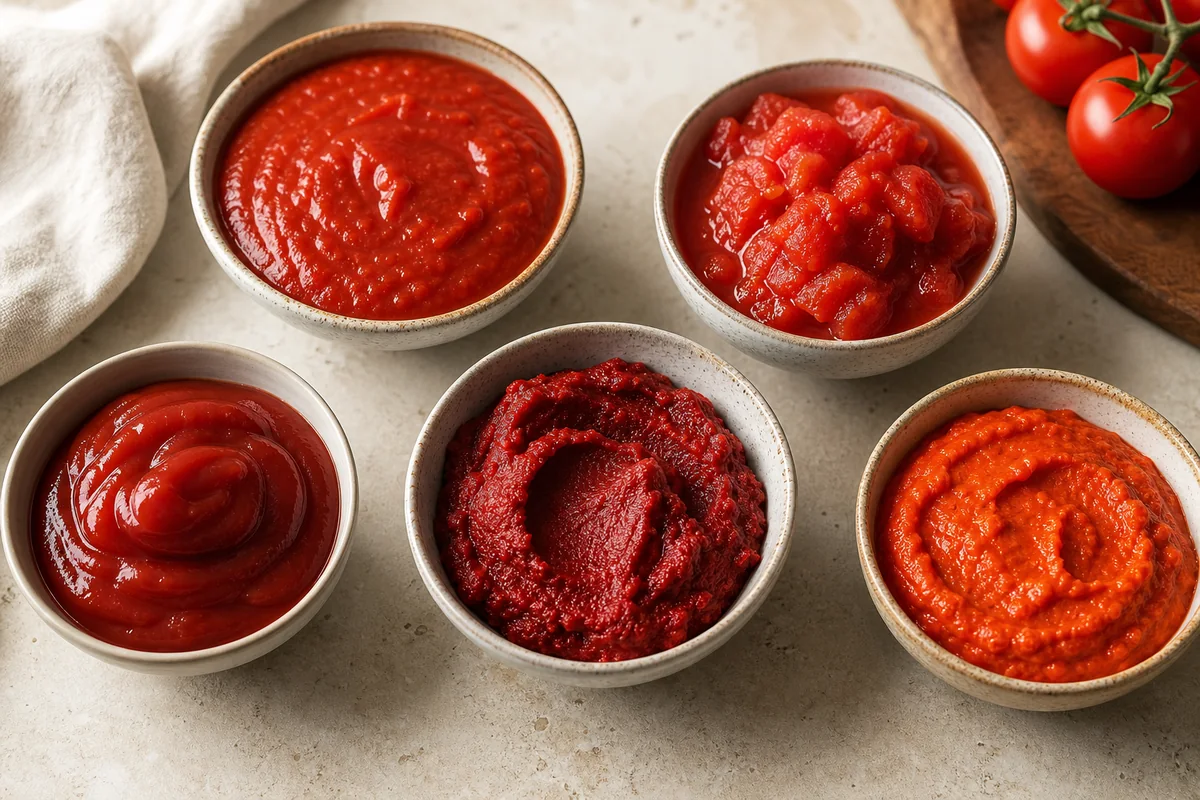
Here's a quick scan of all five options before we get into the details.
| # | Substitute | Best For | Ratio | Key Note |
|---|---|---|---|---|
| 1 | Reduced Tomato Puree | Both | 1:1 | Simmer 5-8 min first |
| 2 | Thick Tomato Sauce | Both | 1:1 | Must coat a spoon |
| 3 | Crushed Tomatoes | Cooking | 2:1 | Reduce 10-15 min |
| 4 | Tomato Sauce (thin) | Cooking | 2:1 | Simmer until thick |
| 5 | Ketchup | Emergency | 1:2 | Sweet; cut salt/sugar |
1. Reduced Tomato Puree
Tomato puree is basically tomato paste before it was cooked down. Simmer it for 5-8 minutes in a wide pan, and it thickens into something that behaves almost identically to paste.
The key step is cooking it in a little oil for 30-60 seconds after it thickens. That quick sauté deepens the flavor the same way a proper paste sauté would.
If you're also working with swapping out puree elsewhere in your recipe, keep those reductions separate so you can control each one.
- Target texture: Stir until it coats the back of a spoon and pulls away from the pan edges slightly.
- Ratio: Use 1:1 once reduced. Before reducing, start with about 1.5x the amount called for.
- Pan choice: A wide skillet reduces faster than a small saucepan. Stir every 2 minutes to prevent scorching.
- Flavor boost: A pinch of salt and a small smear of tomato paste (if you have even a little left) will amplify depth.
Skip if: you need a no-cook swap or are short on stove time.
2. Thick Tomato Sauce
A good thick marinara is already halfway to paste. If the sauce coats a spoon cleanly before you even heat it, you're almost there.
This is the fastest ready-to-use option when you don't want to wait for reduction. Many store-bought jarred sauces are thick enough to use as a direct swap in slow braises or soups.
If you're curious about storing opened sauce before your next cook, that's worth checking too.
- Spoon test: Drag a spoon through the cold sauce. If it holds a clear line, it's thick enough for 1:1.
- Slightly thin sauce: Use 1.25x the amount and simmer 3-5 minutes to concentrate before building your dish.
- Seasoning check: Jarred sauces often contain salt and herbs. Taste before adding your own seasonings.
- Best uses: Braises, slow-cooked meat sauces, shakshuka base, and baked pasta.
Skip if: the sauce is clearly loose and watery after stirring. Reduce it first.
3. Crushed Tomatoes
Crushed tomatoes have more texture and water than paste, so there's a tradeoff between smoothness and convenience. They work well once reduced, but you need 10-15 minutes and some patience.
Simmer over medium heat in a wide pan, stirring often. If your recipe calls for our top braised steak pick, crushed tomatoes are actually a natural fit there since some texture adds body to the sauce.
No Strain (Rustic)
Works for: chunky meat sauces, braises, and stews where texture is welcome
Skip if: your recipe needs a completely smooth base or a fine sauce texture
Strain After Reducing
Works for: pizza bases, smooth soups, and dishes where paste-like smoothness is required
Skip if: you're short on time or don't want to clean extra equipment
- Ratio: Start with 2:1 (twice the crushed tomatoes vs the paste amount), then reduce down.
- Simmer time: 10-15 minutes at medium heat, stirring every 2-3 minutes.
- Straining: Push through a fine mesh strainer after reducing if you need paste-level smoothness.
Skip if: you need a smooth sauce and can't strain.
4. Tomato Sauce (Thin)
Plain canned tomato sauce is thinner than any of the options above. That's the main issue.
But it's also the most common pantry item, so it's worth knowing how to use it well.
The fix is straightforward: simmer it down before you build your dish. Use a 2:1 ratio to start, expecting it to lose roughly half its volume.
The flavor profile of thin canned sauce is milder, so check the mild, bright profile against what your dish needs before relying on it for deep umami.
- Starting ratio: Use 2 tablespoons of sauce for every 1 tablespoon of paste the recipe calls for.
- Simmer time: 8-12 minutes depending on pan width. A 10-inch skillet is faster than a 2-quart saucepan.
- Stir frequently: Thin sauce scorches faster than puree once it starts to concentrate.
- Taste after reducing: Add a small pinch of salt and taste for acidity before adding other seasoning.
Skip if: you have fewer than 10 minutes. Use reduced puree instead.
5. Ketchup
Ketchup is the emergency option. It has the right color and a tomato base, but it also comes with sugar, vinegar, and pre-mixed seasoning.
That's a lot of extra variables in a recipe.
Use it only when you have no other tomato product on hand. It works better in sauces that already have some sweetness tolerance, like a bolognese or a stew with roasted vegetables.
If you're working through a decision on instead of tomato paste options, choosing a tomato sauce swap is usually a better first move than reaching for ketchup.
When Ketchup Works
Works for: bolognese, meatloaf glaze, bean stews, and quick weeknight pasta where a slight tang is fine
Skip if: the dish is already sweet, or you need a clean, unseasoned tomato base
- Ratio: 1 tablespoon of ketchup for every 2 tablespoons of paste called for (it's sweeter and more acidic).
- Sauté first: Cook ketchup in a teaspoon of oil for 20-30 seconds to mellow the sharp vinegar note.
- Seasoning watch: Hold salt until after adding ketchup. Taste before you add any sugar at all.
- Vinegar correction: A tiny pinch of baking soda neutralizes excess acidity if the dish tastes too sharp.
Skip if: the recipe is already sweet or needs a pure, unspiced tomato flavor.
Making Tomato Paste Substitutes Work in Any Recipe
The one rule that applies across every swap: cook the substitute in oil before adding liquid. That 30-60 seconds of sauté removes raw or tinny notes and starts building the same caramelized base that paste creates naturally. When storing leftover paste isn't an option because you're completely out, this step matters even more with a substitute.
- Thicken first: If your substitute is watery, simmer until it coats a spoon before adding broth, wine, or other liquids.
- Balance after the swap: Taste and adjust. A flat-tasting sauce usually needs a pinch of salt. A harsh one may need a pinch of sugar.
- Add early: Paste is used as a base, not a finishing sauce. Add your substitute at the same recipe stage, not at the end.
Frequently Asked Questions
No. Thin tomato sauce is too watery for a direct swap. Simmer it down for 8-12 minutes first, starting with twice the amount the recipe calls for.
Reduced tomato puree is the closest match for pizza. It gives a smooth, concentrated base without added seasoning that could clash with your other toppings.
Simmer crushed tomatoes in a wide pan for 10-15 minutes, stirring often. Strain after reducing if you want a smoother, more paste-like texture.
Yes, in emergencies. Use half the amount, sauté it in oil first, and hold back on added salt and sugar since ketchup already contains both.
Yes. Too much watery substitute dilutes seasoning and thins your sauce. Always reduce before adding, then taste and correct salt and acidity at the end.
5 Best Tomato Paste Substitutes (That Actually Work)
Ingredients
Equipment
Method
- Identify your goal: thickening, deep tomato umami, or color/tang for the finished dish.
- Start with the ratio from the WPRM table, then adjust after 1–2 minutes of cooking in the pan.
- If the substitute is watery (sauce/crushed tomatoes), simmer until it coats a spoon before adding spices.
- Taste and correct balance: add a pinch of salt/umami boost if the swap tastes flat, or a tiny pinch of sugar only if it tastes overly sharp.
- For recipes that require a paste-like “base,” cook the substitute in oil 30–60 seconds to caramelize slightly.
Notes
- If your substitute contains more sugar (like ketchup), use less and taste early.
- For smooth sauces, strain crushed tomatoes after simmering down—or choose puree/paste-like options.
Tried this recipe?
Let us know how it was!
Carrie is a food writer and editor with more than 15 years of experience. She has worked for some of the biggest names in the food industry, including Bon Appétit, Food & Wine, and Martha Stewart Living.
As the Editor in Chief of EpicureDelight, Carrie oversees all of the content on the site. She also manages the team of contributing writers and editors, who help to create delicious recipes, helpful tips, and informative articles that you’ll find on the site.
A native of the Chicago area, Carrie is passionate about all things food. She loves trying new restaurants and experimenting with new recipes in her kitchen. She’s also a graduate of the Culinary Institute of America, so she knows a thing or two about food!



