Blue cheese has a moldy tang and crumbly creaminess that come from Penicillium roqueforti cultures aged into the paste over 2-6 months.
That combination of sharp aroma, high salt (commonly 2.0-3.5% by weight), and soft-but-crumbly body makes it genuinely hard to replace with a single swap.
No substitute nails every quality at once. By the end of this article, you'll know which cheese to reach for based on your cooking application, the exact ratio to use, and which adjustments keep the final dish on track.
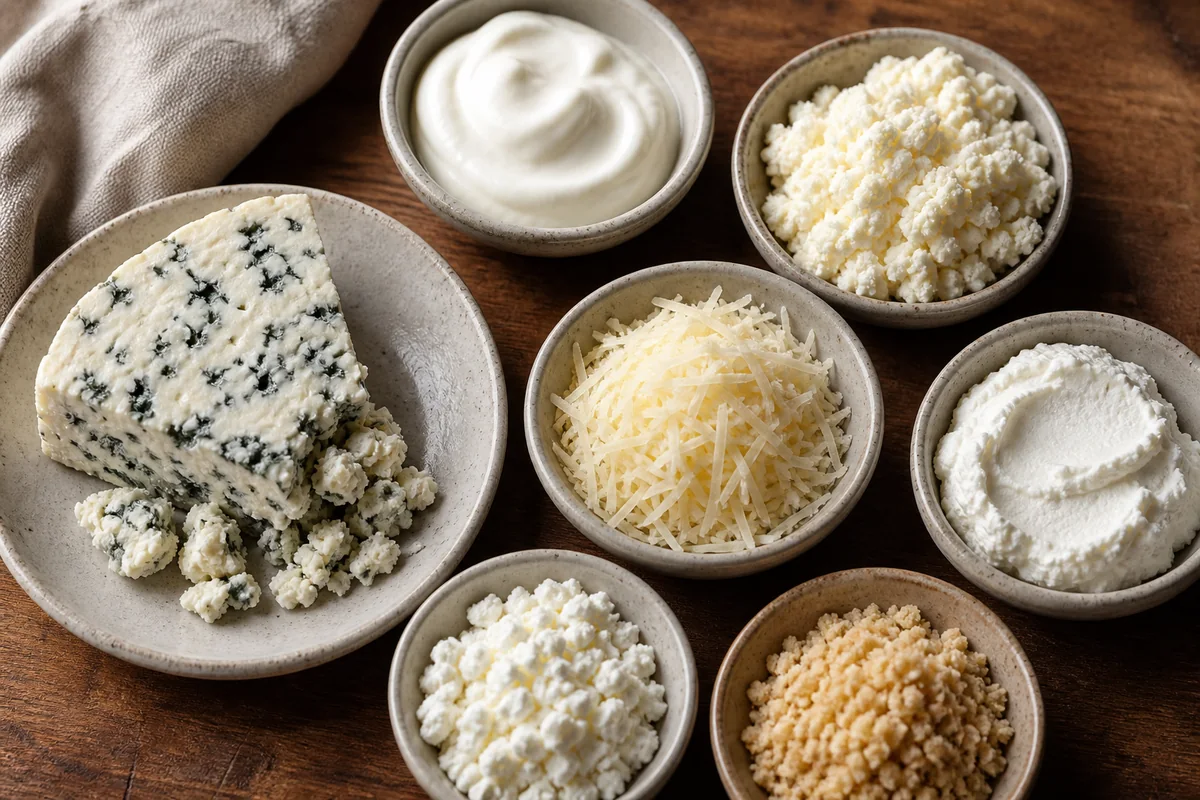
Gorgonzola dolce is the closest match to blue cheese and works at a 1:1 ratio in dressings, salads, and most cooked dishes. For bold baking, use Roquefort at ¾-1:1. For a mild creamy swap, blend 1 cup cream cheese with 2-3 tablespoon Greek yogurt per cup of blue.
5 Best Substitutes for Blue Cheese to Try
Here are five practical swaps ranked from closest to most different.
| # | Substitute | Best For | Ratio | Key Note |
|---|---|---|---|---|
| 1 | Gorgonzola (dolce or piccante) | ✨ Both | 1:1 | Milder, melts readily |
| 2 | Roquefort | 🍳 Cooking | ¾-1:1 | Saltier, bold in heat |
| 3 | Aged Goat Cheese (chèvre) | 🥗 Raw | 1:1 | Tangy, less mold funk |
| 4 | Feta (sheep or blend) | ✨ Both | ¾-1:1 | Briny, pat dry first |
| 5 | Cream Cheese + Greek Yogurt | 🥗 Raw | See notes | Mild, built from scratch |
Common Mistakes When Swapping Blue Cheese
Most swaps go wrong at the salt or texture stage, not the flavor stage. Avoiding a few specific errors keeps your dish where it needs to be.
- Using a soft cheese without adjusting salt: Mild cheeses like cream cheese have far less sodium. Add ¼-½ teaspoon salt per cup to close that gap.
- Expecting blue flavor after full baking: Delicate blue notes burn off in the oven. Fold your substitute in at the very end, or choose Roquefort for its heat-stable sharpness.
- Skipping the pat-dry step with brined cheeses: Wet feta releases brine into batters and doughs. Pat dry thoroughly and toss in a little flour before folding in.
- Over-salting when using Roquefort: Its salt content often runs above 3% by weight. Reduce any added recipe salt by ¼ teaspoon per ½ cup of Roquefort used.
- Using cream cheese straight from the fridge: Cold cream cheese is too dense to crumble. Let it firm up after blending with yogurt, not before.
1 - Gorgonzola (Dolce or Piccante)
Gorgonzola is the closest relative to standard blue cheese. Dolce ages about 2 months for a creamy, mild paste; piccante ages 3-4 months for a firmer, sharper bite closer to aged blue. If you want to understand how blue cheese tastes relative to its substitutes, Gorgonzola is the natural starting point.
Use it at a 1:1 ratio across dressings, salads, and melted applications.
Its moisture content of roughly 40-48% means it melts more readily than most blue cheeses, which is an advantage in sauces but can make it a touch runnier in crumble applications.
- Ratio: 1:1 in all applications - no adjustment needed for most recipes.
- Best use: Cold salads, warm pasta sauces, and dressings where creamy texture matters most.
- Flavor gap: Dolce is noticeably milder; piccante gets closer to sharp blue tang.
- Melting: Higher moisture means faster, smoother melt than traditional blue cheese.
Gorgonzola vs. Blue Cheese
Works for: dressings, salads, pasta sauces, melted toppings, most 1:1 swaps
Skip if: you need the sharp moldy aroma of aged blue or a firm crumble that holds in heat
2 - Roquefort
Roquefort is not a milder option. It ages 3-5 months and carries a salt content commonly above 3% by weight, making it perceptibly sharper and saltier than most commercial blue cheeses. That intensity is exactly what makes it useful in baking, where lower-flavor cheeses fade under heat.
Use ¾ cup of Roquefort per 1 cup of blue cheese to avoid over-salting the dish. Fold it in late during baking rather than mixing it into the batter from the start.
- Ratio: ¾ cup per 1 cup blue cheese - reduce to manage salt load.
- Best use: Hot baked dishes, stuffed proteins, and sauces where bold flavor needs to survive the oven.
- Salt adjustment: Cut added recipe salt by ¼ teaspoon per ½ cup Roquefort used.
- Fold timing: Add at the end of cooking to preserve sharpness; early exposure dulls its edge.
If you ever need to go the other direction, working without Roquefort requires a different set of swaps.
3 - Aged Goat Cheese (Firm Chèvre)
Aged chèvre is dried and firmed over 1-3 months, which gives it a crumbly texture similar to blue cheese without any moldy aroma. Understanding what goat cheese brings to a dish helps you set expectations: its tang is bright and lactic, not funky.
Use it at a 1:1 ratio, but add ½ teaspoon lemon juice or 1 teaspoon cultured yogurt per cup to push the tang toward blue's sharpness. Its salt content runs lower, around 1.0-1.7% by weight, so season up if needed.
- Ratio: 1:1, with ½ teaspoon lemon juice per cup to amplify tang.
- Best use: Cold salads, crostini spreads, and cheese boards where texture matters more than mold aroma.
- Salt note: At 1.0-1.7% salt, it needs a small boost - add a pinch per cup.
- Texture: Firm and crumbly when aged; holds its shape better than Gorgonzola dolce in salads.
If you're working without goat cheese entirely, the next options below fill a similar cold-use role.
Aged Goat Cheese vs. Blue Cheese
Works for: salads, cold appetizers, crostini, spreadable applications with acid added
Skip if: you need moldy aroma, brine character, or a cheese that melts into a sauce
4 - Feta (Sheep or Sheep-Goat Blend)
Feta brings a crumbly, salty, brined profile that works surprisingly well in salads and certain baked dishes. Fresh feta has a moisture content of 56-65%, so brine management is the key step before using it as a blue cheese swap.
At 1:1 for salads, feta crumbles cleanly and holds its shape. For baking, drop to ¾ cup feta per 1 cup blue to reduce the brine impact on the dish.
Pairing it with lemon or honey helps compensate for the missing mold aroma.
- Ratio: 1:1 in salads; ¾:1 in baked dishes to reduce brine.
- Prep step: Pat dry and toss in a small amount of flour before folding into doughs or batters.
- Flavor bridge: Add ½ teaspoon lemon juice or a drizzle of honey to approach blue's complex finish.
- Salt level: Brined salt runs 2.5-3.5%, comparable to blue cheese - taste before adding more salt.
Skip if: your recipe depends on the melting behavior of blue cheese. Feta resists melting and stays crumbly under heat.
By Cooking Application
Here's a quick reference showing which substitute works best by use case.
| Use | Ratio | Notes |
|---|---|---|
| Baking | ¾-1:1 | Roquefort or feta; reduce added salt, fold in at the end |
| Dressing / Salad | 1:1 | Gorgonzola or aged chèvre; crumble cold, add lemon for tang |
| Spread / Soft | 1 cup cream cheese + 2-3 tablespoon yogurt per 1 cup blue | Milder flavor; chill 30 minutes before serving |
5 - Cream Cheese + Greek Yogurt Blend
This constructed substitute gives you the creamy body of blue cheese without any of the mold character.
Combine 1 cup full-fat cream cheese with 2-3 tablespoon Greek yogurt to replace 1 cup of blue cheese in dips, spreads, and mild dressings.
For context on how Greek yogurt compares in tang and acidity, the cultured sharpness is what does the work here.
Chill the blend for 30 minutes before use. To push the savory depth closer to blue cheese, stir in 1 teaspoon umami paste or ½ teaspoon fish sauce per cup.
- Ratio: 1 cup cream cheese + 2-3 tablespoon Greek yogurt replaces 1 cup blue cheese.
- Chill time: 30 minutes in the fridge firms the texture for crumbling or spreading.
- Depth boost: Add 1 teaspoon umami paste or ½ teaspoon fish sauce per cup for savory complexity.
- Best use: Dips, spreads, mild dressings - not for dishes that need visible crumble or mold aroma.
If you run short on components, working without Greek yogurt or needing a cream cheese alternative each have their own swap paths.
Flavor and Texture Differences at a Glance
Each substitute lands in a different spot relative to blue cheese's sharp, fungal, salty profile. Here's how they compare on the metrics that matter most in cooking.
Gorgonzola (moisture ~40-48%, aged 2-4 months) is the closest match. It melts smoothly, carries real blue tang, and lacks only the most aggressive moldy aroma of older blues.
Roquefort (salt >3%, aged 3-5 months) is actually more intense than standard blue cheese. It holds its sharpness through heat better than any other swap on this list.
Aged chèvre (salt ~1.0-1.7%, aged 1-3 months) has bright lactic tang but zero mold aroma. It resists melting, which makes it a strong cold-use option.
Feta (moisture 56-65%, salt 2.5-3.5%) sits close to blue cheese on salt but has no moldy character and holds firm rather than melting. Pair with acid to compensate.
Cream cheese + yogurt blend has the mildest profile of all five. No mold aroma, lower salt, and a smooth texture that won't crumble without chilling. It's the right pick when blue flavor is a background note, not the star.
Frequently Asked Questions
Use Roquefort at ¾ cup per 1 cup blue cheese and fold it in during the last 5 minutes of baking rather than mixing it in from the start. Reduce any added salt in the recipe by ¼ teaspoon per ½ cup of Roquefort to stay within a reasonable salt range.
Crumble feta, drain as much brine as possible, and add ½ teaspoon white miso and 1 teaspoon lemon juice per cup to sharpen and deepen the flavor. The miso adds savory funk that partially replaces blue's mold character in the dressing base.
Temper the cheese into the sauce gradually over low heat and keep the temperature below 180°F. Boiling causes proteins to seize and fat to separate, regardless of which substitute you use.
Cashew-based blue-style cheeses, available from specialty vegan producers, use added cultures and sometimes activated charcoal or blue spirulina for color. For a home shortcut, blend soaked cashews with 1 teaspoon white miso, 1 teaspoon lemon juice, and a pinch of nutritional yeast per half cup to approximate the tangy-salty profile.
Store the blend in an airtight container in the refrigerator and use within 3-4 days. If you're concerned about when dairy-based cheeses go bad, the same visual and smell checks apply: any off-color or sour smell beyond its normal tang means it's time to discard it.
5 Best Blue Cheese Substitutes (Quick Swaps)
Ingredients
Equipment
Method
- Measure your chosen substitute at the recommended ratio from the table (1:1 or adjusted as noted).
- For baking: if using a salty variety (Roquefort or feta), reduce added salt by about ¼ teaspoon per ½ cup substitute and fold in at the end of baking where possible.
- For dressings: crumble substitute cold and whisk with acid (lemon or vinegar)-if using a milder option (cream cheese blend), add ½-1 teaspoon white miso or 1 teaspoon lemon per cup to boost savory depth.
- For spreads: chill the cream cheese + yogurt blend 30 minutes to firm up before spreading or crumbling.
- Test a small portion in your recipe if swapping intensity matters: use ¼ batch (or ¼ cup) to confirm salt and tang before scaling to the full recipe.
Notes
- All ratios given are for swapping by volume unless otherwise noted.
- When in doubt about salt, reduce added salt and taste mid-prep.
Tried this recipe?
Let us know how it was!
Carrie is a food writer and editor with more than 15 years of experience. She has worked for some of the biggest names in the food industry, including Bon Appétit, Food & Wine, and Martha Stewart Living.
As the Editor in Chief of EpicureDelight, Carrie oversees all of the content on the site. She also manages the team of contributing writers and editors, who help to create delicious recipes, helpful tips, and informative articles that you’ll find on the site.
A native of the Chicago area, Carrie is passionate about all things food. She loves trying new restaurants and experimenting with new recipes in her kitchen. She’s also a graduate of the Culinary Institute of America, so she knows a thing or two about food!