
That crisp, lightly herbal bite dry vermouth adds to a Martini or a pan sauce is harder to fake than it looks. A good dry vermouth substitute needs to cover three things at once: a dry wine base, a faint bitter edge, and enough acidity to stay lively.
The substitutes below are matched by purpose, not just flavor. Some are better in a shaker; some only work over heat.
Knowing which axis matters most for your dish makes the swap much easier.
Dry vermouth is a fortified, botanically flavored wine with dryness, faint bitterness, and bright acidity. The best swaps mirror those three qualities. Dry sherry is the closest all-around match. Dry white wine with lemon juice is the easiest cooking fix. For cocktails, gin plus a splash of white wine keeps the herbal lift.
5 Dry Vermouth Substitutes Ranked by Flavor Match
| # | Substitute | Best For | Ratio | Key Note |
|---|---|---|---|---|
| 1 | Dry Sherry | Both | 1:1 | Light nutty edge |
| 2 | Dry White Wine + Lemon | Cooking | 1:1 + 1-2 tsp | Best acidity control |
| 3 | Gin + Dry White Wine | Cocktails | ¾:1 | High botanical punch |
| 4 | White Wine Vinegar + Water | Cooking | 1:1 | No botanicals |
| 5 | Dubonnet-Style Fortified Wine | Both | 1:1 | Watch sweetness level |
Pick by purpose first. If you're making a cocktail, you need bitterness and botanical lift.
If you're deglazing a pan, acidity and dry wine notes do most of the work.
1. Dry Sherry
Dry sherry is the substitute that requires the least adjustment. It shares vermouth's fortified wine base, holds a gentle bitter finish, and stays dry enough for both cocktails and savory cooking.
If you want to understand how vermouth flavor works before picking a swap, that context helps here.
The one caveat is nuttiness. Fino or Manzanilla styles are lighter and work better in a Martini.
Amontillado reads warmer and suits pan sauces.
Dry Sherry
Works for: Martinis, pan sauces, reductions, anywhere vermouth is a small but flavor-active ingredient
Skip if: you need a very neutral flavor profile - sherry's nuttiness can distract in delicate dishes
- Cocktails: Use Fino or Manzanilla sherry at a 1:1 ratio; both stay dry and crisp
- Cooking: Amontillado adds a warm, slightly oxidized note that deepens sauces well
- Serving cold: Chill sherry before mixing - it loses brightness fast at room temperature
2. Dry White Wine + Lemon Juice
For cooking, this is the most practical option on the list. The wine handles the dry base; a small acid boost from lemon gets you close to vermouth's tanginess.
When you're choosing an acid adjustment and want to know if there's a better citrus option, a quick comparison helps.
- Ratio: Use 1 cup dry white wine plus 1-2 teaspoon fresh lemon juice to replace 1 cup vermouth
- Wine choice: Sauvignon Blanc or Pinot Grigio stays neutral; avoid oaky Chardonnay
- Acid timing: Add lemon juice off-heat to keep the brightness from cooking out
- Skip if: your recipe already has strong citrus notes - the extra lemon will push it sharp
3. Gin + Dry White Wine
Gin gives you the botanical complexity that vermouth provides but no wine substitute can fully replicate. Combine it with dry white wine, and you restore the wine-base while the gin carries the herbal lift.
Understanding the spirit balance in a Martini makes this swap easier to dial in correctly.
The key is proportion. Too much gin and the drink shifts away from vermouth's supporting role.
A few rules to keep in mind: use roughly 1 part gin to 3 parts dry white wine for the total vermouth measure; taste before serving since gin botanicals vary by brand; and skip bitters here since the gin handles that function already.
Skip if you want the flavor to stay strictly wine-forward - gin shifts the spirit character noticeably.
4. White Wine Vinegar + Water
This swap only makes sense in cooked dishes, specifically sauces, braises, and reductions where heat mellows harsh acidity. Vinegar matches vermouth's brightness, but it has no botanicals and no bitterness.
For dishes that already use swapping mild acids, the dilution logic is the same.
White Wine Vinegar + Water
Works for: deglazing, pan sauces, braising liquid - any hot application where acidity is the main role
Skip if: making a cocktail - vinegar reads sour and medicinal without heat to round it
- Dilution ratio: Mix 1 part white wine vinegar with 3 parts water to approximate vermouth's mild acidity
- When to add: Add early and let it simmer at least 5 minutes so the raw vinegar sharpness cooks off
- Flavor gap: Add a pinch of dried thyme or a bay leaf to partially fill the botanical gap vinegar leaves behind
5. Dubonnet-Style Fortified Wine
A dry-leaning fortified wine like Dubonnet has herbal bitterness that genuinely resembles vermouth's botanical character. The risk is sweetness.
Some bottles read much sweeter than others, and that sweetness can override the dry profile you need. Knowing the shelf stability of open fortified bottles also matters once you've opened one.
- Bottle check: Choose a bottle labeled "dry" or "extra-dry"; avoid anything described as rouge or sweet
- Taste first: Sip a small amount before adding - if it tastes like dessert wine, reduce the amount by 25%
- Reduce if needed: For cooking, simmer it alone for 2-3 minutes to concentrate the herbal notes and drive off excess sweetness
Skip if the bottle reads clearly sweet on the label or on the palate. Sweetness in this role is hard to correct after the fact.
Making Dry Vermouth Substitutes Work (Cocktail or Cooking)
The method you use matters as much as the substitute you pick. A swap that tastes flat in a glass may be perfect once it's simmered in a pan, and vice versa.
For a broader look at dry wine-based alternatives in cooking, that page covers the wine side in more detail. When you're building a cocktail, also consider the spirit balance tradeoff before finalizing proportions.
- Taste checkpoint: Always taste the substitute before adding it to a cocktail or sauce - adjust acidity with a few drops of lemon juice or a tiny pinch of salt, not by adding more volume
- If it tastes flat: Add a pinch of salt and a small acid hit (lemon juice or vinegar) rather than increasing alcohol - flat usually means the acid and mineral notes are missing, not the alcohol
- If it tastes too sharp: For cocktails, stir briefly over ice to mellow the edges; for cooking, let the sauce simmer an extra 3-4 minutes uncovered so the harshness rounds out
Frequently Asked Questions
Dry sherry (Fino or Manzanilla) is the closest match. It holds vermouth's dryness and light bitterness at a 1:1 ratio without changing the drink's overall structure.
No. Sweet vermouth adds noticeable sweetness and a heavier caramel note that changes both cocktails and savory dishes significantly. Reduce the amount by half if it's your only option.
Yes, but add 1-2 teaspoon of lemon juice per cup to approximate vermouth's acidity. Plain white wine is less tangy and slightly flatter without that adjustment.
For sour: add a small pinch of salt to balance the acid. For bitter: add a few drops of water or dilute with more wine base before tasting again.
No. Vinegar reads sharp and medicinal in a cold glass without heat to mellow it. It only works as a vermouth stand-in in cooked dishes.
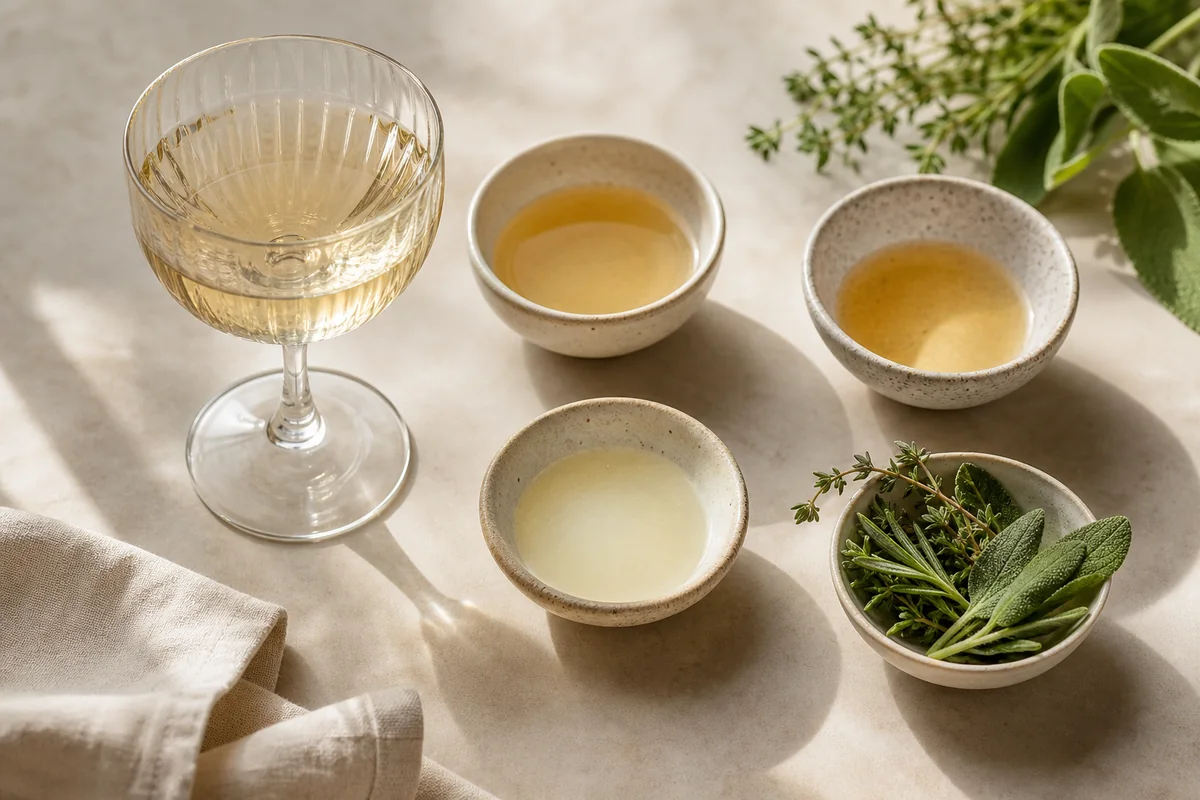
5 Best Dry Vermouth Substitutes (Flavor-Matched)
Ingredients
Equipment
Method
- Identify what you’re making: a cocktail (needs bitter/herbal balance) or cooking (needs acidity and wine notes).
- Start with the listed 1:1 (or mixed) swap ratio, then taste and adjust bitterness and acidity rather than volume.
- If using wine (or a wine blend), add a small acid boost (lemon juice or vinegar) to mimic vermouth’s tang.
- If your swap feels flat, add a tiny pinch of salt and a herbal note (e.g., dried thyme) to recreate botanical lift.
- For cocktails, chill and stir/build gently so the swap stays crisp; for cooking, simmer briefly to round harsh edges.
Notes
- Alcohol strength varies by substitute—use taste adjustments to avoid dominating the recipe.
- Botanical/bitter character matters more than just ‘dry’ wine; add salt/acid/herbs when needed.
Tried this recipe?
Let us know how it was!
Carrie is a food writer and editor with more than 15 years of experience. She has worked for some of the biggest names in the food industry, including Bon Appétit, Food & Wine, and Martha Stewart Living.
As the Editor in Chief of EpicureDelight, Carrie oversees all of the content on the site. She also manages the team of contributing writers and editors, who help to create delicious recipes, helpful tips, and informative articles that you’ll find on the site.
A native of the Chicago area, Carrie is passionate about all things food. She loves trying new restaurants and experimenting with new recipes in her kitchen. She’s also a graduate of the Culinary Institute of America, so she knows a thing or two about food!



