Kefalograviera brings a very specific personality to a dish: salty, nutty, and firm enough to grate but willing to melt and brown when heat hits it. That combination is harder to replace than most people expect.
A good kefalograviera cheese substitute needs to match both the flavor bite and the baking behavior, or the dish will feel off even if it looks right.
This list focuses on cheese-to-cheese swaps only. Skip it if you need a dairy-free option-none of these will get you there.
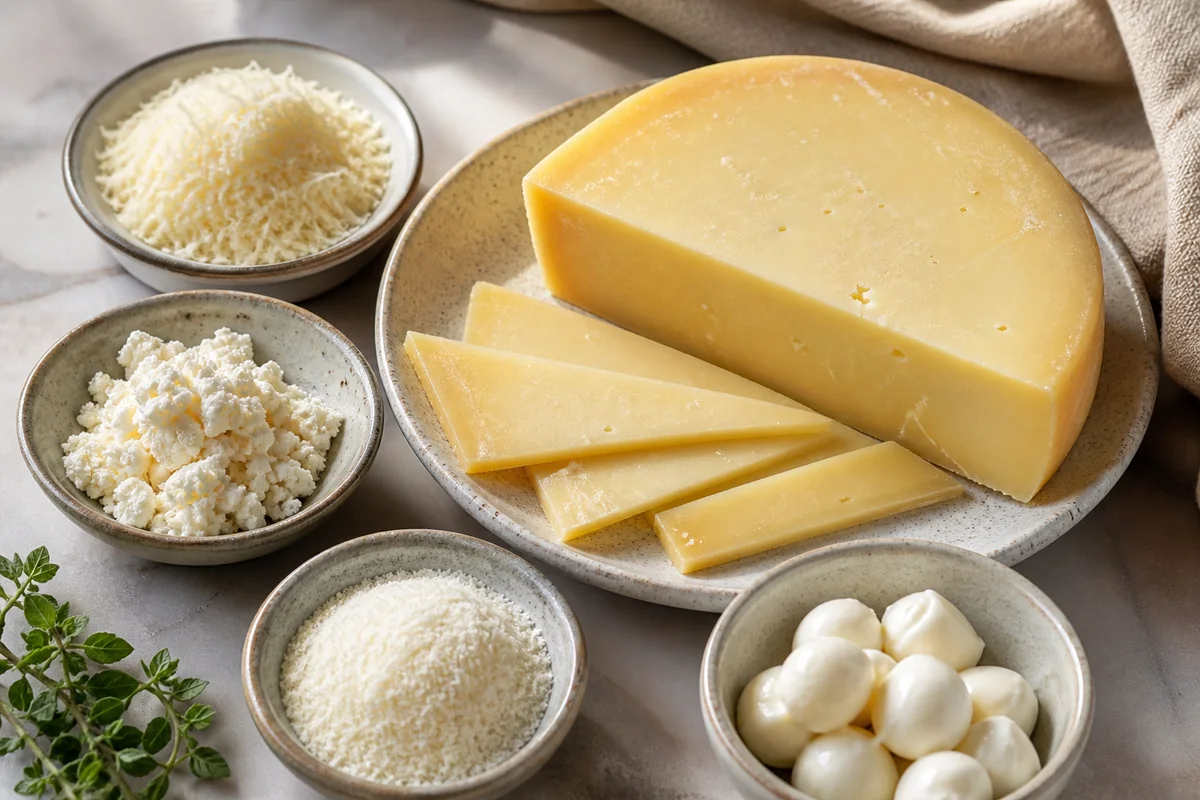
The best kefalograviera swaps are semi-hard, salty, and nutty. Kefalotyri and Graviera are the closest matches. Manchego and Asiago work well in baked dishes. Romano and Parmesan both need a reduced ratio because they hit harder on salt and dryness.
5 Kefalograviera Cheese Substitutes Ranked by Flavor and Melt
Pick your swap by starting with the closest flavor match, then checking melt behavior for your specific dish. A baked topping needs browning ability.
A filled pie or casserole needs a cheese that holds together without pooling liquid.
Soft fresh cheeses like ricotta won't cut it here. They change the bite completely and melt before the dish finishes cooking.
Before you commit to a swap, it's worth understanding this briny Greek cheese so you know what you're actually trying to replicate. If you're also using Asiago as a backup, our top Asiago pick guide covers its limits in longer-cook dishes.
| # | Substitute | Best For | Ratio | Key Note |
|---|---|---|---|---|
| 1 | Kefalotyri | Both | 1:1 | Sharper, saltier bite |
| 2 | Graviera | Both | 1:1 | Milder, nuttier flavor |
| 3 | Manchego | Baking | 1:1 | Buttery, good browning |
| 4 | Romano | Baking | ¾:1 | Very salty, reduce ratio |
| 5 | Parmesan | Cooking | ¾:1 | Less stretch, dry heat only |
1. Kefalotyri
Kefalotyri is the most direct swap on this list. It is a Greek hard cheese built for grating, with a sharp, salty tang that sits just a notch above kefalograviera in intensity.
If your dish leans on a bold cheese presence, this is where to start.
For picking kefalotyri wisely, look for a firm, dry block that grates cleanly without crumbling.
- Melt behavior: Browns well in the oven; grate finely for even distribution in fillings
- Baked toppings: Use 1:1 as a direct drop-in for gratins, pastitsio, or spanakopita tops
- Flavor note: Slightly sharper and saltier than kefalograviera, so taste before adding extra salt
Kefalotyri
Works for: salty baked toppings, Greek-style pies, pasta fillings, grated finishes
Skip if: your dish needs a mild, crowd-friendly cheese-this one bites back
2. Graviera (Greek-Style)
Graviera is the one to reach for when you want the nutty Greek profile without the sharp salt spike. It is semi-hard, grates well, and melts into pies and pasta bakes without fighting the other ingredients.
- Ratio: Use 1:1; grate fine for smoother melt in casseroles and baked pasta
- Baked pies: Works in spanakopita, tiropita, and potato gratins with clean, even browning
- Flavor profile: Lightly sweet and nutty, milder than kefalograviera's briny edge
- Mixed use: Works well alone or blended 50/50 with kefalotyri if you want more salt
When using Graviera in long-bake dishes, add it in the harder Greek cheese tradition: grated on top in the last 10 minutes for the best crust.
Skip if: you want a strong salty tang. Graviera is often noticeably milder than what kefalograviera delivers.
3. Manchego
Manchego is not Greek, but it behaves in the oven the way kefalograviera does. It is semi-hard, grates without crumbling, and browns with a clean golden color.
The flavor goes a little more buttery and less briny, so the swap works better in dishes where the cheese is one of several flavors rather than the star.
The firm, waxy texture of aged Manchego means it grates cleanly and distributes well across baked toppings.
- Ratio: 1:1 for gratins, baked pasta tops, and filled phyllo pastries
- Browning: Excellent in the oven; holds shape longer than softer cheeses
- Salt gap: Add a small pinch of flaky salt to compensate for the missing briny edge
Skip if: your recipe relies on a distinct Greek character. Manchego will read as a different regional flavor entirely.
4. Romano (Aged)
Aged Romano brings serious savory punch. It is sharper and saltier than kefalograviera, so the ratio drops to ¾:1 to keep the dish from tipping too briny.
Where it earns its place is in baked toppings and meat fillings where that extra intensity reads as depth rather than excess.
Understanding sharp-aged cheese swaps can help you decide whether Romano fits your specific recipe before you commit.
- Salt management: Reduce added salt in the recipe by at least half before tasting
- Ratio: Use ¾ the amount called for; top up with plain breadcrumbs if you need volume
- Best use: Baked toppings, meat-and-cheese fillings, and gratins where bold flavor is welcome
Skip if: your recipe already has salty ingredients-olives, anchovies, or cured meats will push the dish over the edge fast.
5. Parmesan (Parmigiano-Reggiano)
Parmesan shares the salty, umami-forward backbone that makes kefalograviera useful in baked dishes. It is drier and less elastic, though, which means it performs best as a topping rather than a melted filling.
Use it at a ¾:1 ratio and grate it very fine so it distributes without clumping.
For context on how sharp aged Italian cheeses compare in heat behavior, the flavor profiles are closer than most cooks assume.
- Best use cases: Grated finishes on gratins, baked pasta tops, savory pie crusts
- Improve the melt: Mix Parmesan 50/50 with Graviera or Manchego for a stretchier result
- Ratio: ¾:1; don't go higher or the dish gets grainy when overheated
- Avoid: Stirring Parmesan into long-simmer sauces-it can seize and turn gritty
Skip if: you need a cohesive, stretchy melt in a sauce or casserole. Parmesan alone will grain under sustained heat.
Making Kefalograviera Substitutes Taste Right
The biggest reason a cheese swap disappoints is not the cheese itself-it is the salt and the grate size. When you swap in Romano or Parmesan, the dish can taste too sharp before the other flavors balance out.
When you use Graviera or Manchego, it can taste flat if you don't adjust seasoning slightly upward. Swapping firm Spanish cheeses follows the same logic: match the salt level first, then the melt.
Grate size also matters more than most cooks expect. Coarse grating leaves pockets of unmelted cheese in fillings and uneven browning on tops.
- Adjust salt early: Taste the base before adding the substitute cheese, then hold back added salt until after the first bake cycle
- Grate fine always: Use the small holes on a box grater or a Microplane for even distribution across fillings and toppings
- Time the top layer: Add grated substitute in the last 10-12 minutes of baking for clean browning without over-drying
Frequently Asked Questions
Kefalotyri is the closest match for baking: same grating texture, similar salt level, and clean browning in the oven. Use it at a 1:1 ratio with no other adjustments needed.
Not quite-Parmesan is saltier and drier, so start at ¾:1 and taste before adding more. It works fine as a baked topping but not as a melted filling on its own.
Reduce the cheese amount by 25% and cut any added salt in the recipe by half before tasting. A squeeze of lemon juice over the finished dish can also pull the flavor back into balance.
Kefalotyri and Graviera melt comparably well. Romano and Parmesan are drier and melt less smoothly, so blend them with a semi-hard cheese like Manchego for better results.
Switch to a finer grate and add the cheese later in the bake, not from the start. Clumping usually means the grate is too coarse or the cheese went in too early.
5 Best Kefalograviera Cheese Substitutes (Quick Swaps)
Ingredients
Equipment
Method
- Identify your use: topping (browning), filling (salt + bite), or baking/melting (needs good grate-and-go behavior).
- Choose the closest match from the list: aim for a semi-hard, salty, nutty cheese for the most kefalograviera-like outcome.
- Apply the listed ratio. If your substitute is saltier (like Romano), start slightly lower and adjust seasoning in the recipe.
- For baked dishes, grate substitutes fine so they distribute evenly and melt without pooling.
- Taste after the first bake cycle (or during final minutes). Add a small pinch of cheese or salt only if needed.
Notes
- If your recipe already has salty ingredients (olives, salted butter, anchovies), consider using the ¾:1 options first.
- For “pull” melt in casseroles, consider blending a flavor-match (Graviera/Manchego) with a more elastic melter (not listed here) while keeping total cheese within the ratio.
Tried this recipe?
Let us know how it was!
Carrie is a food writer and editor with more than 15 years of experience. She has worked for some of the biggest names in the food industry, including Bon Appétit, Food & Wine, and Martha Stewart Living.
As the Editor in Chief of EpicureDelight, Carrie oversees all of the content on the site. She also manages the team of contributing writers and editors, who help to create delicious recipes, helpful tips, and informative articles that you’ll find on the site.
A native of the Chicago area, Carrie is passionate about all things food. She loves trying new restaurants and experimenting with new recipes in her kitchen. She’s also a graduate of the Culinary Institute of America, so she knows a thing or two about food!