
Rock sugar's thick, jagged crystals dissolve slowly and caramelize with a clean, mild sweetness that fine sugar can't quite copy. That dissolve speed matters more than most cooks expect, especially in Chinese braises, candied fruit, or tea where the syrup's clarity is part of the result.
Choosing the right rock sugar substitute means matching that behavior, not just swapping by weight.
Rock sugar dissolves slowly and caramelizes with a mild, clean sweetness. For rock sugar substitute in baking, turbinado and demerara are the closest matches on crystal size and caramel tone. Granulated sugar is the easiest 1:1 swap when only sweetness matters. Avoid powdered sugar if your recipe needs visible crystal texture or syrup clarity.
5 Rock Sugar Substitutes, and How to Swap Them
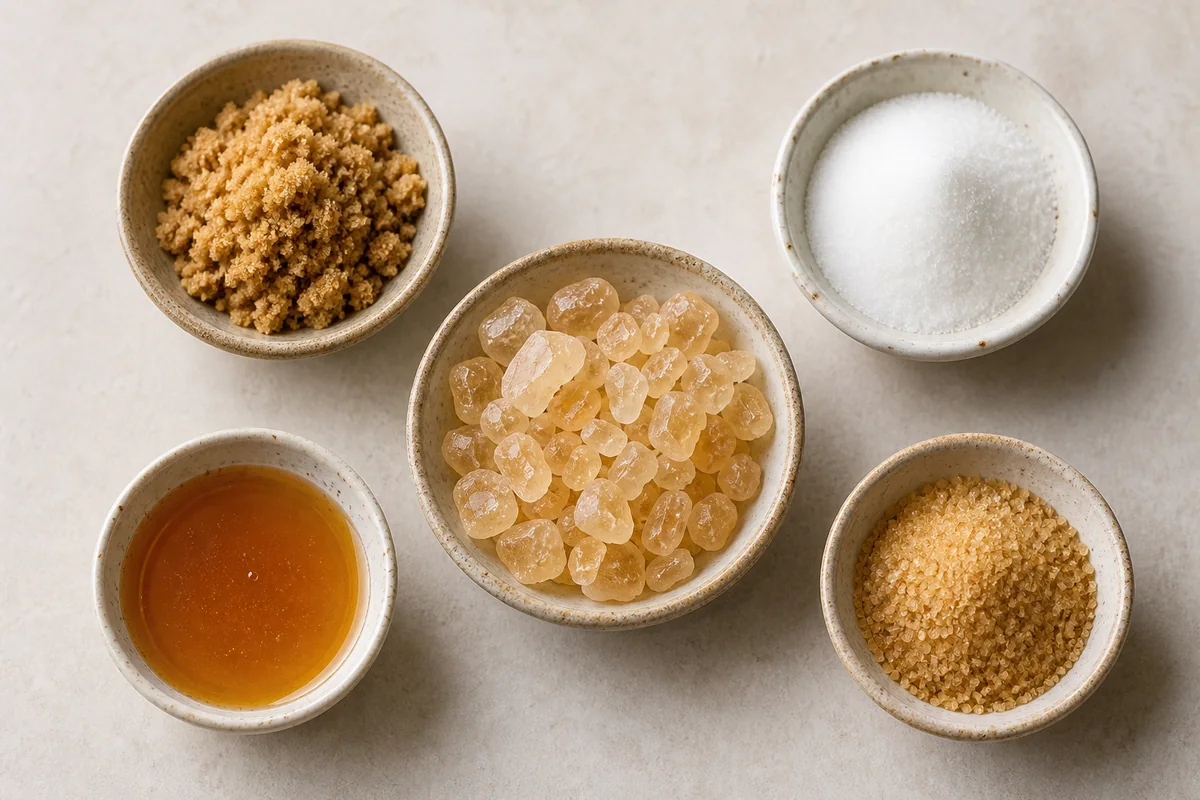
Each swap below is matched by how it dissolves, how it browns, and what it adds to flavor. When you need something with real crystal structure, coarse crystal options are worth comparing before you decide.
The table below gives you a quick overview, and each section below it goes deeper.
| # | Substitute | Best For | Ratio | Key Note |
|---|---|---|---|---|
| 1 | Turbinado Sugar | Both | 1:1 | Best crystal match |
| 2 | Demerara Sugar | Both | 1:1 | Golden color, slow dissolve |
| 3 | Granulated Sugar | Both | 1:1 | Fastest dissolve, clean flavor |
| 4 | Light Brown Sugar | Both | 1:1 | Molasses notes, darker bake |
| 5 | Honey or Maple Syrup | Both | ¾:1 | Reduce added liquid |
1. Turbinado Sugar
Turbinado is the closest dry substitute for rock sugar. Its crystals are large and coarse, they dissolve gradually, and the thin film of surface molasses gives a warm caramel edge that white sugar doesn't produce.
It reads more like rock sugar in both texture and browning behavior than any other pantry swap.
That caramel tone is worth knowing about upfront. Turbinado browns earlier than white sugar at the same temperature, so watch the color closely in the final minutes of baking or simmering.
For its golden, toffee-like notes, it works especially well in tea, glazes, and braised dishes.
Turbinado Sugar
Works for: Tea, glazes, braises, candied fruit, cookies with crunchy tops
Skip if: You need a neutral, white-sugar flavor - turbinado adds a warm caramel note that will show up in delicate bakes
- Ratio: Use 1:1 turbinado for rock sugar in any recipe
- Crystal behavior: Dissolves gradually, similar to rock sugar; partial crunch survives in toppings
- Heat watch: Reduce high-heat time by 2 minutes if you see browning faster than expected
- Best uses: Braised pork belly, spiced tea, crumble toppings, caramel sauces
2. Demerara Sugar
Demerara is another large-crystal brown sugar, and it is nearly as close to rock sugar as turbinado. The crystals are slightly finer but still dissolve more slowly than granulated sugar.
It has a golden color and a mild toffee flavor that suits candied desserts well. This amber-toned sweetener also gives baked goods a subtle crunch on top when used as a finish.
- Ratio: 1:1 demerara for rock sugar across baking and boiled applications
- Where it shines: Custards, candied fruit, shortbread tops, slow-simmered syrups
- Dissolve time: Slightly faster than rock sugar but still slower than granulated - stir a few extra seconds in cold liquid
- Color impact: Adds a golden tint; avoid if you need very pale, lightly colored bakes
Skip if: your recipe calls for a white or pastel result - demerara will tint both batter and syrup toward gold.
3. Granulated Sugar
When rock sugar is in a recipe purely for sweetness, granulated sugar is the correct call. It dissolves faster and doesn't add any caramel tone, so the result stays lighter in color.
The swap is straightforward and requires no measurement change.
The main difference is behavior under heat. Granulated sugar caramelizes a little later and produces less of the amber color that rock sugar gives a braise or sauce.
It also lacks any crystal crunch after baking.
- Ratio: 1:1 granulated for rock sugar; no adjustment needed
- Dissolve speed: Faster - expect a thinner syrup in the early minutes of cooking
- Color: Lighter bake and syrup than rock sugar; fine for tea and mild sauces
Skip if: you need slow-dissolving crystals for texture or want the syrup clarity and golden tone that rock sugar brings to Chinese braises.
4. Light Brown Sugar
Light brown sugar adds molasses notes that rock sugar doesn't have, so the flavor is slightly deeper. It is still a workable 1:1 swap when a recipe can handle a little extra warmth and color.
Choosing a packed brown sugar over a loose scoop matters here since it affects how much sugar you're actually measuring.
Brown sugar browning is faster than rock sugar browning because the molasses content speeds up the Maillard reaction. Start checking cookies or glazed meats 3 minutes earlier than the recipe suggests.
| Use | Ratio | Notes |
|---|---|---|
| Cookies / bars | 1:1 | Light brown sugar; expect chewier texture and darker color |
| Braises / glazes | 1:1 | Light brown sugar; reduce high-heat time by 2-3 min |
| Syrups / drinks | 1:1 | Light brown sugar; syrup will be darker and less clear than rock sugar |
- Ratio default: 1:1, packed
- Sweetness intensity: If the result tastes too sweet, reduce by 2-3% of the recipe's rock sugar weight
- Best recipe types: Cookies, cake layers, braised meats, tea, caramel sauces
Skip if: you want clean, neutral sweetness with minimal color change in a pale or lightly spiced dish.
5. Honey or Maple Syrup
Honey and maple syrup dissolve completely and change the moisture balance of any recipe, which is the most important difference from rock sugar. They also bring their own flavor - floral for honey, woodsy for maple - that will come through in the finished dish.
If you want to understand how this golden liquid sweetener reads on the palate, it helps to taste it against plain syrup before committing.
Honey or Maple Syrup
Works for: Soft cakes, marinades, warm drinks, salad dressings, any recipe that can handle extra moisture and distinct flavor
Skip if: You need crystalline texture or a clear syrup - liquid substitutes won't recreate rock sugar's crunch or visual clarity
- Ratio: Use ¾ the amount of honey or maple syrup for every 1 part rock sugar
- Moisture adjustment: Reduce any other added liquid in the recipe by a small splash (roughly 1-2 tablespoon per cup of sweetener)
- Bake time: Liquid-sweetened batters may brown faster; check 5 minutes before the recipe's suggested time
Making Rock Sugar Substitutes Work
The selection rule is simple: choose by what the rock sugar is actually doing in the recipe. If it is providing slow-dissolving crystal texture, turbinado or demerara is your best call.
If it is there for caramel color and depth, light brown sugar fills that role well. If it is only there for sweetness, granulated sugar gets the job done cleanly.
For this molasses-based pantry staple, storage matters too - packed brown sugar can harden fast, so check it before you measure.
- Match dissolve speed first: Choose turbinado or demerara for braises and syrups where slow dissolve affects texture and clarity
- Match the caramel goal: If a golden color is part of the result, avoid granulated or powdered sugar and use a brown-toned swap instead
- Adjust moisture and heat: If the substitute browns too fast, lower the highest-heat stage by 2-3 minutes; if it tastes flat, add a small pinch of salt to sharpen sweetness perception rather than adding more sugar
Frequently Asked Questions
Yes, rock sugar and granulated sugar swap 1:1 by weight. Rock sugar dissolves more slowly, so cookies may spread slightly less and hold a firmer edge during baking.
Turbinado sugar is the closest match for crystal size and partial crunch. Demerara is a strong second option, especially as a topping on baked goods.
Not exactly. Use ¾ the amount of honey and reduce any added liquid by 1-2 tbsp. Honey also adds its own flavor, which will come through in the finished dish.
Yes. Brown sugar's molasses content speeds up browning, so bakes will be noticeably darker. Reduce high-heat time by 2-3 minutes to prevent over-darkening.
Granulated white sugar gives the clearest syrup. Avoid brown sugars, honey, and maple syrup - all of them add color that clouds a syrup meant to be pale and transparent.
5 Best Rock Sugar Substitutes (with Ratios)
Ingredients
Method
- Identify your use case: quick dissolve (granulated/powdered), caramel flavor (brown sugar), or larger crystals (turbinado/demerara).
- Use the ratio from the ingredient list (start exactly at the listed amount for best results).
- If the substitute is liquid (honey/maple), reduce any added liquid in the recipe by a small splash and mix thoroughly.
- Taste after dissolving/cooking: if it reads flat, add a pinch more salt; if it tastes sharper, bake or simmer 2–3 minutes longer to mellow.
- For desserts that depend on crystal texture, prioritize turbinado/demerara and avoid powdered sugar.
Notes
- Ratios are starting points; final adjustment depends on whether your recipe relies on crystal texture or caramel color.
Tried this recipe?
Let us know how it was!
Carrie is a food writer and editor with more than 15 years of experience. She has worked for some of the biggest names in the food industry, including Bon Appétit, Food & Wine, and Martha Stewart Living.
As the Editor in Chief of EpicureDelight, Carrie oversees all of the content on the site. She also manages the team of contributing writers and editors, who help to create delicious recipes, helpful tips, and informative articles that you’ll find on the site.
A native of the Chicago area, Carrie is passionate about all things food. She loves trying new restaurants and experimenting with new recipes in her kitchen. She’s also a graduate of the Culinary Institute of America, so she knows a thing or two about food!



