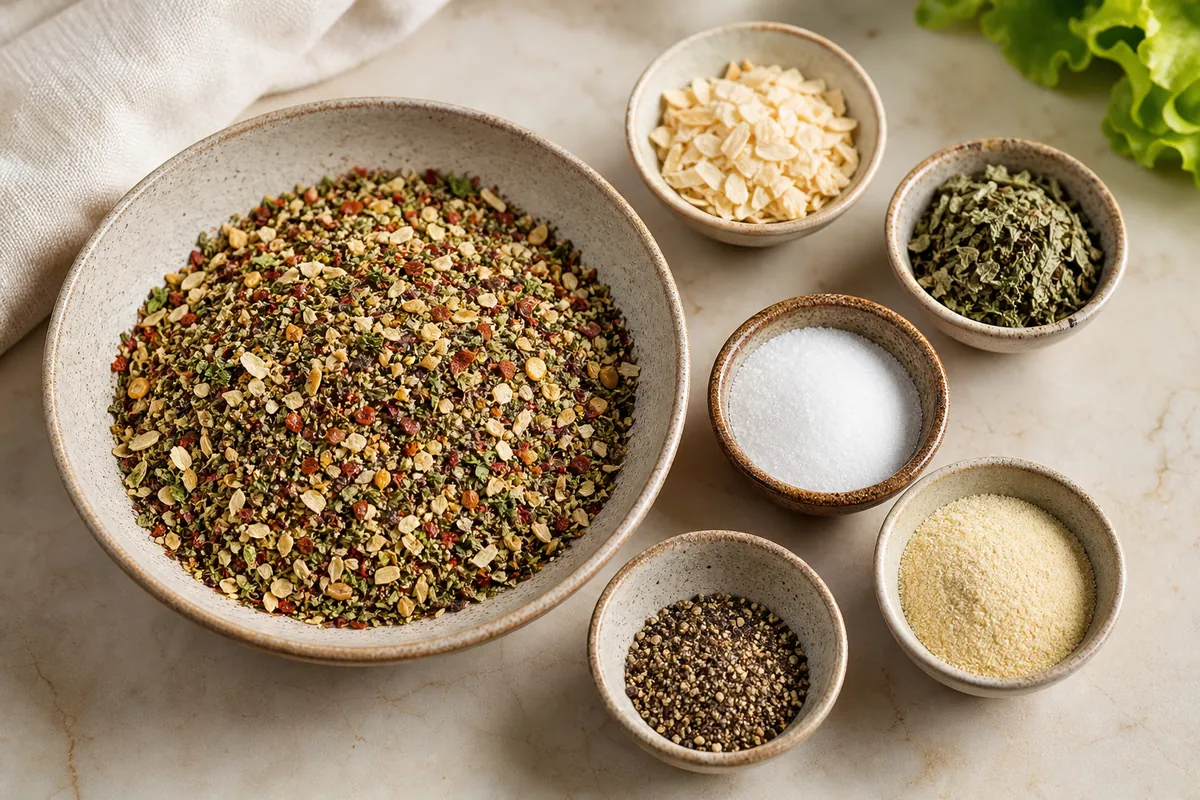
That specific salty-herby punch of salad supreme seasoning is hard to miss when it's gone. It isn't just salt.
It's a blend of dried herbs, a soft savory backbone, and just enough sweetness to make greens taste "finished" rather than flat. Finding a good salad supreme seasoning substitute means matching those layers, not just grabbing the nearest shaker.
Most pantry blends can get you close. The ones below each cover a different angle: herb-forward, savory-bold, tangy, or fast-and-emergency.
If you're also swapping other blend seasonings, swapping a savory blend follows the same taste-and-adjust logic used here.
Salad supreme seasoning is salty, herby, and mildly sweet. The closest swap is Italian seasoning plus a pinch of sugar at a 1:1 ratio. Greek-style blends and everything-bagel seasoning also work well. For emergencies, seasoned salt plus dried parsley or mild taco seasoning plus oregano are solid fallbacks.
5 Best Salad Supreme Seasoning Substitutes Ranked
Each substitute below is matched to what it mimics best, whether that's the herb base, the savory depth, or the tangy brightness. Use this table to pick your swap before reading the detail sections.
| # | Substitute | Best For | Ratio | Key Note |
|---|---|---|---|---|
| 1 | Italian seasoning + sugar | Both | 1:1 | Closest herb match |
| 2 | Greek-style seasoning blend | Both | ¾:1 | Garlic-forward depth |
| 3 | Everything-bagel + lemon powder | Sprinkling | ¾:1 | Tangy, sesame notes |
| 4 | Seasoned salt + dried parsley | Both | 1:1 | Fast emergency swap |
| 5 | Taco seasoning + dried oregano | Dressing | ¾:1 | Bold, herb-bridged |
1. Italian Seasoning + Sugar
Italian seasoning is the backbone of this swap. It matches the oregano-basil-thyme character that salad supreme gets most of its herb identity from.
Add one small pinch of sugar per teaspoon of seasoning, and the flavor rounds out in a way that reads almost identical on greens or in a creamy dressing.
Start at 1:1, then stir and wait two full minutes before tasting. Dried herbs need that time to hydrate and release their oils into the dressing.
Italian Seasoning + Sugar
Works for: pasta salads, green salads, vinaigrettes, anywhere salad supreme would be sprinkled or mixed in
Skip if: your Italian seasoning is coarse-ground and you need a fine powder for a smooth blended dressing
- Dressing use: Whisk into oil and vinegar first, then let it sit 3 minutes before adding to greens
- Sprinkling use: Apply after tossing so the herbs stay visible and don't clump
- Too flat? Add a second pinch of sugar and a tiny squeeze of lemon to restore the "snap"
- Too herby? Pull back by ¼ teaspoon and compensate with a small pinch of kosher salt
If you want to compare Italian seasoning to a similar blend, the Provençal versus Italian choice is worth a quick read before you decide.
2. Greek-Style Seasoning Blend
Greek-style blends work because they already carry garlic, onion, and dried herb layers. Those three elements together replace salad supreme's savory backbone faster than any single herb can.
The garlic and onion can read bold on delicate greens like butter lettuce. For light salads, the tuna salad swap logic applies here too: start smaller and build rather than dump in the full amount.
- Start ratio: Use ¾:1 on light greens, then taste and add more if needed
- Full dressings: 1:1 works well when the dressing has an acidic element like red wine vinegar
- Tone it down: If it reads too garlicky, add ¼ teaspoon of dried basil to soften the edge
- Skip if: You want a neutral herb presence. This blend reads as distinctly Mediterranean.
3. Everything-Bagel Seasoning + Lemon Powder
Everything-bagel seasoning brings a savory, onion-and-seed depth that covers the salty side of salad supreme well. On its own, though, it misses the bright tang that salad supreme has.
Lemon powder, or a small pinch of citric acid, fixes that gap directly.
The ground versus dried oregano difference matters here too: if you want to add a bit more herb character, ground oregano dissolves more evenly into a dressing than dried flakes.
- Ratio: Start at ¾:1 because the sesame and salt in bagel seasoning can overwhelm quickly
- Lemon powder amount: Add ⅛ teaspoon per teaspoon of bagel seasoning, then taste
- Best salads: Grain salads, chopped salads, or any recipe that can handle a bit of texture
- Bitter edge? Too much lemon powder causes this. Pull back by half and balance with a pinch of sugar
- Skip if: Seeds bother you texturally. The poppy and sesame seeds don't dissolve in dressing.
4. Seasoned Salt + Dried Parsley
This is the fastest emergency swap in the list. Seasoned salt hits the salty-savory note immediately.
Dried parsley restores the herb character that seasoned salt alone can't deliver.
The risk is oversalting. If your seasoned salt is already heavy, many bottled dressing bases already carry enough sodium to push it over the edge.
| Use | Ratio | Notes |
|---|---|---|
| Light green salad | ¾:1 | Seasoned salt + ½ teaspoon parsley per tsp |
| Pasta or grain salad | 1:1 | Full ratio holds well with starchy base |
| Vinaigrette | ¾:1 | Thin with extra oil if salt reads sharp |
- Mix first: Combine seasoned salt and parsley before adding to the dish so they hydrate together
- Too salty? Add more greens or an extra tablespoon of dressing rather than adjusting seasoning mid-bowl
- Want more depth? A pinch of garlic powder closes the gap between this swap and the full salad supreme profile
- Skip if: You need herb aroma to carry the dish. Seasoned salt reads flat compared to a full herb blend.
5. Mild Taco Seasoning + Dried Oregano
Taco seasoning is a bolder, spicier base than salad supreme, but mild versions can work well when oregano is added to shift the flavor toward herbs rather than smoke or chili. Think of oregano as the bridge that softens the savory-spice angle.
Understanding what taco seasoning actually tastes like helps here. Some blends lean smoky, others lean cumin-forward.
Pick one that's neither, and the oregano will do its job. If you need more ideas for spice blend swaps, that's worth checking before committing to this route.
Mild Taco Seasoning + Dried Oregano
Works for: heartier salads, grain bowls, dressings where bolder savory flavor is welcome
Skip if: your taco seasoning contains smoked chili or heavy cumin - the flavor will shift far from salad supreme
- Ratio: Use ¾:1 taco seasoning, then add ¼ teaspoon dried oregano per teaspoon used
- Oregano fix: Keep adding oregano in small pinches until the blend smells herb-forward, not spice-forward
- Spice check: Taste the taco seasoning alone first. If it stings, swap it for something milder or use ½:1
Making Salad Supreme Substitutes Taste Right
The ratio gets you close. What gets you all the way there is timing and order of adjustment.
Let any of these substitutes sit in the dressing for at least 2 minutes before tasting, because dried herbs release flavor slowly and an underdeveloped blend can seem flat when it isn't. For similarly bold spice blends, the same rule applies: taste after hydration, not before.
- Hydration first: Mix the substitute into the dressing or oil base and wait 2-5 minutes before final seasoning decisions
- Adjustment order: Fix salt level first by diluting with extra dressing or greens, then add tang (a few drops of vinegar or lemon juice), then sweetness (one small pinch of sugar at a time)
- Application method: For salads, toss greens with oil first, then add the seasoning blend so it coats evenly rather than clumping in one spot
Frequently Asked Questions
Most substitutes start at 1:1, but taste after 2 minutes of hydration before finalizing. Greek-style and taco-based swaps should start at ¾:1 because they're stronger.
Italian seasoning at 1:1 is the closest single-herb match. Add one small pinch of sugar per teaspoon to replicate salad supreme's mild sweetness.
Dilute with extra greens, oil, or a tablespoon of unseasoned dressing rather than adding more ingredients. Don't try to counter salt with sugar; it creates imbalance.
Yes. Italian seasoning or Greek-style blends work well in roasted vegetables and pasta dishes at the same ratios. Reduce overall salt in the recipe if your swap is salt-heavy.
Most formulations include a small amount of sugar or a sweet spice like paprika. A single pinch of granulated sugar per teaspoon of substitute is enough to replicate it.
5 Best Salad Supreme Seasoning Substitutes
Ingredients
Method
- Decide what matters most: herb flavor (choose Italian/Greek-style) or the sweet-savory balance (add a tiny pinch of sugar).
- Apply the listed ratio to your dressing or salad base, then stir until fully dissolved.
- Taste after 2 minutes; if it’s too salty, dilute with more dressing/greens rather than adding more sweetness.
- Adjust in small steps: add a pinch more herb blend for aroma, or a squeeze of lemon for tang.
- If serving immediately, let the salad sit 5 minutes so the seasoning hydrates and flavor rounds out.
Notes
- Start with slightly less than the ratio if your substitute is salt-heavy.
- For tang, use lemon powder or a small splash of vinegar to avoid over-sweetening.
Tried this recipe?
Let us know how it was!
Carrie is a food writer and editor with more than 15 years of experience. She has worked for some of the biggest names in the food industry, including Bon Appétit, Food & Wine, and Martha Stewart Living.
As the Editor in Chief of EpicureDelight, Carrie oversees all of the content on the site. She also manages the team of contributing writers and editors, who help to create delicious recipes, helpful tips, and informative articles that you’ll find on the site.
A native of the Chicago area, Carrie is passionate about all things food. She loves trying new restaurants and experimenting with new recipes in her kitchen. She’s also a graduate of the Culinary Institute of America, so she knows a thing or two about food!