
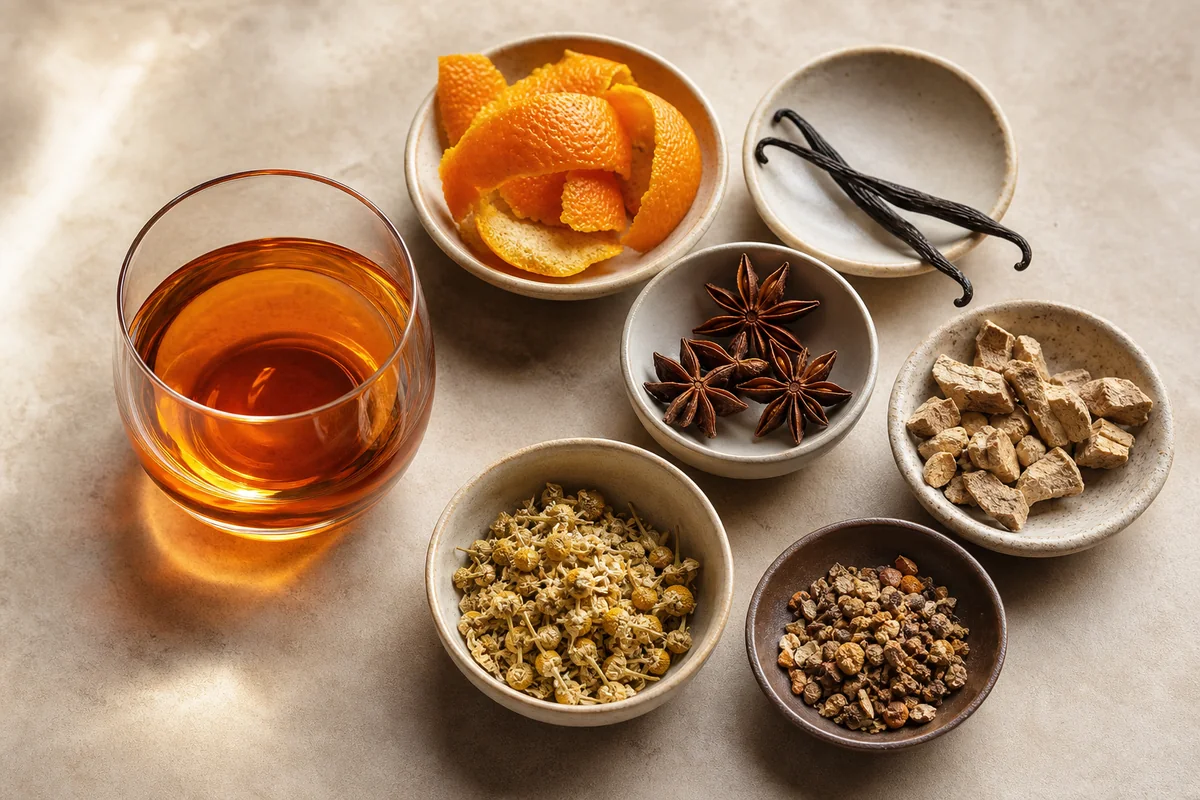
That sweet-bitter, herbal-botanical balance in amaro Montenegro is deceptively hard to replace. It sits in a narrow middle ground: not as aggressively bitter as Fernet-Branca, not as candy-red as Campari, and far more complex than a plain liqueur.
When you need an amaro montenegro substitute, the right pick depends on whether you're building a cocktail or baking it into a dessert-and on how much bitterness your recipe can handle.
Understanding the flavor of amaro montenegro is the clearest path to picking the right swap. The ratios below handle most scenarios, but the flavor context-sweetness level, herbal intensity, and the role of alcohol-determines which one you reach for first.
Amaro Montenegro is sweet-bitter with soft herbal complexity. For cocktails, Amaro Averna or Ramazzotti Amaro work 1:1. For baking, reduce Campari or Cynar to ¾:1 and adjust sweetness. Dry sherry is the emergency swap-add a small sweetener boost. Avoid Fernet-Branca at 1:1; it runs too intense.
5 Amaro Montenegro Substitutes Ranked by Flavor Match
Each substitute below is chosen for how closely it mirrors Montenegro's sweet-bitter herbal center. The ratios assume you're starting with the listed amount of Montenegro and swapping directly-no test batches needed if you follow the table first, then adjust.
| # | Substitute | Best For | Ratio | Key Note |
|---|---|---|---|---|
| 1 | Amaro Averna | Both | 1:1 | Closest sweet-bitter match |
| 2 | Ramazzotti Amaro | Both | 1:1 | Brighter, citrus-forward |
| 3 | Campari | Both | ¾:1 | More bitter, reduce in baking |
| 4 | Fernet-Branca | Cocktails | ¾:1 | Very intense; use less |
| 5 | Amaro Nonino | Both | 1:1 | Drier, gentian-forward |
If you're ever building a broader swap list, understanding best amaro nonino alternatives adds useful context for where the gentian-heavy amari sit relative to Montenegro's sweeter profile.
1. Amaro Averna
Averna is the most direct replacement for Montenegro you're likely to find at a standard liquor store. The amaro averna flavor profile runs sweet-first with a clean bitter finish-close enough to Montenegro that most cocktail drinkers won't notice a difference in a mixed drink.
It's slightly darker and a touch more caramel-forward than Montenegro, but the herbal roundness holds in both shaken and stirred applications. In baking, it adds the same boozy-bitter depth without the risk of over-sharpening a sauce or ganache.
Amaro Averna
Works for: cocktails at 1:1, baking in chocolate desserts, bitter-sweet reductions
Skip if: your recipe needs a minty or strongly herbal top note
- Closest flavor note: Caramel-herbal with a clean bitter finish, nearly identical to Montenegro's base
- Best use: Negroni variations, tiramisu, and any recipe where Montenegro acts as a background bitter
- Adjustment tip: If Averna reads too sweet, add 2-3 drops of Angostura bitters to sharpen the finish
2. Ramazzotti Amaro
Ramazzotti runs with a brighter, citrus-forward bitterness compared to Montenegro's rounder herbal base. It's not dramatically different-both are Italian digestif amari with multi-herb builds-but the orange peel note in Ramazzotti is more forward.
When you're substituting for baking, that citrus lift can actually work in your favor in citrus-adjacent desserts. For cocktails where Montenegro sits quietly in the background, Ramazzotti does the same job cleanly.
If you're ever swapping cynar in the same recipe, Ramazzotti is the lighter-handed counterpart.
- Ratio: 1:1 in cocktails and baking without adjustment
- What carries over well: The herbal bitterness backbone and mid-range alcohol intensity
- What to watch: The citrus note reads louder in neutral desserts-if your recipe is chocolate-only, pull back by 1 teaspoon per ¼ cup used
- Adjustment: If the brightness feels too sharp in a sauce, a small pinch of brown sugar evens it out quickly
*Skip if:* You want a flatter, darker bitter profile rather than the brighter citrus character Ramazzotti brings.
3. Campari
Campari is sharper, redder, and more aggressively bitter than Montenegro. It won't taste the same, but it keeps the bitter-herbal backbone that most Montenegro recipes rely on.
If you're looking at campari alternatives for reference, the same logic reverses here-Campari is that louder, brighter alternative.
Start at ¾:1 in baking. Full 1:1 works in cocktails where the bitter punch is intentional, like a Negroni riff.
| Use | Ratio | Notes |
|---|---|---|
| Cocktails | 1:1 | Campari holds up at full swap; expect a sharper bitter finish |
| Baked desserts | ¾:1 | Reduce to avoid over-bitterness; add ½ teaspoon honey to balance |
| Sauces / reductions | ¾:1 | Start low; Campari concentrates fast when cooked down |
- Starting ratio: ¾:1 for baking, 1:1 for cocktails
- When ¾:1 matters most: Any dessert where Montenegro adds just a background bitter note-full-swap Campari will dominate
- Sweetener fix: Add ½ teaspoon honey or simple syrup per 1 oz Campari used to recover Montenegro's sweeter base
*Skip if:* Your recipe is already very sweet and you can't add any extra sweetener to compensate for Campari's dryness.
4. Fernet-Branca
This one can wreck a recipe if you're not careful. Fernet branca in cooking lands with a pronounced minty, mentholated bitterness that's significantly more intense than Montenegro's gentle herbal warmth. Never go 1:1.
Start at ¾:1 and taste before adding more. In stirred cocktails with a long list of ingredients, the intensity gets absorbed.
In simpler drinks or baked goods, it can take over entirely. If you find yourself curious about broader fernet branca options, that page also covers how to dial back the menthol character in mixing.
Fernet-Branca
Works for: stirred cocktails, bold bitter sauces, recipes with heavy sweetness to offset the intensity
Skip if: you dislike mint/menthol top notes, or the recipe is a delicate dessert
- Recommended ratio: ¾:1-start there, increase only if the result tastes too mild
- Flavor to expect: Minty, heavily herbal, with a long bitter finish that reads nothing like Montenegro's soft warmth
- When it works best: Cocktails with vermouth or citrus, which soften the menthol edge; also works in dark chocolate desserts at ½:1
5. Amaro Nonino (Quintessentia)
Amaro Nonino is lighter-bodied and more aromatic than Montenegro, built on a grappa base with gentian root providing a dry, clean bitter note. The sweetness is there but restrained-more like a dry bitter aperitif than the rounder, syrupier style Montenegro occupies.
At 1:1, it's the closest aromatic stand-in when Montenegro is being used as a sipping amaro or a light cocktail bitter. For desserts, add a small sweetener boost-about 1 teaspoon simple syrup per 1 oz used-to recover the sweetness Montenegro normally contributes.
- Starting ratio: 1:1 in both cocktails and desserts
- When it tastes closest: Stirred cocktails and amaro-forward drinks where the bitter complexity is the star
- Dessert adjustment: Add 1 teaspoon simple syrup per 1 oz Nonino to recover Montenegro's missing sweetness
- Watch out: Nonino is drier than Montenegro; if your recipe relies on the sticky sweetness, this swap will read leaner
*Skip if:* You need a syrupier, heavier sweetness rather than Nonino's drier, gentian-forward character.
Making Amaro Montenegro Substitutes Work
The main friction point is the sweet-bitter balance. Montenegro sits at a sweeter midpoint, and most of these substitutes skew either more bitter (Campari, Fernet-Branca) or drier (Nonino, dry sherry).
In cocktails, you can adjust on the fly by tasting as you build. In baking, you need to decide before mixing-most of these substitutes can't be corrected after they're baked in.
For savory applications, dry sherry substitutes explores the drier end of fortified wine swaps if your dish needs less sweetness overall.
- Step 1 - Match the base: For cocktails, start with Averna or Ramazzotti at 1:1. For baking, start at the listed ratio and hold back a small amount to adjust after tasting.
- Step 2 - Taste for bitterness: If the swap reads too bitter, add simple syrup in ¼ teaspoon increments, not more liqueur. If it reads too sweet, add 2 drops of Angostura bitters.
- Step 3 - Adjust intensity last: If the substitute is too mild (common with Averna in bold cocktails), add a bar spoon of the substitute and re-taste rather than pouring in extra volume.
Frequently Asked Questions
Amaro Averna is the closest 1:1 replacement for cocktails. The sweet-bitter herbal balance is nearly identical, and most mixed drinks won't show a noticeable difference.
Yes, but reduce to ¾:1 and add ½ teaspoon honey or simple syrup to balance Campari's sharper bitterness. At a full 1:1, it tends to overpower delicate desserts.
Add simple syrup in ¼ teaspoon increments and re-taste after each addition. Don't reduce the substitute volume-adjust sweetness instead to preserve the herbal character.
It works as an emergency swap at 1:1, but sherry is much drier and lacks the herbal bitterness. Add a drizzle of honey and a pinch of allspice to get closer.
Use Fernet-Branca when the recipe has enough sweetness or citrus to absorb its intensity. Always start at ¾:1 and only increase if the result tastes too mild.
5 Best Amaro Montenegro Substitutes (with Ratios)
Ingredients
Equipment
Method
- Match the use: for cocktails, choose a 1:1 amaro-style replacement first (Averna or Ramazzotti).
- For baking, start with the listed ratio, then taste/adjust sweetness and bitterness (especially if using Campari/Cynar/Fernet).
- If the substitute is drier than Montenegro (e.g., dry sherry), add a small sweetener boost before final mixing.
- If the substitute is more intense (e.g., Fernet-Branca), reduce to the lower ratio and increase only if the flavor reads too mild.
Notes
- Ratios are designed for flavor direction: start at the ratio, then adjust sweetness or bitterness based on your recipe.
- Fernet-Branca is notably intense—use less than 1:1 to prevent an overly minty bite.
Tried this recipe?
Let us know how it was!
Carrie is a food writer and editor with more than 15 years of experience. She has worked for some of the biggest names in the food industry, including Bon Appétit, Food & Wine, and Martha Stewart Living.
As the Editor in Chief of EpicureDelight, Carrie oversees all of the content on the site. She also manages the team of contributing writers and editors, who help to create delicious recipes, helpful tips, and informative articles that you’ll find on the site.
A native of the Chicago area, Carrie is passionate about all things food. She loves trying new restaurants and experimenting with new recipes in her kitchen. She’s also a graduate of the Culinary Institute of America, so she knows a thing or two about food!



