
That silky, translucent sauce you get with arrowroot powder is harder to fake than it looks. Most starches thicken just fine, but they don't all produce the same clarity or hold up the same way to heat.
Picking the right arrowroot powder substitute means matching your goal: clear glaze, gluten-free sauce, or a quick pantry fix.
Arrowroot thickens fast and stays glossy at lower temperatures. It's also naturally gluten-free, which matters when you're cooking for someone with dietary restrictions.
The best swap depends on whether you need that clear finish, a neutral flavor, or just reliable body without lumps.
The closest swap for arrowroot powder is cornstarch at a 1:1 ratio-it thickens reliably and stays mostly clear. Potato starch and tapioca starch are strong gluten-free runners-up. Rice flour works for softer textures, and all-purpose flour is the emergency option when nothing else is available.
5 Best Arrowroot Powder Substitutes That Thicken Cleanly
The table below gives you ratios and the one-line situation where each substitute wins. Always whisk your starch into cold liquid before adding it to anything hot-that slurry step is what prevents lumps every single time.
| # | Substitute | Best For | Ratio | Key Note |
|---|---|---|---|---|
| 1 | Cornstarch | Both | 1:1 | Slightly more opaque finish |
| 2 | Potato Starch | Both | 1:1 | Avoid long simmering |
| 3 | Tapioca Starch | Both | 1:1 | More elastic, holds heat well |
| 4 | Rice Flour | Both | ¾:1 | Softer, less glossy result |
| 5 | All-Purpose Flour | Both | 2:1 | Cook longer to remove raw taste |
1. Cornstarch
Cornstarch is the most reliable one-to-one swap for arrowroot powder. It thickens at a similar concentration and produces a sauce that reads as clear to most eyes, though it sits fractionally more opaque than arrowroot under bright light.
- Texture: Smooth and glossy; very close to arrowroot in spoonable sauces and gravies
- Best dishes: Stir-fry sauces, gravies, custards, and any sauce you want to coat the back of a spoon
- Method: Whisk 1 teaspoon cornstarch into 2 teaspoons cold water per teaspoon of arrowroot called for, then pour into simmering liquid
- Cook time: Thickens in about 60 seconds once the liquid returns to a simmer
If you want to explore what happens when choosing a starch-free thickener is the goal, the options diverge pretty quickly from what cornstarch can do.
Cornstarch vs. Arrowroot
Works for: sauces, gravies, glazes, custards; holds well at moderate heat; easy to find
Skip if: you need the clearest possible finish-cornstarch is slightly more opaque than arrowroot at full concentration
2. Potato Starch
Potato starch produces a notably smooth finish with almost no grittiness. It's fully gluten-free and thickens fast, which makes it a strong swap in cream sauces and lighter gravies where you want a clean, spoon-coating body.
- When it shines: Short-cook sauces, soups, and any dish where the sauce won't sit on heat for more than a few minutes
- Slurry method: Whisk into cold liquid before adding-never drop dry potato starch into hot liquid or it clumps immediately
- Cook time: Simmer only until the sauce turns glossy, usually 30 to 60 seconds; stop there
- Heat behavior: Unlike cornstarch, potato starch can break down and thin out if held at high heat past that glossy point
If your sauce ends up too thick, stir in warm liquid one tablespoon at a time. Too thin, give it 15 more seconds of gentle simmering before adding more starch.
3. Tapioca Starch
Tapioca starch gels with a slightly elastic, chewy quality that arrowroot doesn't quite match. That's actually a feature in fruit fillings and pie-style preparations, where you want the sauce to hold a defined shape after cooling rather than run thin when sliced.
- Best uses: Fruit pie fillings, jam-style glazes, boba-adjacent puddings, and reheated sauces
- Slurry method: Mix into cold water at 1:1, stir until completely smooth, then pour into the simmering filling
- Heat stability: Handles reheating better than potato starch and stays thick after a second warm-through
- Texture note: The elastic quality is mild in sauces but more noticeable in thick puddings-taste and adjust
For a deeper look at how the tapioca alternative stacks up against gum-based thickeners, the differences in texture are worth knowing before you commit to a filling recipe.
Skip if: you want an ultra-silky, spoonable sauce with zero chew. Tapioca's gel can feel slightly more elastic than arrowroot in thin sauces.
4. Rice Flour
Rice flour thickens with a softer, less glossy finish than arrowroot. The result is closer to a matte sheen-perfectly fine for creamy soups, white sauces, or any preparation where a bright, translucent look isn't the goal.
- Ratio: Use ¾ teaspoon of rice flour for every 1 teaspoon of arrowroot-it's less concentrated per unit
- Slurry method: Whisk into cold water until fully smooth; rice flour hydrates slower than pure starches, so give it 30 seconds of whisking before adding to the pot
- Cook until: The sauce thickens and loses the raw, floury smell, about 2 to 3 minutes at a light simmer
- Gluten-free: Yes, as long as you're using certified gluten-free rice flour
If your sauce looks thin after cooking, simmer another 30 seconds before adding more flour. Lumps usually mean the slurry wasn't fully smooth before it hit the heat.
5. All-Purpose Flour
Flour needs more time and more volume than arrowroot to get the job done. Use 2 teaspoons of flour for every 1 teaspoon of arrowroot, and plan for at least 2 to 3 minutes of simmering to cook out the raw, starchy flavor that otherwise lingers in your sauce.
- Slurry method: Whisk flour into cold water or cool stock at a 1:3 flour-to-liquid ratio, then pour slowly into the simmering sauce while whisking constantly
- Cook time: Simmer for at least 2 minutes after it thickens; undercooking leaves a pasty taste
- Adjusting consistency: If too thick, add warm liquid in 1-tablespoon increments; if too thin, simmer uncovered 1 to 2 minutes more
- Finish: Noticeably more opaque than any starch substitute-expect a cloudy, creamy look
| Sauce Volume | Flour Amount | Notes |
|---|---|---|
| 1 cup | 2 tsp | Simmer 2 min after thickening |
| 2 cups | 4 tsp | Whisk slurry in gradually |
| 4 cups | 2 tablespoon + 2 tsp | Increase simmer to 3-4 min |
Skip if: you're cooking gluten-free or need a neutral, clean flavor. Flour adds a heavier, more wheat-forward taste that other starches don't.
Making Any Arrowroot Substitute Work (No Lumps, Right Thickness)
The difference between a smooth sauce and a lumpy one usually comes down to two steps: slurry and timing. Understanding this neutral, nearly flavorless starch helps clarify why its substitutes sometimes behave differently under heat.
Any starch you use as a swap will behave better when you treat it the same way arrowroot gets treated-cold mix first, hot liquid second.
- Slurry and whisk: Mix your substitute starch with an equal volume of cold water or cold cooking liquid, whisk until fully smooth with no white streaks, then pour into the simmering pot in a slow, steady stream while whisking. Never add dry starch directly to hot liquid.
- Stop at glossy: Pull the pot off heat or drop to the lowest simmer the moment the sauce turns glossy and thick. Continued boiling thins most starches and dulls the finish-30 to 90 seconds is the target window for pure starches like cornstarch, potato, and tapioca.
- Quick fixes: Too thick? Stir in warm liquid one tablespoon at a time. Too thin? Return to a gentle simmer for 20 to 30 seconds before adding any more starch-overcorrecting with dry starch is the fastest way to make lumps.
Frequently Asked Questions
Yes, cornstarch swaps in at a 1:1 ratio with no adjustment needed. The sauce may look slightly more opaque than arrowroot, but the thickening strength is nearly identical.
Use potato starch at a 1:1 ratio, the same as cornstarch. Simmer only until glossy and stop there-potato starch thins quickly if held at high heat too long.
Always make a slurry first-whisk the starch into cold liquid until smooth before adding to anything hot. Pouring dry starch into a hot pot causes lumps every time.
Cornstarch, potato starch, tapioca starch, and certified gluten-free rice flour are all naturally gluten-free. All-purpose flour is the only option on this list that contains gluten.
Tapioca starch holds up better after reheating than potato starch does. It may become slightly more elastic on the second warm-through, but it rarely breaks down or turns watery.
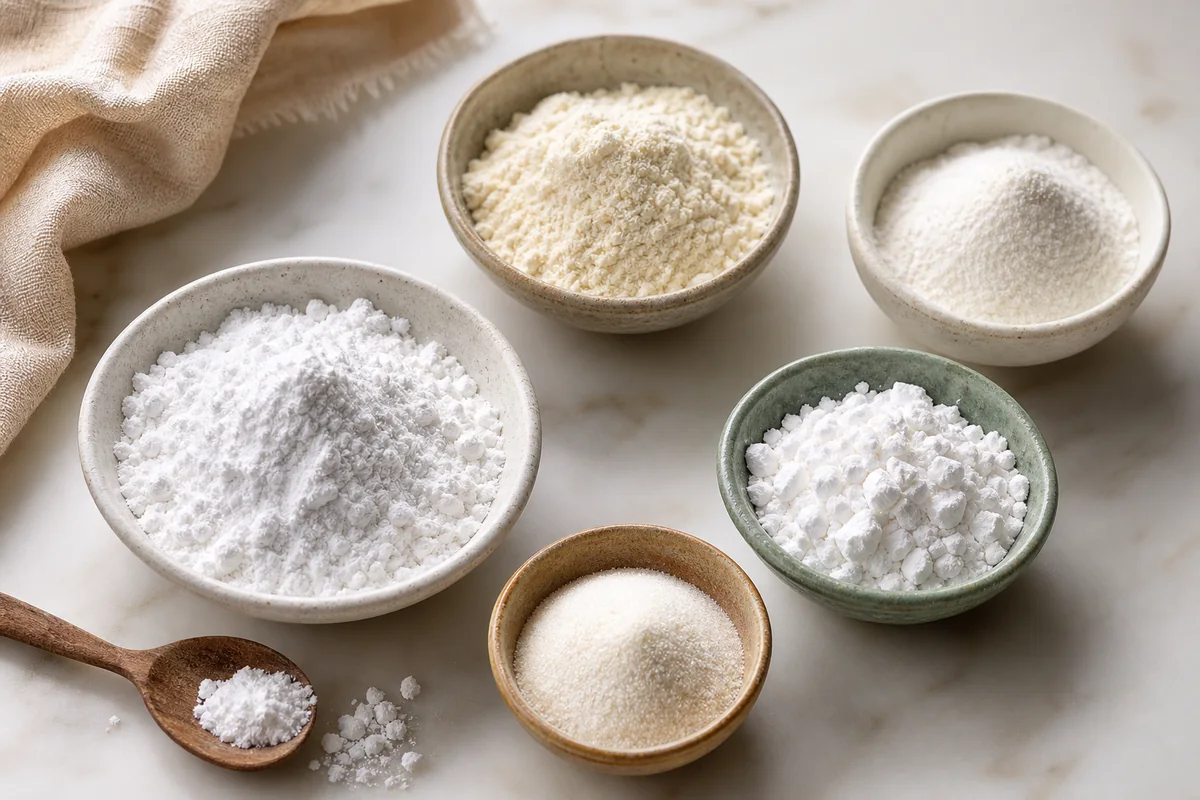
5 Best Arrowroot Powder Substitutes That Taste Right
Ingredients
Equipment
Method
- Identify what you’re thickening (sauce, fruit filling, glaze, or pudding) and whether you need a clear/bright look.
- Pick your substitute from the list and use the ratio in the table (arrowroot-style slurry swaps best).
- Make a slurry: whisk the starch with cold water or cooking liquid until smooth, then pour into simmering liquid while whisking.
- Cook only until glossy and thick (usually 30–90 seconds for starches); avoid long boiling to prevent thinning or a starchy taste.
- If too thick, loosen with a splash of warm liquid; if not thick enough, simmer 15–30 seconds more.
Notes
- Arrowroot performs best when added as a slurry and heated briefly until glossy.
- For clearer sauces, choose cornstarch or potato starch and avoid aggressive boiling.
Tried this recipe?
Let us know how it was!
Carrie is a food writer and editor with more than 15 years of experience. She has worked for some of the biggest names in the food industry, including Bon Appétit, Food & Wine, and Martha Stewart Living.
As the Editor in Chief of EpicureDelight, Carrie oversees all of the content on the site. She also manages the team of contributing writers and editors, who help to create delicious recipes, helpful tips, and informative articles that you’ll find on the site.
A native of the Chicago area, Carrie is passionate about all things food. She loves trying new restaurants and experimenting with new recipes in her kitchen. She’s also a graduate of the Culinary Institute of America, so she knows a thing or two about food!



