
Basket cheese has a quiet, specific personality - dense enough to hold its shape, tangy enough to notice, mild enough to work in sweet and savory bakes alike. Most grocery stores don't carry it, and even specialty delis run out.
If you need a reliable basket cheese substitute today, you have five options that each cover a different use case, from spreading to baking to filling.
The best basket cheese substitute is full-fat cream cheese for spreads and drained ricotta for baking. Neufchâtel matches the tang closely. Blended cottage cheese works well in casseroles. Greek yogurt is a last-resort swap - use ¾ of the amount and drain it well before mixing.
5 Basket Cheese Alternatives Compared (Quick Pick Table)
The five substitutes below are ranked by how closely they mimic basket cheese's texture and tang. Texture match is mostly a draining problem - wetter cheeses just need time in a fine-mesh strainer or a few rounds of paper-towel blotting.
Understanding basket cheese in cooking helps you decide which swap fits your dish before you commit to a ratio.
Proper ricotta storage also matters here - if your ricotta has been open for a few days, check it before using it as a stand-in.
| # | Substitute | Best For | Ratio | Key Note |
|---|---|---|---|---|
| 1 | Cream Cheese (full-fat) | Both | 1:1 | Smoothest swap, add pinch of salt |
| 2 | Neufchâtel (plain) | Both | 1:1 | Tangier, slightly softer body |
| 3 | Ricotta (drained) | Baking | 1:1 | Must remove whey first |
| 4 | Cottage Cheese (blended) | Both | 1:1 | Blend smooth, drain well |
| 5 | Greek Yogurt (strained) | Baking | ¾:1 | Reduce by 2 tablespoon per cup |
1. Cream Cheese (Plain, Full-Fat)
Full-fat cream cheese is the easiest swap on this list. It matches basket cheese's dense, spreadable body almost exactly, and its mild tang is close enough that most tasters won't notice in a finished dish.
Read up on cream cheese options if you need to go one step further and swap the cream cheese itself.
- Ratio: 1:1 - no adjustment needed for most recipes
- Flavor fix: Add a small pinch of salt to lift the savory edge basket cheese naturally carries
- Texture: Stays smoother and denser than basket cheese; it won't crumble like fresh curd cheeses
- Best in: Cheesecakes, spreads, stuffed pasta fillings, and cheese-topped breads
Skip if: your recipe depends on a crumbly or curd-like texture - cream cheese will stay smooth and solid where basket cheese would break into soft chunks.
2. Neufchâtel (Plain)
Neufchâtel sits right between cream cheese and basket cheese on the tang scale. It has a slightly softer body and a noticeably tangier finish, which makes it a strong match when the recipe is already built around dairy brightness.
If you need to go further than Neufchâtel for your dish, check out alternatives to neufchatel cheese that cover other flavor angles.
It performs well folded into cheesecake-style fillings and creamy casseroles. The lower fat content compared to full-fat cream cheese means it sets a touch lighter after baking.
- Ratio: 1:1 for most applications
- Tang level: Higher than cream cheese - skip the added salt and taste first
- Baking note: Works well in no-bake cheesecakes and egg-based tarts; holds shape reliably
- Texture check: Slightly wetter than block cream cheese - blot with a paper towel if the recipe is moisture-sensitive
Skip if: you need a mild, neutral dairy flavor - Neufchâtel can taste noticeably sharper than what basket cheese brings.
3. Drained Ricotta
Ricotta is the go-to for baked dishes where basket cheese adds body without making the filling dense. The catch is moisture.
Undrained ricotta brings extra whey into your batter, and that alone can throw off set times and texture by a wide margin. Knowing the cottage cheese taste profile alongside ricotta helps clarify which swap suits a sweeter vs savory bake.
Drained Ricotta
Works for: cheesecakes, baked pasta fillings, savory tarts, stuffed shells
Skip if: you can't drain it first - excess whey will loosen your batter and extend bake time
Undrained Ricotta
Works for: very wet-tolerant recipes like some lasagna layers where moisture is absorbed
Skip if: your recipe needs a firm, cohesive filling - undrained ricotta will stay loose and watery
- How to drain: Line a fine-mesh strainer with cheesecloth, add ricotta, refrigerate for at least 2 hours - or press overnight for a firmer result
- Quick method: Spread ricotta on three layers of paper towels, cover with two more, and press firmly for 5 minutes; repeat if still wet
- Target texture: It should hold a shape when scooped, not spread flat on its own
- Ratio: 1:1 once drained - do not reduce the amount, just the moisture
Skip if: you want a one-step swap without prep - undrained ricotta adds moisture that loosens the final bake.
4. Cottage Cheese (Blended, Drained)
Raw cottage cheese looks nothing like basket cheese, but once you blend it smooth and drain off the extra liquid, the result is surprisingly close. The flavor is tangier and slightly saltier, which usually works in savory applications and holds up fine in egg-heavy baked dishes.
If you need even more options in this space, cottage cheese substitutes cover what to do when cottage cheese also isn't available.
Blend it first, always. Unblended cottage cheese keeps its curds, and those curds change the mouthfeel of anything you fold it into. Run it in a blender or food processor for about 30 seconds until fully smooth, then drain through a fine-mesh strainer for 20-30 minutes.
The finished texture is a bit looser than basket cheese but firms up well during baking. In casseroles, lasagna, and baked egg dishes, it performs reliably at a 1:1 ratio.
Skip if: you can't blend - unblended cottage cheese will leave visible curds and a grainy texture that basket cheese never has.
5. Thick/Strained Greek Yogurt
Greek yogurt is the emergency option when nothing else is available. It has real dairy tang and a thick body, but it is more acidic and wetter than basket cheese even at its thickest.
Understanding what greek yogurt tastes like before you swap helps you predict how the finished dish will land on the palate.
- Strain it further: Even "thick" Greek yogurt benefits from 1-2 hours in a cheesecloth-lined strainer before use
- Ratio: Use ¾ cup of strained Greek yogurt per 1 cup of basket cheese called for - reduce by 2 tablespoon per cup to manage moisture
- Tang balance: In sweet bakes, add a small pinch of sugar; in savory dishes, a pinch of salt and a tiny bit of cream cheese stirred in smooths the acidity
- Texture check: After straining, it should mound on a spoon without spreading immediately - if it flows, strain longer
Skip if: your dish needs a neutral, creamy base - Greek yogurt is noticeably sharper and will read as tart rather than mild in the finished recipe.
Making the Swap Work (Texture + Flavor Fixes)
Most substitution failures come down to two problems: the replacement is too wet, or the flavor is off after baking. Both are fixable before you add the cheese to the batter.
Texture matching is almost always a draining or blotting issue - an extra 20 minutes in a strainer is usually all it takes. Flavor matching for sweet bakes is mostly about salt and a touch of sugar to smooth out any sharpness; for savory dishes, greek yogurt substitutes and their flavor profiles are worth reading if you're stacking swaps.
- Too wet: Spread the substitute on paper towels in a single layer, press gently, and repeat until the towel barely picks up moisture - then measure and use
- Too tangy: Stir in a small pinch of sugar (sweet bakes) or a few drops of cream and a pinch of salt (savory dishes) to round out the sharpness before folding into the recipe
- Too thick or stiff: Add 1 teaspoon of whole milk at a time, stirring between additions, until the texture matches what basket cheese looks like fresh from the container
Frequently Asked Questions
Yes, full-fat cream cheese works at a 1:1 ratio in most baked recipes. Add a small pinch of salt to match basket cheese's mild savory edge.
Drained ricotta is your best fix - press it overnight in cheesecloth for the firmest result. Blotting with paper towels for 5 minutes works when you're short on time.
Yes. Unblended cottage cheese keeps large curds that change the mouthfeel of the finished dish. Blend it smooth for 30 seconds before draining and using.
Stir in a small pinch of sugar and a tablespoon of cream before mixing into the batter. That combination softens acidity without making the filling taste sweet.
It should hold a scooped shape without spreading flat on its own. If it flows or pools, drain or blot further before adding it to your mix.
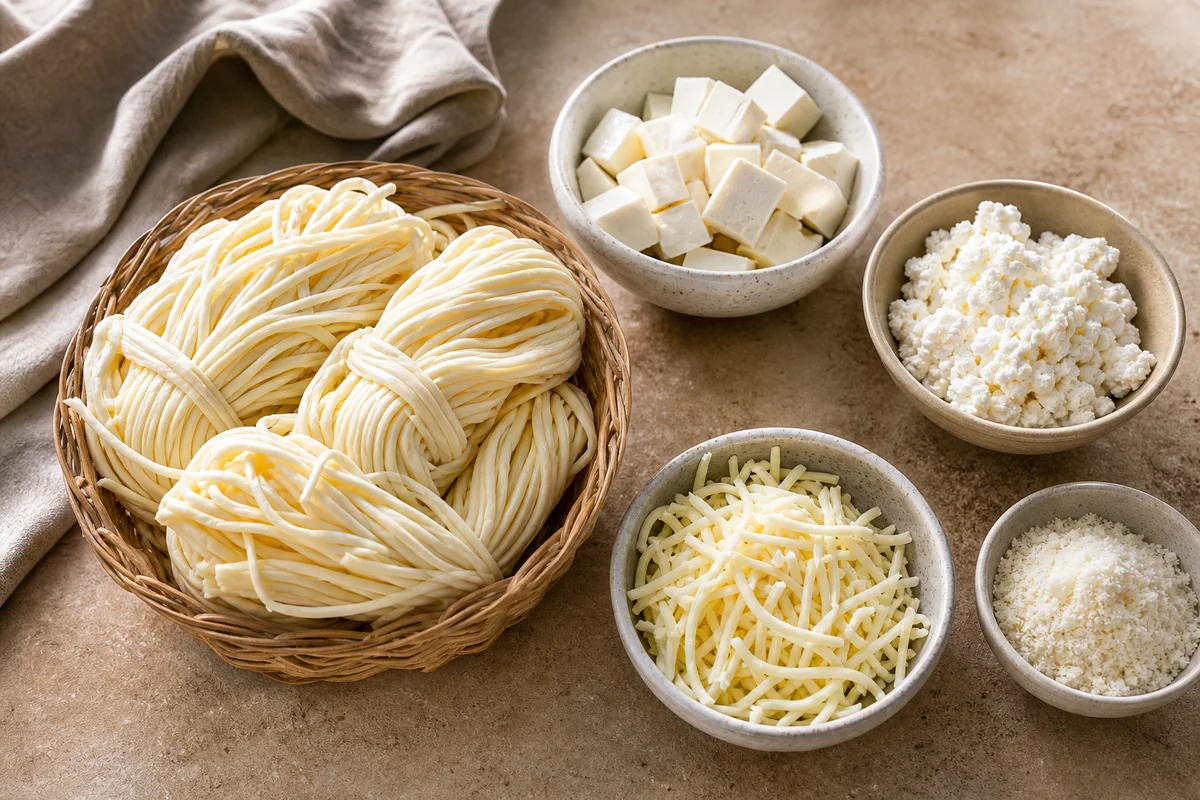
5 Best Basket Cheese Substitutes (Honest Picks)
Ingredients
Equipment
Method
- Identify how you're using basket cheese: spread on bread, fold into batter, or use as a soft topping.
- Choose the closest match from the list based on texture: creamy-spread (cream cheese/neufchâtel) vs. bake-friendly curds (drained ricotta/cottage cheese).
- Apply the listed ratio. For wetter options (ricotta/cottage cheese/yogurt), blot or drain first so the final texture tightens.
- Adjust for flavor: if your substitute tastes flat, add a pinch of salt; if it's too tangy for the dish, balance with a small pinch of sugar (only in sweet bakes).
- Do a quick test: mix a small portion into your base and check thickness before committing to the full batch.
Notes
- Basket cheese varies by brand and drain level-draining/blotting is the biggest lever for matching texture.
- For baking, prioritize substitutions that you can thicken (cream cheese/neufchâtel or drained ricotta/cottage cheese).
Tried this recipe?
Let us know how it was!
Carrie is a food writer and editor with more than 15 years of experience. She has worked for some of the biggest names in the food industry, including Bon Appétit, Food & Wine, and Martha Stewart Living.
As the Editor in Chief of EpicureDelight, Carrie oversees all of the content on the site. She also manages the team of contributing writers and editors, who help to create delicious recipes, helpful tips, and informative articles that you’ll find on the site.
A native of the Chicago area, Carrie is passionate about all things food. She loves trying new restaurants and experimenting with new recipes in her kitchen. She’s also a graduate of the Culinary Institute of America, so she knows a thing or two about food!



