
Farro has that specific bite. Pull a forkful from a warm grain bowl and you feel it: dense, slightly springy, still with a little resistance at the center.
That texture is what most swaps get wrong. Choosing a good farro substitute means matching the grain's behavior in the pan, not just its color on a plate.
The failure usually comes from one mismatch. A soft grain soaks up dressing and collapses.
A faster grain cooks through before the recipe even warms up. Get the texture logic right first, and the swap almost always works.
The best farro substitutes match either its chewy bite (barley, spelt berries) or its soft bulk (brown rice, quinoa). Use a 1:1 volume ratio for most swaps, start checking doneness 5 minutes early, and cool the grain before mixing with any dressing or sauce.
5 Best Farro Substitute Picks (Closest Match by Texture)
The table below ranks your five options by how closely they replicate farro in real recipes. Scan it first, then read the section for whichever grain fits your dish.
| # | Substitute | Best For | Ratio | Key Note |
|---|---|---|---|---|
| 1 | Barley (pearled/semi-pearled) | Both | 1:1 | Check 5 min early |
| 2 | Spelt berries | Both | 1:1 | Nutty, forgiving texture |
| 3 | Brown rice (short/medium) | Both | 1:1 | Undercook for more bite |
| 4 | Quinoa | Bowls | 1:1 | Fluffy, not chewy |
| 5 | Oats (steel-cut/rolled) | Baking | 1:1 | Best as binder or base |
Two things shape the choice: how much chew you need, and how long your recipe actually cooks. If the dish holds dressing for hours, you want a grain that stays firm even when wet.
That's where the tangy dressing sit-time matters as much as the grain itself.
For any of these swaps, start checking doneness earlier than the package says. Finish to your preferred bite and pull the grain from heat before it crosses into mushy.
1. Barley (Pearled or Semi-Pearled)
Barley is the closest thing to farro's chew that most grocery stores carry. It has a mild, grainy flavor and holds its shape well in warm bowls and grain salads.
Understanding barley's flavor profile helps you predict how it pairs once you add acid or salt.
Pearled Barley
Works for: Quick weeknight bowls, soups, salads where you want some softness
Skip if: Grains need to stay fully intact for 2+ hours in dressing
Semi-Pearled Barley
Works for: Farro-style grain salads, roasted vegetable bowls, stuffed vegetables
Skip if: You need a very fast-cooking grain and can't monitor closely
- Best recipe fits: Grain bowls, warm salads, stuffed peppers, and broth-based soups
- Cooking-time adjustment: Start checking barley 5 minutes before the suggested time; it softens faster than semi-pearled farro
- Preventing mushiness in salads: Undercook by 2 minutes, spread on a sheet pan to cool, then dress cold so the grains firm up before they absorb liquid
Skip if: Your salad needs grains to stay firm for 2 or more hours after dressing. Barley can soften quickly unless you undercook and cool first.
2. Spelt Berries
Spelt berries sit in the same grain family as farro, and the eating experience is close: nutty, slightly dense, and springy at the center. They're forgiving to cook and won't require a dramatic shift in how you build your recipe.
If you want to understand the structural differences between spelt and its nearest relative, the wheat berry comparison is worth a quick read before you buy.
- Ratio: Use spelt berries 1:1 by volume in place of farro; water ratio stays the same
- Doneness window: Start checking 5-8 minutes before the suggested time; they go from chewy to tender fast
- Where they shine: Warm grain salads with roasted vegetables, stuffing-style bakes, and herb-forward bowls where farro's nuttiness is part of the dish
- Where they struggle: Very short-cook recipes where you'd normally rely on a 10-minute grain; spelt berries still need 30-40 minutes from dry
Skip if: Your recipe calls for a quick-cooking grain. Spelt berries take similar time to farro and won't speed up your meal.
3. Brown Rice (Short or Medium Grain)
Short or medium grain brown rice is a solid stand-in when you want tender bulk rather than the specific chew of farro. It absorbs liquid well and fills the bowl in the same satisfying way.
Knowing brown rice's flavor notes helps you season it to land closer to farro's mild nuttiness.
- Best uses: Grain bowls, casseroles, baked pilafs, and any dish where farro plays a background bulk role
- Keeping it from going soft: Cook to just under done, drain immediately, and cool on a flat surface before adding sauce or dressing
- Reheat tip: Add 1-2 tablespoons of water or broth per cup of rice when reheating; it loosens clumps and refreshes texture without overcooking
Skip if: You're making a farro salad that needs to hold its structure for the whole meal. Brown rice softens more than farro and will lose its shape under prolonged dressing contact.
4. Quinoa
Quinoa is the fast option. It cooks in about 12-15 minutes, absorbs broth well, and adds visible grain texture to any bowl.
The tradeoff is clear: quinoa is springy and light, not dense and chewy. If you're deciding whether the quick cook is worth the texture compromise, consider choosing lighter grain options before committing to this swap.
Where quinoa does work well is in recipes where farro is providing bulk and nutrition rather than a specific bite. Think grain bowls, lunch prep containers, and warm salads where the dressing and toppings carry the flavor.
- Reduce wateriness: Use a 1:1.75 grain-to-water ratio instead of 1:2 to avoid pooling liquid at the bottom of the bowl
- Drain well: After cooking, let quinoa sit uncovered for 5 minutes to steam-dry before fluffing
- Cool before mixing: Like most grains, quinoa holds its shape better in salads if it's fully cool before dressing goes on
Skip if: Your recipe specifically depends on farro's chewy strands. Quinoa's springy texture reads differently, and that gap is noticeable in simple dishes.
5. Oats (Steel-Cut or Rolled)
Oats are an emergency substitute for baking, not a first choice for grain salads. In baked recipes where farro adds chew, texture, or acts as a binding base, steel-cut oats come closest.
The grain-forward swap options are worth reviewing if you're deciding between oats and barley for a baking application.
| Use | Ratio | Notes |
|---|---|---|
| Binder (muffins, loaves) | 1:1 by volume | Rolled oats; let batter rest 10 min to hydrate before baking |
| Grain texture base | 1:1 by volume | Steel-cut oats; cook to just-chewy before adding to batter |
| Thickener (baked casseroles) | Use 75% of farro amount | Either type; reduce slightly to avoid gummy results |
- Which type to choose: Steel-cut holds bite longer and reads more grain-like; rolled oats soften fast and work better as a binder
- Hydration expectations: Both oat types absorb more liquid than farro per cup; reduce added liquid by 2 tablespoons per cup of oats
- Batter rest rule: Let any batter with oats sit for 8-10 minutes before baking so the oats fully absorb moisture and won't feel raw
Skip if: Visible whole-grain texture matters in the final dish. Cooked oats can read as porridge-like rather than distinct grains, which changes the look entirely.
Making Any Farro Substitute Work (Timing + Texture Fixes)
The method is the same regardless of which grain you choose. Start checking doneness earlier than you expect, cool the grain before it meets dressing or sauce, and use liquid to refresh it if it tightens up overnight.
Understanding how grains absorb stored moisture over time helps you plan ahead for meal-prep batches that need to stay firm across multiple days.
- Check doneness early: Pull a grain and bite through it 5 minutes before the suggested time; it should have a small firm center, not be fully soft
- Cool and drain rule: Spread the cooked grain on a sheet pan or wide bowl and let it cool uncovered for at least 10 minutes before combining with dressing or broth
- Dressing and broth refresh: If the grain feels tight or dry the next day, add 2 tablespoons of warm water or broth per cup and toss before serving; do not reheat until after you've added liquid
Skip if: Your recipe is already liquid-heavy at rest, like a soup or stew. In that case, you can cook the substitute grain to a slightly softer doneness and let the broth handle the final hydration.
Frequently Asked Questions
Pearled or semi-pearled barley is the closest match for farro's chew. It holds its bite well in bowls and salads when you undercook slightly and cool before dressing.
Yes, if you pull it 2 minutes early and cool it flat before dressing. Brown rice softens faster than farro, so it won't hold up well for hours in dressing.
Spelt berries take roughly the same time as farro, around 30-40 minutes. Soaking is optional but reduces cook time by about 10 minutes and produces more even texture.
Barley works best in bowls and grain salads. In baking, it can add chew but softens more than farro; steel-cut oats or spelt berries are more reliable baking substitutes.
Add 2-3 tablespoons of warm water or broth, cover, and cook on low heat for 3-5 more minutes. Avoid stirring constantly; let steam do the work to prevent sticking.
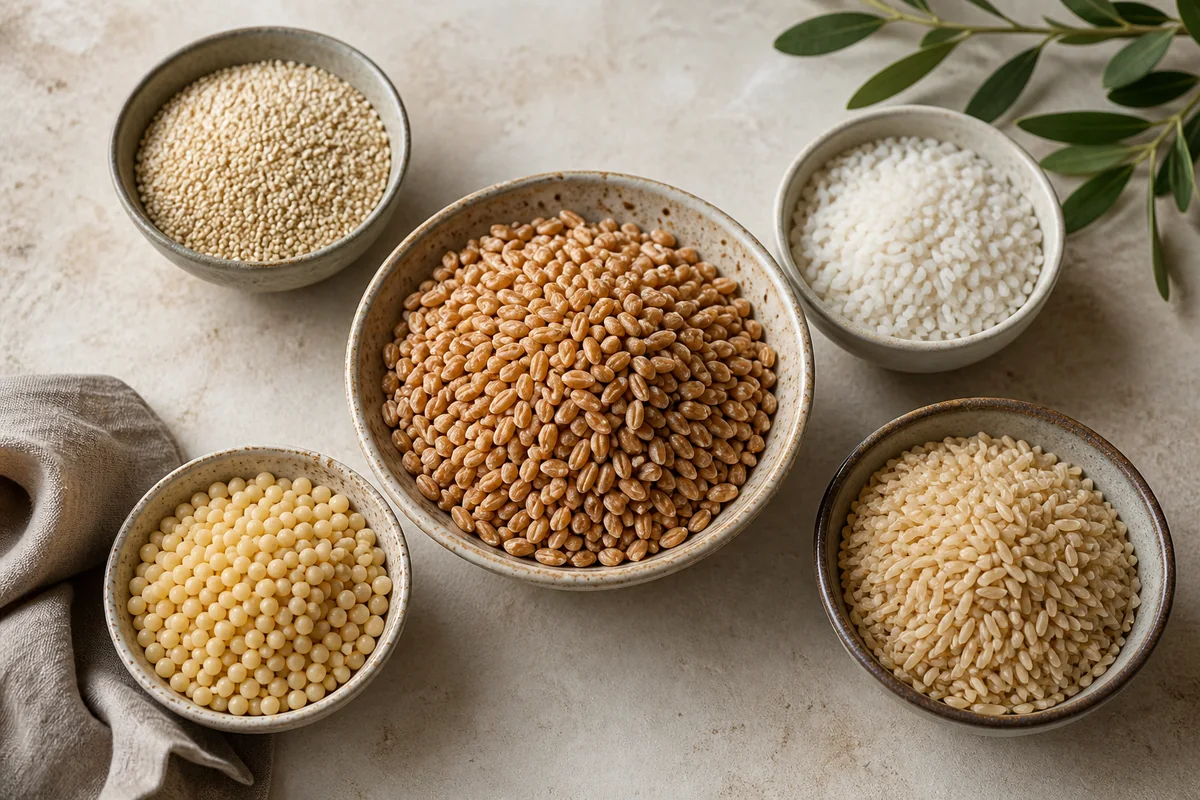
5 Best Farro Substitutes (Closest Match)
Ingredients
Equipment
Method
- Decide what you need most: chewy bite (barley/spelt) or softer grain bulk (brown rice/quinoa).
- Measure your substitute using the 1:1 ratio, then start checking doneness 5 minutes earlier than farro would typically take.
- If your recipe needs farro’s texture (salads or warm grain bowls), drain/undercook slightly and cool before mixing.
- If your recipe is baking-thick or binding-heavy, use the substitute that softens well (spelt/oats) and let the batter sit briefly before baking to hydrate.
- Taste-test the grain before combining with dressing or sauce; add a splash of water/broth and rewarm if it has tightened.
Notes
- Cooking times vary by brand and grain type (pearled vs semi-pearled, berries vs flour-form).
- For best texture in salads, cool grains after cooking to firm up and prevent mushiness.
- For baking uses, let the grain hydrate so it mimics farro’s structure once baked.
Tried this recipe?
Let us know how it was!
Carrie is a food writer and editor with more than 15 years of experience. She has worked for some of the biggest names in the food industry, including Bon Appétit, Food & Wine, and Martha Stewart Living.
As the Editor in Chief of EpicureDelight, Carrie oversees all of the content on the site. She also manages the team of contributing writers and editors, who help to create delicious recipes, helpful tips, and informative articles that you’ll find on the site.
A native of the Chicago area, Carrie is passionate about all things food. She loves trying new restaurants and experimenting with new recipes in her kitchen. She’s also a graduate of the Culinary Institute of America, so she knows a thing or two about food!



