
That cooling sensation mint delivers-whether it's floating in a mojito or scattered over a lamb chop-is actually two separate things. There's the fresh, bright-green lift, and then there's the cold-tasting menthol hit.
A good mint substitute matches whichever one your recipe actually needs.
The choice matters more than most people think. Swapping for the wrong herb gives you a dish that tastes almost right but slightly off.
Pick based on your goal: cooling for drinks and dressings, brightness for fruit and tea, or a plain herbal lift for savory sauces.
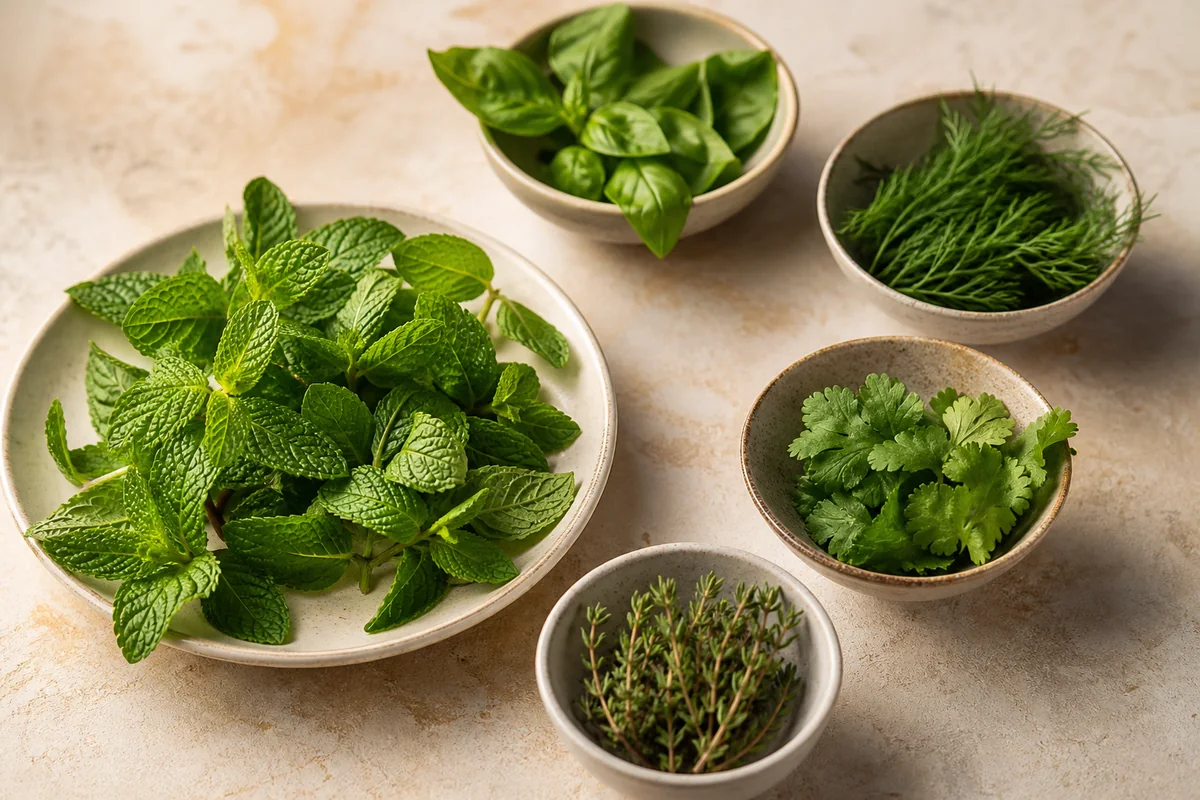
The best mint replacement depends on what mint is doing in the dish. For cooling, use spearmint or peppermint. For bright freshness, use lemon balm. For savory herb lift, reach for basil or cilantro. Start with 70% of the called-for amount, taste, and adjust from there.
Best Mint Substitutes (Quick Swap Guide)
Each substitute below targets a specific job mint does in a recipe. Use the table as a fast reference, then read the section for the swap that fits your dish.
| # | Substitute | Best For | Ratio | Key Note |
|---|---|---|---|---|
| 1 | Spearmint | Both | 1:1 | Mildest true-mint option |
| 2 | Peppermint | Both | 1:1 fresh / use less dried | Intense-start with less |
| 3 | Lemon Balm | Fresh | 1:1 | Citrusy, not icy |
| 4 | Sweet Basil | Savory | 1:0.75 | Add citrus to mimic lift |
| 5 | Cilantro | Savory | 1:0.75 | Pair with lime always |
5 Best Mint Substitutes Ranked by Flavor Goal
1. Spearmint
Spearmint is the most reliable mint swap because it is, technically, a mint. Its flavor is softer and less intense than peppermint, with a mild sweetness that rarely overwhelms a dish.
It works well in drinks, garnishes, salads, and fruit-forward preparations. The tea variety comparison breaks down how spearmint's gentler profile differs from peppermint's sharper one.
Spearmint
Works for: Cocktails, garnishes, fruit salads, mint sauce, yogurt dips, iced tea
Skip if: You need the sharp, almost medicinal cooling of peppermint-spearmint won't deliver that intensity
- Ratio: Use 1:1 by volume for fresh leaves in any recipe
- Timing: Add at the same point you would add fresh mint-last for garnishes, early for muddled drinks
- Intensity: Spearmint is about 20% milder, so you can nudge slightly over 1:1 if the dish needs punch
2. Peppermint
Peppermint carries significantly more menthol than common garden mint, which means a little goes a long way. Fresh peppermint at 1:1 is usually fine; dried peppermint is much stronger and needs halving.
The minty liqueur distinction is a good frame for thinking about cooling intensity-some mint moments call for that sharp edge, others don't.
- Fresh peppermint: Use 1:1, but taste after the first mix before adding more
- Dried peppermint: Start at half the amount; dried is concentrated and hits fast
- For drinks: Add late-muddle only briefly, or drop in as a garnish rather than blending
- For sauces: Stir in at the end, off heat, to keep the flavor clean and not soapy
Skip if: Your dish is delicate-light fruit teas or subtle panna cotta-where peppermint's boldness will take over.
3. Lemon Balm
Lemon balm is in the mint family but leans toward lemon verbena territory. It gives you freshness and a herbal lift without the icy menthol quality that peppermint and spearmint carry.
It is best in fruit salads, cold teas, summer cocktails, and light desserts where brightness is the goal. Using fresh citrus juice alongside lemon balm can sharpen the effect and get closer to mint's clean finish.
Use it at a 1:1 ratio for fresh leaves. Tear or gently bruise the leaves before adding to release the oils.
It holds up in cold preparations but wilts quickly under heat, so skip it in cooked sauces.
- Best uses: Fruit salad, cold cocktails, iced tea, yogurt parfaits
- Avoid heat: Lemon balm loses its brightness quickly when cooked
- Pair with: Honey or elderflower to round out the citrusy edge in drinks
Skip if: You need that pure icy cooling note-lemon balm reads citrusy and soft, not cold.
4. Sweet Basil
Sweet basil has a floral, slightly peppery character that works in savory mint contexts. In a lamb sauce, grain salad, or cucumber-yogurt dip, basil reads as fresh and herb-forward-it just doesn't cool the way mint does.
To bring it closer to mint's profile, add a small pinch of sugar (for sweet recipes) or a squeeze of lime brightener (for savory ones). That citrus note lifts basil's flavor and approximates mint's brightness.
Use ¾ of the amount mint calls for and taste before adding more.
- Ratio: 0.75:1 (three-quarters the amount of mint called for)
- Citrus boost: Add 1 teaspoon lemon or lime juice per 2 tablespoon basil to mimic mint's lift
- Chop fine: Basil bruises and blackens fast-chiffonade or tear just before using
- Best dishes: Tabbouleh, tzatziki-style sauces, grain bowls, summer pasta salads
Skip if: Your recipe is a cold drink where basil's floral warmth will read strange against ice.
5. Cilantro
Cilantro doesn't taste like mint. It tastes like cilantro-bright, green, and slightly soapy for some people.
But in lime-forward savory dishes, it fills the same role mint does: fresh green contrast.
Mint vs. Cilantro
Works for: Salsas, marinades, savory salads, tacos, grain bowls with citrus dressing
Skip if: You dislike cilantro's flavor, or the recipe is sweet-cilantro in a dessert or tea will clash
For a dish like choosing cilantro-lime chicken over mint-marinated chicken, the swap is natural-the lime does the lifting and cilantro brings the green freshness. Use ¾ of the mint quantity and always pair with citrus.
- Chop just before using: Cilantro wilts fast and browns at the cut edges
- Always add lime or lemon: Without citrus, the fresh-herb effect is weaker
- Use stems too: Cilantro stems carry strong flavor-chop fine and add to marinades
Making Mint Substitutes Work (Taste, Time, and Adjustment)
The single most useful rule when swapping any herb is to add in stages. Start at 70% of the quantity, taste, and build up.
Mint's flavor is assertive, and most substitutes will hit differently-some faster, some softer-so early tasting saves the dish.
Timing also changes the result. Herbs added early in cooking mellow out; herbs added at the end stay sharp and green.
For cold drinks and garnishes, always add the substitute last. If you need to explore tarragon as a backup herb for this same principle, picking the right tarragon option follows the same timing logic.
- Start at 70%: Use three-quarters of the mint amount first, taste, then adjust upward in small additions
- Add late for freshness: Stir fresh herb substitutes in off-heat or just before serving to preserve the green, bright character
- Citrus is a cheat code: A squeeze of lemon or lime alongside any substitute closes the gap when the "fresh" note feels missing
Frequently Asked Questions
Spearmint is the closest match for cocktails and cold drinks. It has a true mint flavor with slightly less intensity, so it swaps in at 1:1 without overpowering.
Yes, but use one-third the amount-dried herbs are concentrated. Dried mint works in cooked sauces; it doesn't work well as a garnish.
Start with half the amount and taste before adding more. For drinks, add peppermint as a garnish rather than muddling it into the base.
Sweet basil is the best option for savory sauces. Add a small squeeze of lemon to mimic mint's brightness and use about three-quarters the amount.
Both work visually and add fresh green contrast. Basil suits Italian or Mediterranean plates; cilantro fits Mexican and Southeast Asian dishes better.
5 Best Mint Substitutes (Tested Swaps)
Ingredients
Method
- Decide what mint role you need: cooling (cocktails/dressings), brightness (fruit/tea), or herb lift (savory sauces).
- Choose the closest match from the list using the ratio, then chop or crush the substitute to release oils.
- Add about 70% at first, mix well, and taste—mint flavor is easy to overshoot.
- If your swap lacks the “cool” effect, compensate with a small squeeze of citrus or a tiny pinch of sugar (depending on the recipe).
- Finish with the substitute late (if possible) to preserve freshness, especially for garnishes and uncooked drinks.
Notes
- For drinks, use fresh herbs and add at the end to prevent flavor fading.
- Dried herbs are more concentrated—start with less and adjust after tasting.
Tried this recipe?
Let us know how it was!
Carrie is a food writer and editor with more than 15 years of experience. She has worked for some of the biggest names in the food industry, including Bon Appétit, Food & Wine, and Martha Stewart Living.
As the Editor in Chief of EpicureDelight, Carrie oversees all of the content on the site. She also manages the team of contributing writers and editors, who help to create delicious recipes, helpful tips, and informative articles that you’ll find on the site.
A native of the Chicago area, Carrie is passionate about all things food. She loves trying new restaurants and experimenting with new recipes in her kitchen. She’s also a graduate of the Culinary Institute of America, so she knows a thing or two about food!



