
Taleggio has a washed-rind funk that most cheeses don't come close to matching, and that's exactly what makes swapping it frustrating.
It's a semi-soft, cow's-milk Italian cheese aged 35-60 days, with roughly 48-52% fat in dry matter, and it delivers a silky melt that holds together cleanly between 130-150°F without splitting or turning greasy.
Finding a substitute means making a trade-off. You can match the melt, or you can chase the aroma, but rarely both at once.
This article cuts through that by giving you direct swaps organized by how you're actually using the cheese.
Fontina is the best overall Taleggio substitute at a 1:1 ratio, covering melting pizzas, crostini, and baked pastas. Most other options swap 1:1 as well. The main limitation is that no substitute fully replicates the washed-rind aroma that defines authentic Taleggio.
5 Best Substitutes for Taleggio Cheese to Try
These five options cover the full range of Taleggio's uses. Each one was chosen for a specific context, so pick based on what your recipe actually needs.
| # | Substitute | Best For | Ratio | Key Note |
|---|---|---|---|---|
| 1 | Fontina | ✨ Both | 1:1 | Best melt match |
| 2 | Robiola | 🥗 Raw | 1:1 / ¾:1 | Softer; boards only |
| 3 | Munster | 🍳 Cooking | 1:1 | Stronger washed-rind |
| 4 | Brie | ✨ Both | 1:1 | No washed-rind aroma |
| 5 | Smoked Scamorza | 🍳 Cooking | 1:1 | Adds smoky note |
1 - Fontina
Fontina is a pasteurized cow's-milk cheese with roughly 45% fat in dry matter, and it melts smoothly at 130-145°F, which puts it squarely in Taleggio's range. It's the go-to for anyone who needs reliable melt above everything else.
Classic Fontina has a long history in fonduta, and the 1:1 swap translates directly to risotto, pizza, and baked casseroles.
It's slightly nuttier and less pungent than Taleggio, so if you're ever caught without it, the options for working without fontina cheese are narrower than many cooks expect.
- Ratio: 1:1 in all applications - no adjustment needed.
- Best Uses: Pizza, fonduta, baked pasta, creamy sauces, and casseroles.
- Watch: Milder aroma means washed-rind depth is lost; acceptable in most cooked dishes.
- Texture: Melts to a smooth, slightly stretchy consistency without splitting.
2 - Robiola (or mixed soft-rind cheeses)
Robiola is a soft Italian cheese that can be made from cow's, goat's, or sheep's milk, or any combination. Mixed-milk versions tend to sit at 60-75% moisture, giving a spreadable texture similar to Taleggio on a board but noticeably less structured in heat. It ages less than 30 days, so the paste is fresh and mild with just a faint tang.
Use Robiola at 1:1 on a cheese board or for crostini. Drop to ¾:1 in cooked dishes because its higher moisture content makes it slicker and thinner than Taleggio under heat.
If your supply runs short, knowing when robiola cheese runs out and what to reach for next will save the dish.
- Ratio: 1:1 on boards; ¾:1 in hot applications.
- Best Uses: Cheese boards, crostini, cold appetizers, and light warm dips.
- Prep Tip: Serve at room temperature for 20 minutes to improve spreadability.
Robiola vs Taleggio
Works for: Fresh boards, spreads, and cold preparations where creamy texture matters most
Skip if: You need full melt - Robiola softens but rarely reaches Taleggio's runny consistency under heat
3 - Munster (French Munster / German Muenster)
Munster is the closest match to Taleggio's washed-rind character. It's a cow's-milk cheese aged 5-6 weeks with the same surface-bacteria washing technique, which produces a stronger ammonia and earthy aroma. It melts reliably at 135-150°F and browns well under a broiler, making it a solid pick for grilled cheese, open-faced tartines, and gratins.
Use it at a 1:1 ratio, but pay attention to intensity. Munster's aroma runs noticeably stronger than Taleggio's, which can overwhelm subtle recipes.
If that's a concern, blend 75% Munster with 25% Fontina to keep the washed-rind depth while softening the sharp edge.
- Ratio: 1:1 standard; 75/25 Munster-Fontina blend for milder dishes.
- Best For: Grilled cheese, tartines, gratins, and any recipe needing washed-rind aroma.
- Aroma Tip: Remove rind before melting if the ammonia smell is too pronounced at room temperature - the cooked interior is milder.
Mid-Article Use Guide
| Use | Ratio | Notes |
|---|---|---|
| Melting & Baking | 1:1 | Fontina - smoothest melt, clean sauce integration |
| Boards & Cold Uses | 1:1 | Robiola - spreadable, mild tang, best at room temp |
| Grill / Smoky Applications | 1:1 | Smoked Scamorza - browning, smoke note, slight stretch |
4 - Brie (or Camembert for creamier board and gentle melt)
Brie is a widely available soft-ripened cow's-milk cheese with about 60% moisture and 45-50% fat in dry matter. It's the easiest swap when Taleggio is unavailable for a board or a gently baked topping. The white bloomy rind is edible and adds mild earthiness, though it doesn't carry the washed-rind funk that how Taleggio cheese tastes is known for.
Brie's interior goes runny at 120-135°F, which is slightly lower than Taleggio's range. For baked recipes, slice Brie thinner than you would Taleggio so it melts through before the dish over-browns.
- Ratio: 1:1 on boards; slice thinner for baking to ensure full melt.
- Best Trick: Lower oven temperature by 10-15°F to avoid over-browning before the cheese fully melts.
- Texture Note: Brie's rind stays slightly firm even when the interior is runny; remove it for smooth sauces.
5 - Smoked Scamorza (or regular Scamorza)
Smoked Scamorza is a pasta filata cheese - stretched-curd style - that's cold-smoked after shaping. It's firmer than Taleggio at room temperature but melts to a stringy, slightly elastic texture around 140-155°F. Understanding what sets scamorza cheese apart from other melting cheeses helps explain why it excels on pizza and in grilled sandwiches where you want visible pull and a light smoky edge.
Use it at 1:1 for grilled applications. For a cheese board, let it rest at room temperature for 20-30 minutes first to soften the texture.
If you ever need a different option in that grilled context, when scamorza cheese runs out covers the next best moves.
- Ratio: 1:1 for grilling and baking; room-temp rest needed for board use.
- Best For: Grilled sandwiches, pizza, panini, and broiled vegetable dishes.
- Prep Tip: Rest 20-30 minutes at room temperature before serving on a board to improve sliceability.
Smoked Scamorza vs Taleggio
Works for: Grilled, broiled, and baked applications where melt and browning matter
Skip if: You need a creamy spread or raw board cheese - Scamorza is too firm without resting
Adjusting Your Recipe for These Substitutes
Swapping cheese isn't always drop-in simple. A few small adjustments keep the dish on track regardless of which substitute you choose.
- Lower oven temp by 10-15°F when using Brie or Camembert - their lower melt point means they'll brown before the dish is done.
- Add 1-2 tablespoons of milk or cream per cup of Robiola or Brie in sauces and risottos to match Taleggio's natural silkiness.
- Blend Munster 75/25 with Fontina to preserve washed-rind depth while keeping the aroma from overpowering lighter ingredients.
- Remove the rind from Brie or Munster before adding to smooth sauces - rinds can create uneven texture.
- Test a small portion first - melt 1-2 oz of the substitute in a small pan using the same method to confirm aroma and texture before finishing the full recipe.
Proper storage also matters once you've made your swap. Knowing when Taleggio cheese goes bad applies broadly to semi-soft substitutes too; most follow similar fridge-life guidelines once opened.
Frequently Asked Questions
Cheddar melts at a higher temperature (around 150-160°F) and has a sharper, more acidic flavor profile that clashes with the mild, creamy role Taleggio plays in baked pasta. It also lacks the semi-soft paste texture, so the result will be grainier and less cohesive. Fontina at 1:1 is a much closer match for that dish.
No plant-based cheese currently replicates Taleggio's washed-rind aroma or its specific melt behavior reliably. Cashew-based soft vegan cheeses can approximate the creamy texture on a board, but they don't melt smoothly in baked dishes. For cooked recipes, a vegan Mozzarella-style block gives better melt consistency than a spread-style product, though the flavor gap remains significant.
Wrap opened semi-soft cheeses like Taleggio, Fontina, or Munster in wax paper first, then loosely in plastic wrap, and refrigerate at 35-40°F. This lets the cheese breathe without drying out. Soft-rind cheeses like Brie and Robiola are best kept in their original packaging or a loosely sealed container; for Brie specifically, guidance on storing camembert properly applies almost identically.
Munster's aroma is noticeably stronger than Taleggio's, and in a tart with delicate fillings - caramelized onion, leek, or mushroom - it can dominate. The 75% Munster / 25% Fontina blend reduces that risk while keeping enough washed-rind character to feel intentional. Use the full-strength Munster only when other bold flavors (cured meats, roasted garlic) are already in the tart.
Once sliced and left at room temperature on a board, most semi-soft cheeses are best consumed within two hours. Refrigerated and re-wrapped after serving, sliced Fontina and Munster keep 3-5 days; Robiola and Brie are softer and best used within 2-3 days after cutting. Smoked Scamorza is the most durable, holding up to 5-7 days tightly wrapped in the fridge.
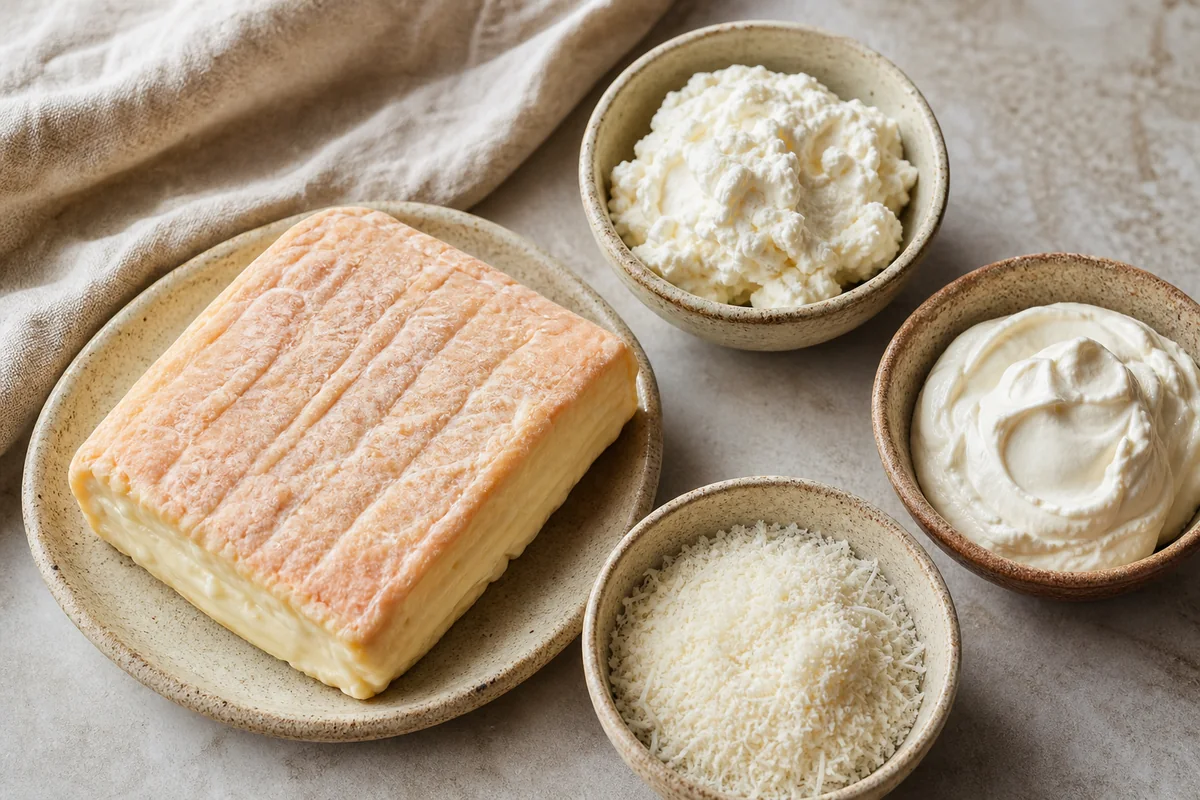
5 Best Taleggio Cheese Substitutes in Every Recipe
Ingredients
Equipment
Method
- Choose substitute by application: Fontina for melting, Robiola or Brie for boards, Munster for washed-rind depth, Scamorza for grill/smoke.
- Measure substitute at the recommended ratio (most are 1:1; Robiola may use ¾:1 in hot dishes).
- If substitute is drier or firmer, add 1-2 tablespoons milk or cream per cup to match Taleggio's silkiness in sauces or risottos.
- Adjust cooking temperature: reduce oven temp 10-15°F if using higher-fat soft cheeses to avoid over-browning while achieving runniness.
- Test one small portion (if unsure): heat 1-2 oz of substitute in the recipe's intended way to check melt and aroma before committing to the full batch.
Notes
- When in doubt for aroma, blend a stronger washed-rind cheese with a milder melting cheese at 75/25.
Tried this recipe?
Let us know how it was!
Carrie is a food writer and editor with more than 15 years of experience. She has worked for some of the biggest names in the food industry, including Bon Appétit, Food & Wine, and Martha Stewart Living.
As the Editor in Chief of EpicureDelight, Carrie oversees all of the content on the site. She also manages the team of contributing writers and editors, who help to create delicious recipes, helpful tips, and informative articles that you’ll find on the site.
A native of the Chicago area, Carrie is passionate about all things food. She loves trying new restaurants and experimenting with new recipes in her kitchen. She’s also a graduate of the Culinary Institute of America, so she knows a thing or two about food!



