
That deep brown crust on roast potatoes or a perfectly seared steak? Beef tallow is often behind it.
When you can't get your hands on it, or you're cooking for someone who avoids animal fats, you need a beef tallow substitute that actually delivers on browning and texture-not just a shrug of a swap.
Beef tallow is rendered beef fat. It's semi-solid at room temperature, has a high smoke point around 400°F, and adds a savory, slightly meaty undertone to whatever it touches.
Understanding what it does is the fastest way to match it correctly.
The best beef tallow substitutes are lard, ghee, duck fat, an olive oil and butter blend, and vegetable shortening. Each fat mimics tallow's browning or structural role depending on whether you're roasting, frying, or baking. Lard is the closest 1:1 swap for most savory dishes.
5 Best Beef Tallow Substitutes (At a Glance)
Rendered solid fats are usually the closest performers, since they mimic tallow's spoonable texture and browning behavior best.
If you're already exploring fat swaps, you may also be curious about unsalted butter substitutes or olive oil alternatives that work in similar savory contexts.
| # | Substitute | Best For | Ratio | Key Note |
|---|---|---|---|---|
| 1 | Lard | Roast / Fry | 1:1 | Closest neutral-fat match |
| 2 | Ghee | Bake / Sauté | 1:1 | Butter-forward, dairy present |
| 3 | Duck Fat | Roast / Sauté | 1:1 | Richest crisping result |
| 4 | Olive Oil + Butter | Sauté / Bake | ¾:1 | Blend beats oil alone |
| 5 | Vegetable Shortening | Bake | 1:1 | Best for structure, flat flavor |
5 Beef Tallow Substitutes Matched to Your Dish
1. Lard
Lard is the obvious first call when a recipe needs solid fat that browns hard and stays out of the way flavor-wise. It's rendered pork fat, semi-solid at room temperature, and behaves almost identically to tallow in a cast iron pan or roasting tray.
If you're curious about gaps where lard still doesn't hit, lard alternatives cover the next tier of swaps well.
Use it at a 1:1 ratio by weight for the most consistent results. For pan-frying or roasting, melt it first and brush a thin layer onto the food before it hits the heat-this jumpstarts browning before the fat in the pan fully heats.
- Texture match: Semi-solid, spoonable-nearly identical to tallow at room temperature
- Smoke point: Around 370-375°F, slightly lower than tallow but still strong for most roasting
- Flavor: Mildly porky, much less pronounced than tallow's beef note-most people won't notice the difference in mixed dishes
- Best uses: Roasted potatoes, pan-seared meats, pie crust, tamales
Lard vs. Beef Tallow
Works for: roasting, frying, and any dish where solid-fat texture and high browning are the goal
Skip if: you want that specific beefy, savory fat flavor and your dish is simple enough for the fat to be tasted directly
2. Ghee
Ghee is clarified butter with the milk solids removed, which gives it a higher smoke point than regular butter (around 450°F) and a more concentrated, nutty quality. It's butter-forward but not as sharp as whole butter in savory bakes-a useful middle ground.
If you want a deeper look at tasting beef tallow before committing to a swap, that comparison can sharpen your choice here.
- Ratio: 1:1 by weight for baking; works directly in most recipes without adjustment
- Pie crust: Keeps layers distinct and adds a slight richness that reads as "buttery" rather than "beefy"
- Cookies: Produces crisp edges and a golden bottom crust comparable to tallow
- Savory roasting: Works well at high heat-brush onto vegetables or meat before roasting
Skip if you're avoiding all dairy. Ghee still contains trace milk proteins even after clarification, so it's not a dairy-free option.
3. Duck Fat
Duck fat sits at the overlap of luxury and practicality. It's semi-liquid at room temperature, has a smoke point around 375°F, and produces a crispness on roasted vegetables and potatoes that's hard to beat.
Understanding what duck fat tastes like before using it helps you gauge whether its mild gamey undertone will read as flavor complexity or a distraction in your dish.
- Ratio: Use 1:1 for roasting and high-heat sautéing
- Flavor intensity: More aromatic than tallow-if it feels too strong, mix 50/50 with lard on the next batch
- Best uses: Duck-fat potatoes, confit vegetables, pan sauces where richness is welcome
- Where it falls short: Baking-its semi-liquid texture doesn't firm up in dough the same way solid fats do
Skip if you need a neutral fat. Duck fat has a personality, and delicate dishes will notice it. For those cases, check the best duck fat alternatives instead.
4. Olive Oil + Butter Blend
When solid fat is not available, a blend always outperforms oil alone. Pure olive oil lacks the fat solids that help create Maillard browning, and it hits a lower ceiling before smoking.
Butter adds those solids and raises the flavor floor, but alone it burns too fast-so the blend covers both gaps. If you're building a roasting setup from scratch, it's also worth a quick look at roasting rack swaps for equipment that supports even fat distribution.
- Ratio: 3 parts olive oil to 4 parts butter by weight (use unsalted butter for control)
- Heat behavior: Start at medium heat-this blend has a lower effective smoke point than tallow; watch the pan closely
- Flavor: Slightly fruity and buttery; works best in Mediterranean-leaning dishes or where fat flavor is secondary
- Cook time: Reduce cook time by about 10% and check browning 2-3 minutes earlier than usual
Skip if your recipe requires the fat to remain solid during mixing-this blend is liquid at room temperature and won't substitute for tallow's solid-fat structure in laminated doughs or icings.
5. Vegetable Shortening
Shortening is the workhorse of the baking aisle-predictable, shelf-stable, and solid at room temperature. It's made from hydrogenated vegetable oil, which means it disperses evenly through dough without adding much flavor, making it a go-to for pie crust and cookies where structure matters more than taste.
If you need the full picture on what shortening brings to a dish (and where it falls flat), the savory use cases are worth checking.
- Ratio: 1:1 by weight for any recipe that calls for rendered fat in a baking context
- Flakiness: Stays solid through mixing, which keeps fat pockets intact and produces distinct layers in pastry
- Browning: Lighter color than tallow-expect a paler crust and adjust bake time slightly if you want more color
| Use | Ratio | Notes |
|---|---|---|
| Pie crust | 1:1 | Shortening - produces flaky, distinct layers; very pale color |
| Cookies | 1:1 | Shortening - soft crumb, less spread than tallow; add pinch of salt for flavor |
| Biscuits | 1:1 | Shortening - tender interior, minimal browning on top |
| Roasting | 1:1 | Shortening - functional but no savory note; use only if no other solid fat available |
Skip if you need the savory, beef-like flavor contribution from the fat. Shortening is flavorless by design, and in simple preparations, that gap will show.
Making Beef Tallow Substitutes Work Every Time
The core decision is always solid versus liquid fat, and whether your dish is flavor-sensitive. Roasting and frying lean toward solid fats like lard or duck fat.
Baking structure calls for shortening or ghee. And when you're working with a liquid fat blend, lower your initial heat and monitor browning more tightly than you would with tallow.
Most of these swaps are interchangeable at 1:1 by weight, with the olive oil and butter blend being the one exception at ¾ oil to 1 butter.
- Melt and brush: For roasting, melt your substitute and apply a thin coat to the surface of meat or vegetables before the tray goes in-this mimics how tallow creates an early browning crust
- Watch liquid fats closely: Oil-based substitutes brown faster at the edges and slower in the center; rotate the pan halfway through cooking to even things out
- Chill solid-fat doughs: If you're using ghee or shortening in pastry, rest the dough in the fridge for 20-30 minutes before rolling to keep fat pockets intact
Frequently Asked Questions
Lard is the closest match for roasting-it's semi-solid, has a similar smoke point, and browns food comparably. Duck fat is a strong second if you want extra crispness.
Yes, for most baked recipes you can swap at 1:1 by weight using lard, ghee, or shortening. Liquid fats like oil require a ratio adjustment and behave differently in dough.
Ghee works well in pie crust at a 1:1 ratio and keeps layers defined. It adds a mild buttery note rather than a beefy one, which suits most pie fillings.
Vegetable shortening is the most neutral option and works well in baking. For savory cooking, refined coconut oil or lard are your next-best neutral-flavored solid fats.
Reduce your cook time by about 10% and check browning earlier. Liquid fats heat unevenly compared to solid fats and can over-brown edges before the center is done.
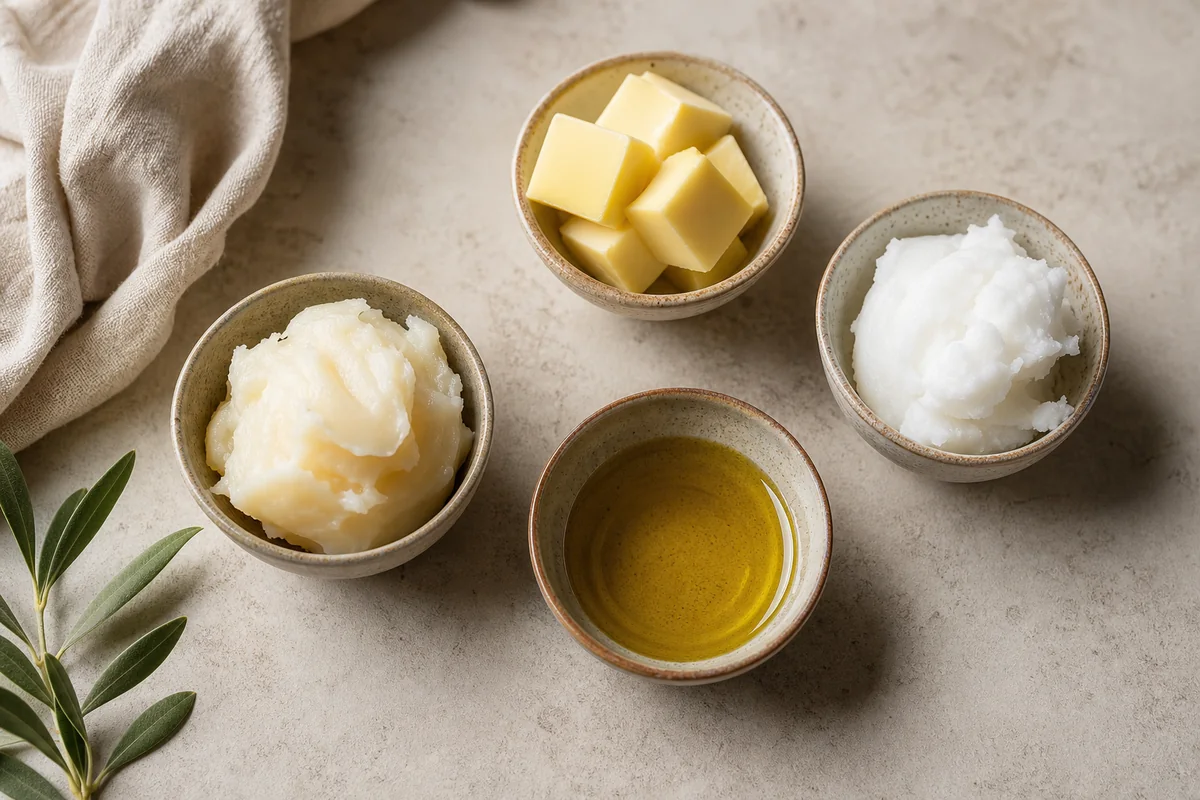
5 Best Beef Tallow Substitutes (Tested)
Ingredients
Equipment
Method
- Identify your use: browning/roasting vs. baking/structure, since fat behavior changes results.
- Start with the closest ratio from the list (usually 1:1, or ¾ oil : 1 butter for blends).
- If the substitute is softer or liquid (like olive oil), reduce the cook time slightly and watch browning closely.
- For baked goods, choose a solid fat (lard, ghee, shortening) to maintain flaky or tender crumb; chill if your recipe allows.
- Taste and adjust: if flavor is missing, add a small boost of salt or a small amount of butter flavoring next time rather than changing ratios mid-bake.
Notes
- For the closest sensory match, prioritize solid rendered fats (lard, ghee, duck fat) over oils.
- If your recipe is sensitive to flavor, use ghee or shortening rather than strongly flavored animal fats.
Tried this recipe?
Let us know how it was!
Carrie is a food writer and editor with more than 15 years of experience. She has worked for some of the biggest names in the food industry, including Bon Appétit, Food & Wine, and Martha Stewart Living.
As the Editor in Chief of EpicureDelight, Carrie oversees all of the content on the site. She also manages the team of contributing writers and editors, who help to create delicious recipes, helpful tips, and informative articles that you’ll find on the site.
A native of the Chicago area, Carrie is passionate about all things food. She loves trying new restaurants and experimenting with new recipes in her kitchen. She’s also a graduate of the Culinary Institute of America, so she knows a thing or two about food!



