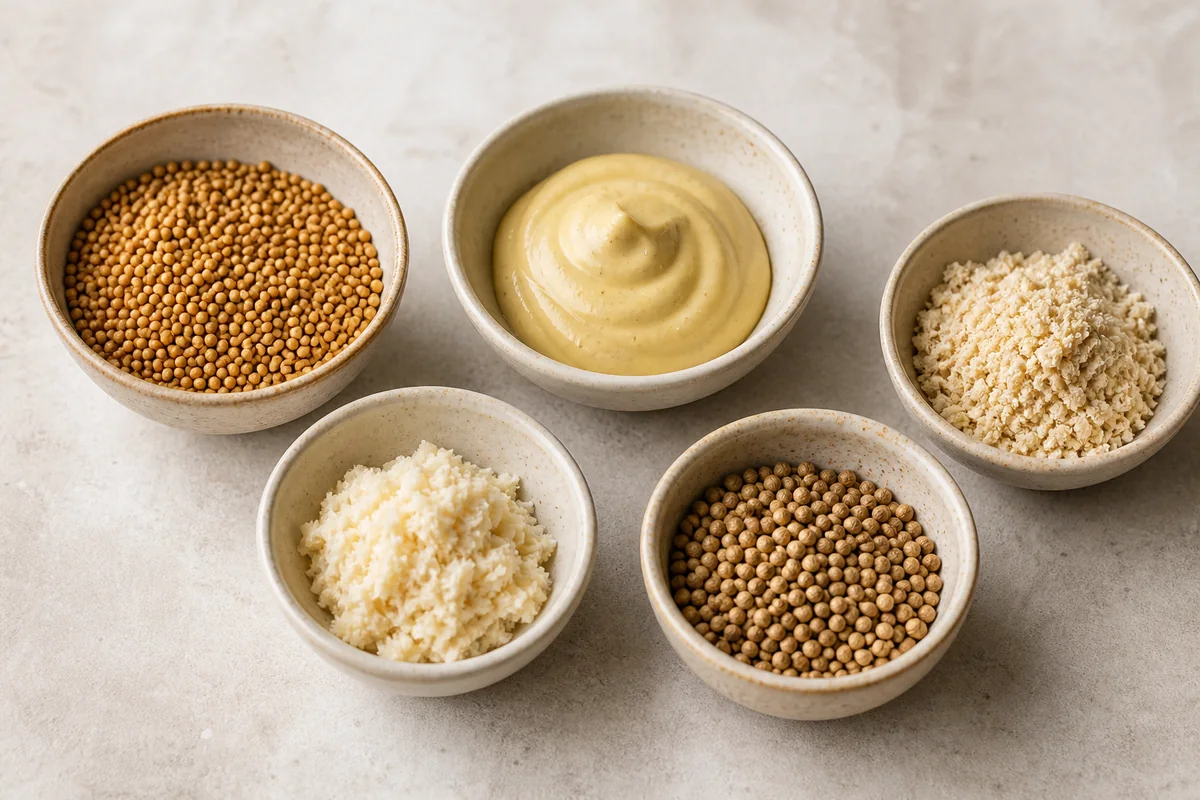
Mustard seed does three different jobs depending on how it's used. It pops and crunches whole in pickles.
It melts into baked goods as tangy warmth. It gives sauces a sharp, nasal heat when cracked or ground.
Knowing which job your recipe needs is the only way to pick a swap that actually works.
The mustard seed substitute that works for your spice rub won't necessarily work for your pickle brine. Some replacements match the flavor precisely but lose the texture.
Others nail the heat while dropping the tang.
The best swap depends on what mustard seed is doing in your recipe. Yellow mustard powder works for baking tang. Prepared Dijon handles sauces and marinades. Ground mustard covers cooking heat. For emergency texture, a pepper and acid blend gets you close.
5 Best Mustard Seed Substitutes for Any Recipe
Match the substitute to what mustard seed is doing: whole-seed crunch needs a different approach than ground-seed tang or baking heat. Use the table below as your starting point, then adjust after tasting.
| # | Substitute | Best For | Ratio | Key Note |
|---|---|---|---|---|
| 1 | Yellow Mustard Powder | Baking | 1:1 | Dissolve in wet mix first |
| 2 | Ground Mustard (Brown) | Cooking | Start at ¾:1 | Punchier than yellow powder |
| 3 | Prepared Dijon Mustard | Sauces | 1:2 | Reduce other liquids slightly |
| 4 | Wasabi Paste | Heat Only | ¼:1 | Very intense, use sparingly |
| 5 | Black Pepper + Vinegar | Emergency | 1:1 | Best for pickling-style dishes |
If your recipe depends on brine-friendly spice swaps, the pepper-and-acid option near the bottom of this list is worth reading first.
1. Yellow Mustard Powder
Yellow mustard powder is the closest thing to mustard seed's flavor profile in baked goods. It dissolves cleanly into batters and doughs, delivering that signature tang without any gritty texture.
- Ratio: Use 1 teaspoon of powder for every 1 teaspoon of whole mustard seed called for.
- Mix method: Stir the powder into your wet ingredients before combining. This prevents dry pockets and cuts the risk of bitterness.
- To avoid bitterness: Don't add it dry to flour alone. A brief mix with liquid activates it evenly.
- Timing: Add early in the recipe so the flavor has time to mellow.
This won't replicate whole-seed crunch at all. The tangy, peppery character carries through, but the physical pop of a whole seed doesn't.
Skip if: You need visible seeds for texture, such as in pickle jars or whole-grain bread toppers.
2. Ground Mustard (Brown)
Brown ground mustard is sharper and more intense than yellow mustard powder. It works well in cooked sauces, spice rubs, and braises where heat is the primary goal.
Start with about three-quarters of the amount called for. You can always add more after tasting, but you can't take it back once it's in the pan.
- For less harshness: Add it at the start of cooking so the heat mellows over time.
- For more bite: Stir it in at the end of cooking, off the heat, for a sharper finish.
- In dry rubs: Combine with a small pinch of sugar to balance the sharpness before applying.
Understanding how powder heat builds helps you judge how early to add it. Ground mustard also has a shorter potency window once opened, so check yours before using.
Skip if: Your recipe calls for a mild, rounded tang. Brown ground mustard reads noticeably sharper than whole yellow mustard seed.
3. Prepared Dijon Mustard
Dijon is what you reach for when a sauce or marinade needs mustard's flavor but you have nothing dry on hand. It adds tang and helps emulsify oil-based dressings naturally.
What You Gain
Works for: tang, emulsification in vinaigrettes, depth in pan sauces
Skip if: your recipe is texture-driven (visible seeds), because Dijon will not replicate that crunch
The smooth, wine-forward bite of Dijon is slightly gentler than raw mustard seed heat. That's a useful quality in cream sauces or honey-mustard glazes.
- Ratio: Use 1 teaspoon of Dijon for every 2 teaspoons of mustard seed.
- Liquid adjustment: Dijon adds moisture. Reduce other liquids in the recipe by about 1 teaspoon per tablespoon of Dijon added.
- Timing: Stir in off heat or at the very end of cooking to avoid a sharp, harsh taste.
Skip if: The dish depends on visible whole seeds, like classic potato salad with whole-grain character.
4. Whole Mustard Seeds (If You Have Them)
If your recipe calls for ground mustard and you only have whole seeds, you're actually in a good position. Whole seeds are the source ingredient, and a little prep turns them into exactly what you need.
Toast them in a dry pan over medium heat for 60 to 90 seconds until they begin to pop. That popping signals the oils are activated and the flavor is at its peak.
From there, grind them in a spice grinder or crush with a mortar and pestle for ground-mustard uses.
- Toasting: Best for spice rubs, tempering in oil (Indian-style tadka), and coarse toppings.
- Grinding after toasting: Best when the recipe uses ground mustard for even flavor distribution.
- Simmering whole: Drop into soups, stews, or brines early. They soften and release flavor slowly over heat.
The shelf life of stored seeds matters here. Old seeds that have lost their scent won't deliver much flavor even after toasting.
Skip if: You don't have whole mustard seeds at all. This section assumes you do.
5. Wasabi Paste
Wasabi isn't a flavor match for mustard, but it delivers the same sharp, nasal heat. That makes it useful when you need pungency and can't find any mustard ingredient.
The heat in wasabi is volatile and fades with heat. Use it in cold or room-temperature applications for the most impact.
- Mix into fat first: Stir wasabi into butter, oil, or mayonnaise before combining with other ingredients. This distributes it evenly.
- For sauces: Add at the very end, off heat, to keep the heat punch intact.
- Ratio: Start with about ¼ teaspoon wasabi paste per 1 teaspoon mustard seed called for.
- Taste early: Check before the dish is done. You can stir in a small amount more, but overdoing it is hard to fix.
Skip if: The recipe needs mustard's tangy, rounded flavor, not just sharpness. Wasabi brings heat but misses the acidic character mustard seed has.
Emergency Swap: Pepper and Vinegar
When you're out of every mustard ingredient, black pepper and vinegar together can fill the gap. It's not an exact match, but picking the right pepper base makes a real difference in how close the swap lands.
This combination works especially well in quick marinades, simple dressings, and pickling-style dishes where mustard seed is adding background tang-heat rather than forward flavor.
- Base ratio: For every 1 teaspoon mustard seed, combine ½ teaspoon black pepper and 1 teaspoon white or apple cider vinegar.
- Adjusting tang: If the blend tastes flat, add vinegar in ¼-teaspoon increments until the acidity sharpens.
- Adjusting heat: If you need more bite, swap some black pepper for a pinch of white pepper or a small drop of hot sauce.
Skip if: The recipe depends on mustard's specific emulsifying behavior, like certain pan sauces or compound butters. The pepper-acid blend adds heat and tang but won't bind fat and liquid the way mustard does.
Making the Substitute Work in Any Recipe
The method is straightforward once you know the job. First, identify what mustard seed is doing in your recipe.
Then match that to the best substitute from the list above. Start at the suggested ratio, cook or mix as normal, and do a quick taste check before serving.
If it's too sharp, a small amount of honey or sugar will round it out. If it tastes flat, a few drops of white vinegar or a milder prepared swap can restore the brightness.
Keep in mind that older dry mustard powder loses potency fast, so a paste or fresh substitute may actually outperform a stale powder sitting in the back of the cabinet.
- Step 1 - Match the job: Crunch needs a textural element (whole seeds). Tang needs a powder or prepared mustard. Heat needs a stronger powder or wasabi.
- Step 2 - Adjust quantities: Most powder and paste swaps are more concentrated than whole seeds. Start at three-quarters of the original amount and scale up.
- Step 3 - Finish with acid: A small splash of vinegar or lemon juice after cooking can restore the brightness that a substitute might not fully replicate.
Frequently Asked Questions
Yellow mustard powder is the best match. Use a 1:1 ratio and dissolve it into the wet ingredients before mixing to avoid bitterness and gritty texture.
No. Prepared mustard is wetter and milder. Use about half as much and reduce other liquids in the recipe to compensate.
Toasting only helps whole seeds. Powders and pastes don't benefit and can burn quickly, so add them off heat or into liquids instead.
Use whole seeds if you have them, or add black pepper plus a small splash of vinegar. Prepared mustard adds cloudiness to the brine, so avoid it there.
Add a small amount of honey, sugar, or cream to round out sharpness. For bitterness from powder, a splash of apple cider vinegar often helps rebalance the flavor.
5 Best Mustard Seed Substitutes for Any Recipe
Ingredients
Method
- Identify what the mustard seed is doing in your recipe: crunch (whole seeds), tang (seed flavor), or heat (sharpness).
- Choose the closest match from the list: mustard powder for baking, prepared mustard for sauces and marinades, or a pepper+acid blend for pickling.
- Use the listed ratio as your starting point; if the substitute is stronger or wetter than mustard seed, reduce and adjust after tasting.
- For powder swaps, mix into wet ingredients to avoid gritty texture; for whole-seed effects, briefly toast the substitute and then add early.
- Finish with a quick taste test and tweak acidity (vinegar/lemon) or heat (more powder) to land where the original recipe would.
Notes
- Mustard seed substitutes vary mainly by heat level and moisture.
- Whole-seed crunch is hardest to replace—use a ground or powder swap for flavor, not texture.
Tried this recipe?
Let us know how it was!
Carrie is a food writer and editor with more than 15 years of experience. She has worked for some of the biggest names in the food industry, including Bon Appétit, Food & Wine, and Martha Stewart Living.
As the Editor in Chief of EpicureDelight, Carrie oversees all of the content on the site. She also manages the team of contributing writers and editors, who help to create delicious recipes, helpful tips, and informative articles that you’ll find on the site.
A native of the Chicago area, Carrie is passionate about all things food. She loves trying new restaurants and experimenting with new recipes in her kitchen. She’s also a graduate of the Culinary Institute of America, so she knows a thing or two about food!