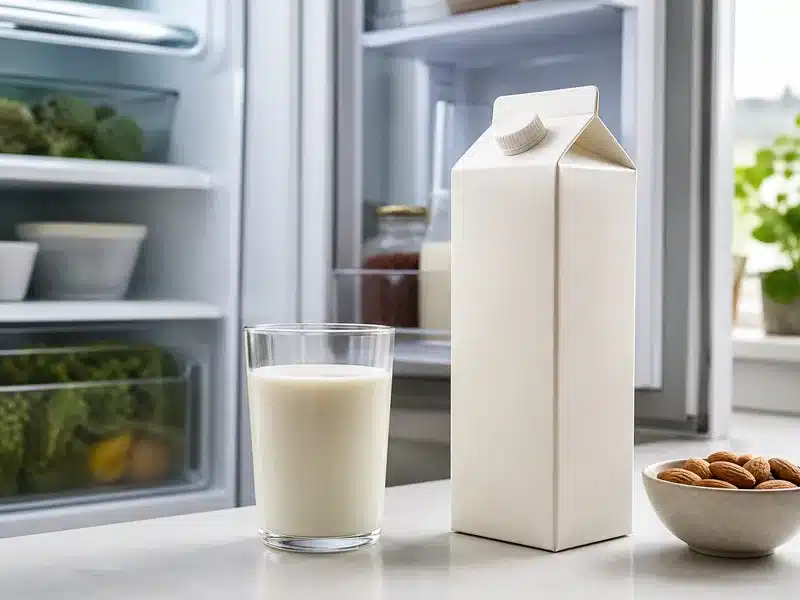
Unopened shelf-stable almond milk can stay in a cool pantry through its printed date, while a carton sold from a refrigerator must remain cold.
After opening, both types belong in the refrigerator at 40°F or below. Most brands direct you to finish opened almond milk within about 7 to 10 days, though the package instruction should decide the exact window.
Discard opened almond milk that stayed above 40°F for more than 2 hours, or more than 1 hour above 90°F. A printed date cannot make warm-stored milk safe.

Shelf-stable almond milk can stay in the pantry until opened, but refrigerated cartons must stay cold the whole time. Once any carton is open, follow the package window and discard it after warm storage or spoilage signs.
How Long Does Almond Milk Last in Each Carton Type?
| Type | Before opening | After opening | Best guide |
|---|---|---|---|
| Shelf-stable carton | Cool, dry pantry through printed date | Refrigerate and use in about 7 to 10 days | Brand instructions |
| Refrigerated carton | Refrigerate at 40°F or below | Refrigerate and often use within 7 days | Use-by date and brand instructions |
| Homemade almond milk | Not shelf-stable | Refrigerate and use in about 3 to 4 days | Preparation date and condition |
| Frozen portion | Not applicable | Thaw in refrigerator and use promptly | Texture and recipe plan |
Remember where you picked up the carton.
A carton from a room-temperature grocery aisle usually uses aseptic processing and packaging, while a carton from a chilled case needs refrigeration even before opening.
The printed date assumes the package stayed sealed and undamaged. Discard a leaking, swollen, punctured, or badly crushed carton even when the date has not passed.
Do not use the long pantry life for homemade milk. Blending almonds and water at home does not create a commercially sterile package, so write the preparation date on the container.
Use a bottle that was washed, rinsed, and fully dried before filling it. A wide-mouth bottle is easier to clean around the shoulder, where old almond solids can cling and seed the next batch with sour flavors.
Make smaller homemade batches when you use almond milk only in coffee. Finishing a three-day batch is safer and preserves a cleaner flavor than keeping a large bottle until the last glass smells questionable.
A small batch also works better for quick breakfast smoothies because the planned portions are used while the flavor is still clean.
The nuts themselves use a different storage clock. If the ingredient rather than the beverage is in question, the opened almond bags owns that decision.
How Should You Store Almond Milk After Opening?
The cap seal breaks the protected package and exposes the drink to air, hands, and kitchen surfaces.
Refrigeration slows change after opening, but it does not restore the unopened carton.
Write the opening date near the cap, close it after every pour, and keep the carton on an interior shelf. The refrigerator door warms repeatedly and gives an opened beverage a less steady environment.
Date the carton when the seal breaks
Count from the day you opened it, then follow the shorter of the brand's opened-use window and any printed use-by date.
Keep the cap clean and the temperature steady
Close the carton after every pour and use an interior shelf. The refrigerator door warms repeatedly.
Pour what you need into a clean glass and return the carton at once. Do not drink from the carton or pour unused milk back after it touched cereal, coffee, a blender cup, or a measuring spoon.
An opened carton near the end of its window can still be used in a planned dish when it passes every check. If it fails, choose an option from the clean milk backup instead of hiding an off flavor.
How Can You Tell Whether Almond Milk Has Gone Bad?
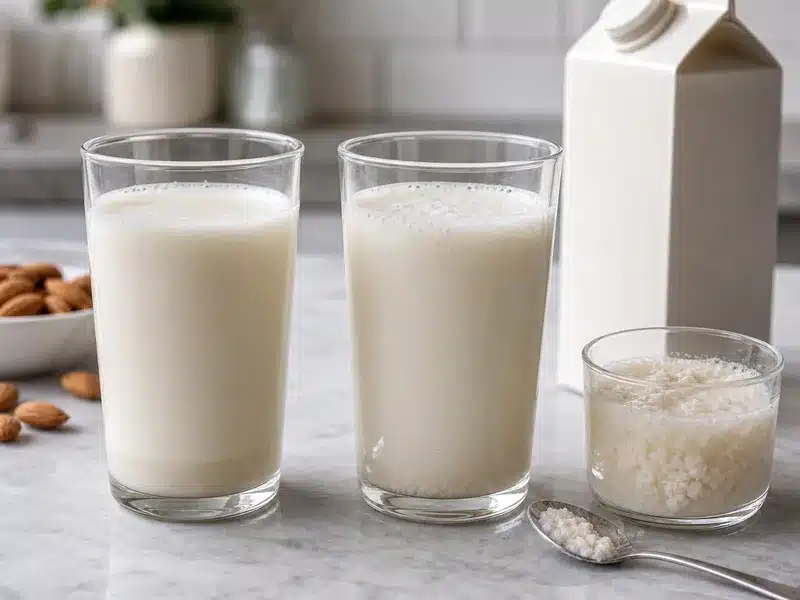
A thin layer at the bottom of a cold carton can come from suspended almond solids settling while the milk sits.
A firm shake should return normal settling to a smooth, even drink. Persistent clumps, slime, or a sour smell do not belong.
- Settling that remixes: a smooth layer disappears after shaking, and the milk still smells mild.
- Curds that remain: stubborn clumps, ropey texture, or fizzing support a discard decision.
- A swollen carton: outward pressure can point to gas production.
- Sour or stale-nut odor: discard the milk without tasting it.
Fresh almond milk is usually off-white, so a small color difference between brands can be normal. Pink, green, gray, or patchy growth is not normal.
Do not confuse a clean shake with a safety test. Milk that sat warm too long should be discarded even when it becomes smooth again.
How Long Can Almond Milk Stay Out?
A breakfast glass found at noon needs a time decision before a smell decision.
Discard perishable almond milk after more than 2 hours above 40°F, or after more than 1 hour above 90°F.
A forgotten glass gets the two-hour test
Discard milk left in a glass or cereal bowl after the limit. In air above 90°F, the limit drops to one hour.
A long trip home needs an insulated bag
Keep refrigerated cartons cold when errands delay the trip. A shelf-stable carton keeps its pantry advantage only while sealed.
A power outage needs a temperature decision
A closed refrigerator holds cold for about 4 hours. After that, the opened carton needs an actual time-and-temperature check.
Do not return a warmed glass to the carton. That action can move food, saliva, or warm milk into the portion that remained cold.
The same time rule applies whether the milk is plain, vanilla, sweetened, or unsweetened. A general milk alternative may rescue the meal, but it cannot rescue the warmed carton.
Can You Freeze Almond Milk?
A thawed glass often shows a grainy edge because water and almond solids separate as ice crystals form.
The drink may remain useful, but it rarely returns to the same smooth texture for cereal or drinking.
Freeze measured portions while the milk is still sound
Use freezer-safe containers or an ice cube tray, leave room for expansion, and label each portion by volume. Freezing does not rescue a sour or time-abused carton.
Thaw it for recipes that can hide the texture
Thaw one portion in the refrigerator, then whisk or blend it into batter, oatmeal, sauce, soup, or a smoothie. A plain drinking glass will still show more separation.
Use thawed almond milk in batter, oatmeal, sauce, soup, or a high-protein smoothie where mixing can hide some separation. Do not extend its refrigerator life because it spent time frozen.
Label frozen portions by volume so one cube or container matches a recipe. Accurate portions prevent repeated thawing and stop a partly used batch from returning to the freezer with a new handling history.
For a dairy-free smoothie, thaw only the measured portion the blender needs. The remaining cubes keep their original storage history.
If the recipe needs a neutral plant milk, compare soy-based backup or cashew-style backup.
For dairy texture, the richer dairy option explains richer options. An opened oat carton still needs its own storage check before it becomes the backup.
Freeze for a named recipe, not because the carton already looks doubtful. Sour, swollen, curdled, or time-abused almond milk belongs in the trash.
Keep one rule separate from every date on the carton. If the milk smells sour, pours ropey, or sat warm too long, discard it even when the printed date still looks fine.
One more clue is carton behavior. A carton that puffs, hisses hard, or smells sharp after you open it should be discarded even if the date still looks fine.
Sources
These sources support the package, time, and temperature decisions in this guide.
- Almond Breeze almond beverage questions for refrigerated and shelf-stable opened-use windows and settling.
- FoodSafety.gov food safety and waste guidance for the 2-hour and 1-hour warm limits.
- FoodSafety.gov power outage guidance for opened nut milk and refrigerator warming.
Brands use different processing and formulas, so the storage statement on your carton remains the owner of its exact opened-use window.
Frequently Asked Questions
Plan for about 3 to 4 refrigerated days because homemade milk lacks commercial aseptic processing. Use a clean covered container and write the preparation date on it.
Check the brand's wording and the package condition. Discard a carton that is swollen, leaking, punctured, badly crushed, or far outside its quality date.
No. Milk that touched a glass, bowl, blender, or utensil can carry crumbs and microbes into the clean cold portion.
Yes. Transfer the frozen cubes to a sealed container, then use them in smoothies, sauces, oatmeal, or baking where separation matters less.
Not before opening when its label says shelf-stable. Keep it in a cool dry pantry, then refrigerate it as soon as the seal opens.

Carrie is a food writer and editor with more than 15 years of experience. She has worked for some of the biggest names in the food industry, including Bon Appétit, Food & Wine, and Martha Stewart Living.
As the Editor in Chief of EpicureDelight, Carrie oversees all of the content on the site. She also manages the team of contributing writers and editors, who help to create delicious recipes, helpful tips, and informative articles that you’ll find on the site.
A native of the Chicago area, Carrie is passionate about all things food. She loves trying new restaurants and experimenting with new recipes in her kitchen. She’s also a graduate of the Culinary Institute of America, so she knows a thing or two about food!