
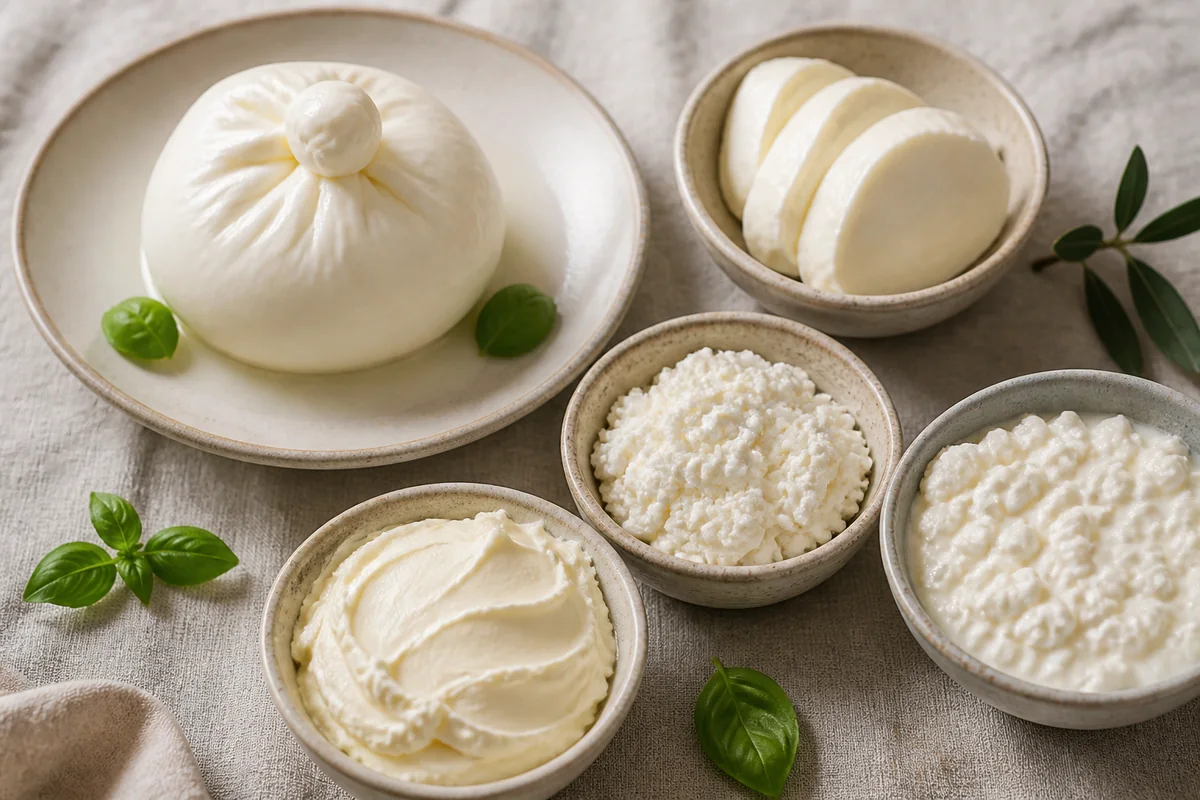
Burrata's appeal is built on contrast - a firm outer shell of pulled mozzarella enclosing a loose, creamy center of stracciatella that spills when you cut it open. That interior is roughly 40-60% of the ball by weight, sitting at 55-65% moisture.
Standard fresh mozzarella only reaches about 45% moisture, which explains immediately why a block-for-block swap rarely works.
Getting the swap right means matching two things: the spreadable richness of that filling and the soft-pull of the outer layer. Moisture imbalance causes weeping on the plate.
Wrong fat content flattens the delicate texture. The five options below each solve a different piece of that problem, and the guide covers exactly which one fits your dish.
Quick Summary
For most fresh applications, stracciatella is the closest one-to-one replacement for burrata you'll find at a cheese counter.
The best overall swap for burrata is stracciatella, used at a 1:1 ratio by weight. For a shell-and-filling effect, pair fresh mozzarella with whipped ricotta. Avoid all creamy substitutes in high-heat baking above 175°C (350°F), where moisture weeping becomes unmanageable.
5 Best Substitutes for Burrata Cheese to Try
Each substitute below targets a specific cooking context. The table gives you the ratio and key constraint at a glance before the full explanation in each section.
| # | Substitute | Best For | Ratio | Key Note |
|---|---|---|---|---|
| 1 | Stracciatella | ✨ Both | 1:1 by weight | No outer shell structure |
| 2 | Fresh Mozzarella + Whipped Ricotta | 🥗 Fresh | 1:1 by volume | Assemble max 30 min ahead |
| 3 | Ricotta + Heavy Cream | 🍳 Cooking | ¾ cup + 2 tablespoon per 1 cup | Bakes poorly above 350°F |
| 4 | Mascarpone + Fresh Mozzarella | 🥗 Fresh | 60/40 by weight | Richer, sweeter - add acid |
| 5 | Cream Cheese + Milk | 🧁 Baking | 8 oz + 2-4 tablespoon milk | Tangier flavor, heat-stable |
1 - Stracciatella (Fresh Cheese Curds + Cream)
Stracciatella is literally what burrata is filled with - shredded mozzarella curds stirred through fresh cream at roughly 30-36% fat and about 60% moisture.
Because it's the same ingredient, the swap ratio is a direct 1:1 by weight.
It works best on fresh salads, crostini, and anywhere burrata is served cold or at room temperature.
The one limitation: stracciatella has no outer skin, so it won't replicate the visual drama of a whole burrata ball splitting open.
To approximate that, wrap a portion in a thin sheet of pulled fresh mozzarella and pinch the edges shut.
Refrigerate and use within 3-4 days of opening for best results.
2 - Fresh Mozzarella + Whipped Ricotta
This combo rebuilds burrata from scratch: small fresh mozzarella balls act as the shell, and whipped ricotta mimics the stracciatella interior.
The working ratio for the filling is 1 cup ricotta blended with 2 tablespoons heavy cream, which produces a texture close to stracciatella by volume.
Salt the mixture lightly - ¼ teaspoon per cup - before assembling, since this draws moisture inward rather than letting it pool on the plate.
Use mozzarella balls in the 60-80 g range, split them, press some curd aside, and fill with the whipped ricotta blend before pressing the edges shut.
Serve within 30 minutes of assembly.
- Salt the ricotta first - ¼ teaspoon per cup prevents surface weeping during plating
- 60-80 g mozzarella balls give enough curd to press and seal without tearing
- Add 1 teaspoon white balsamic to the filling if the mozzarella is especially bland
- Assemble to order - filled shells degrade noticeably after 30 minutes at room temperature
Fresh Mozzarella + Whipped Ricotta
Works for: fresh plates, caprese boards, stuffed presentations, a crostini recipe worth trying
Skip if: you need to bake above 350°F, or you're assembling more than 30 minutes ahead
3 - Ricotta + Heavy Cream (Simple Creamy Substitute)
For spreads, pasta finishes, and pizzas where the cheese goes on after the bake, a ricotta-cream blend is the most fridge-friendly option.
The ratio is ¾ cup ricotta (about 180 g) plus 2 tablespoons heavy cream per 1 cup (240 g) of burrata - a roughly 3:4 volumetric replacement.
Stir until smooth, but stop before it turns airy; you want a dense, spoonable consistency, not a whip.
One flavor note: ricotta skews mildly sweet without any brightness.
Adding ½ teaspoon lemon juice or 1 teaspoon white balsamic per cup lifts the mix closer to burrata's clean dairy flavor - this ricotta approach with lemon and olive oil follows the same logic.
Hold the cream separate in the fridge and stir it in right before serving to preserve texture.
For how long ricotta keeps when stored this way, the blend holds 2-3 days refrigerated.
4 - Mascarpone + Fresh Mozzarella
Mascarpone runs at about 40% fat - notably richer than stracciatella - so blending it with torn fresh mozzarella is the key to keeping the mouthfeel from turning heavy.
Use 60% mascarpone and 40% torn fresh mozzarella by weight for an interior that has both creaminess and a little pull.
This pairing suits rich crostini and fruit-forward dessert plates far better than it suits savory salads, mostly because mascarpone's sweetness needs contrast to read as cheese rather than filling.
That sweetness also needs an acidity check. Add ½ teaspoon lemon zest or 1 teaspoon white vinegar per 150 g mascarpone before mixing.
Avoid extended baking - mascarpone begins softening and weeping near 140°F (60°C), so this is firmly a fresh-application substitute. For a crostini variety platter done differently, this mascarpone blend pairs well with figs or stone fruit.
5 - Cream Cheese + Milk (Emergency Heat-Stable Option)
When baking is unavoidable and every other substitute would collapse into a puddle, full-fat cream cheese is your most stable choice.
Soften 8 oz (226 g) and loosen with 2-4 tablespoons of whole milk until you reach approximately 1 cup (240 g) of spreadable, burrata-like cream.
Two tablespoons produces a thicker, more spreadable result; four tablespoons gets closer to a pourable consistency.
Cream Cheese + Milk
Works for: baked tartlets, pizzas at ≤375°F (190°C), hot pasta dishes where weeping is a problem
Skip if: you need a neutral dairy flavor - cream cheese tang will read through in cold, fresh dishes
Cream cheese tolerates oven temps up to 375°F (190°C) with far less weeping than any ricotta- or stracciatella-based swap.
It also keeps 7-10 days refrigerated once opened, making it practical for batch cooking.
The tradeoff is flavor: the natural tang is noticeable, especially on dishes where burrata's mild sweetness is part of the point.
For other common cream cheese swaps that address similar heat-stability needs, the same loosening technique applies.
Adjusting Your Recipe for These Substitutes
The swap ratio alone won't save a dish if the application ignores temperature and timing. Here's what to adjust across three real cooking contexts:
- Fresh/cold plates: assemble no more than 30 minutes before serving; excess moisture pools quickly at room temperature and turns a clean presentation into a watery one
- Quick baking (pizza, tartlets): add your creamy substitute after the bake rather than before, or use the cream cheese blend and keep oven time to ≤8 minutes at ≤350°F (175°C)
- Hot, saucy dishes: stir the substitute in off-heat at the very end; this preserves texture and prevents the fat from splitting
- Flavor adjustment: add 1-2 tablespoons lemon juice or white vinegar per cup of ricotta or mascarpone mix to match burrata's clean finish
- Salt check: taste every substitute before plating - ricotta and mascarpone often need ¼ teaspoon extra salt per cup to match burrata's seasoning level
Understanding burrata cheese's flavor profile helps calibrate how much acid and salt each substitute needs to land in the right place.
Frequently Asked Questions
Freezing burrata is not recommended - the cream separates on thaw and the texture becomes grainy and wet. Cream cheese-based mixes freeze better than stracciatella or ricotta blends, though they lose some creaminess. For best results, make fresh in small batches rather than freezing. Proper burrata cheese storage methods consistently recommend refrigeration over freezing.
Fresh mozzarella is your base for the bake - it melts evenly without breaking. Add whipped ricotta or stracciatella after the pizza exits the oven. Avoid baking burrata or its creamy substitutes above 350°F (175°C) for more than 8 minutes, or the fat weeps and pools on the surface.
Shred fresh mozzarella by hand into thin strips and stir in 2-3 tablespoons of heavy cream per 100 g of shredded curd, then season lightly with salt. This produces a stracciatella-like filling that's close to what's inside a commercial burrata ball. Use it immediately or refrigerate for up to 24 hours. If cheese curds run out, standard fresh mozzarella shredded by hand is the most workable starting point.
No - assembled burrata salads should not be stored overnight. The cheese weeps and the greens become waterlogged within an hour at room temperature. Store the burrata or its substitute separately in the fridge, then plate just before serving. Unassembled, fresh burrata holds 24-48 hours refrigerated in its brine.
Drain off the excess liquid with a spoon and blot the surface lightly with a paper towel - the remaining cheese is still usable. To prevent recurrence, add the substitute off-heat and reduce time at warm temperatures. Salting the ricotta or mascarpone before assembly (¼ teaspoon per cup) draws moisture out in a controlled way before it hits the plate.
5 Best Burrata Cheese Substitutes (with Ratios)
Ingredients
Equipment
Method
- Choose substitute by use: freshest plates → stracciatella or mozzarella+whipped ricotta; baking or heat → cream cheese mix.
- Measure substitute at specified ratio (prefer weight for best accuracy). For example, replace 100 g burrata interior with 100 g stracciatella, or with 75 g ricotta + 25 g cream equivalent.
- If assembling post-cook, add the creamy substitute after the dish exits the oven or during plating to avoid weeping; limit time at room temp to 30 minutes for fresh plates.
- Adjust seasoning: add ½ teaspoon lemon or 1 teaspoon white balsamic per cup of ricotta/mascarpone mix; add ¼ teaspoon salt per cup if the substitute tastes flat.
- For shell replication: split small fresh mozzarella, remove some curd, fill with whipped ricotta/stracciatella, and press edges to seal; serve within 1 hour for best texture.
Notes
- Prefer weight measurements for accuracy when mimicking moisture balance
- Avoid prolonged oven exposure for cream-forward substitutes (keep ≤350°F / 175°C when possible)
Tried this recipe?
Let us know how it was!
Carrie is a food writer and editor with more than 15 years of experience. She has worked for some of the biggest names in the food industry, including Bon Appétit, Food & Wine, and Martha Stewart Living.
As the Editor in Chief of EpicureDelight, Carrie oversees all of the content on the site. She also manages the team of contributing writers and editors, who help to create delicious recipes, helpful tips, and informative articles that you’ll find on the site.
A native of the Chicago area, Carrie is passionate about all things food. She loves trying new restaurants and experimenting with new recipes in her kitchen. She’s also a graduate of the Culinary Institute of America, so she knows a thing or two about food!



