
Cantal has that particular quality that makes it hard to replace casually: a firm body, a mildly nutty flavor, and a melt that holds together without turning greasy. When your recipe calls for it and the cheese counter comes up short, you need a swap that behaves the same way, not just one that tastes vaguely similar.
The best cantal cheese substitute options are chosen here by melt performance and flavor intensity, in that order. A cheese that looks right on a board but seizes up in the oven is no good for a gratin.
If you're baking, grate your substitute before it goes in. Grated cheese melts more uniformly and browns more predictably than slabs.
Gruyère and Comté are the closest cantal cheese substitutes for baked dishes and gratins. Both melt cleanly and carry a nutty, savory flavor close to cantal's. For a lighter melt, Emmental or mild Swiss works well. Use Havarti at a ¾:1 ratio to avoid greasiness.
5 Best Cantal Cheese Substitutes by Closest Match
Each substitute below is ranked by how closely it mirrors cantal's melt behavior and flavor profile. Use the table to match your dish type, then read each entry for ratio and adjustment notes.
| # | Substitute | Best For | Ratio | Key Note |
|---|---|---|---|---|
| 1 | Gruyère | Both | 1:1 | Nutty, firm, clean melt |
| 2 | Comté | Both | 1:1 | Deeper flavor, ideal gratin |
| 3 | Emmental | Both | 1:1 | Milder, season after melt |
| 4 | Mild Swiss | Both | 1:1 | Gentlest flavor, add salt |
| 5 | Havarti | Cook | ¾:1 | Creamier, use less |
1. Gruyère
Gruyère is the substitute we reach for first when cantal is unavailable. It has a firm, gratable texture, melts without separating, and carries a nutty-savory flavor that sits close to cantal's profile.
For baked dishes, the swap is straightforward. Gruyère behaves well at oven temps and browns reliably on top.
If you're uncertain about how this cheese performs across other recipes, our guide on swapping Gruyère out covers alternative directions from there.
- Ratio: 1:1 by weight for all melt-based and baked applications
- Prep tip: Grate it fine for gratins; coarser shreds work for toasted sandwiches
- Flavor note: Gruyère reads slightly more assertive than cantal, so taste before adding extra seasoning
- Browning: Expect even, golden browning similar to cantal at the same oven temperature
Skip if: your recipe needs a very mild, non-nutty flavor. Gruyère will taste noticeably stronger than cantal for palates sensitive to that difference.
2. Comté
Comté is closely related to Gruyère in production and behavior, but it tends to have a longer aging process that gives it a slightly more complex finish. For gratins and baked pasta, that depth works in your favor.
It melts smoothly and creates a cohesive layer, not a stringy one. If you want to explore Comté-forward swapping options for dishes where Comté itself runs short, that's worth a look.
Comté
Works for: gratins, baked pasta, cooked sandwiches, and any dish where you want a nutty, layered finish
Skip if: your recipe depends on cantal's lighter tone - Comté can taste more developed and may shift the dish's character
- Ratio: 1:1 by weight for all cooked applications
- Grating: Shred on the medium side for smoother melt on gratins
- Flavor watch: Comté's depth can increase if it overbakes, so pull the dish a few minutes early if browning fast
3. Emmental
Emmental is the low-key option in this list. It has a mild tang, melts easily, and won't overpower a dish where cantal was supposed to play a supporting role.
The right choice for milder dishes often lands here.
| Use | Ratio | Notes |
|---|---|---|
| Gratin topping | 1:1 | Emmental; season with a pinch of salt after baking |
| Baked pasta | 1:1 | Emmental; add pepper at the table to boost flavor |
| Cooked sandwich | 1:1 | Emmental; melt is clean but mild - consider adding mustard |
- Ratio: 1:1 by weight across most applications
- Seasoning: Add an extra pinch of salt and black pepper after melting - Emmental's milder tang can leave dishes tasting flat
- Melt speed: Emmental melts a little faster than cantal, so watch browning time closely
Skip if: your dish is cheese-forward and depends on cantal's nutty bite. Emmental may read noticeably flatter.
4. Mild Swiss (Jarlsberg-Style)
Jarlsberg-style mild Swiss is the gentlest swap on this list. It melts well in cooked dishes and won't push any sharp or assertive flavors into the final result.
That makes it useful when the cheese is a background element, not the star.
When you're deciding between options, picking a milder Swiss-style cheese for baking often comes down to the dish's overall salt level - mild Swiss runs low, so seasoning matters more than usual.
- Ratio: 1:1 by weight for gratins, sauces, and cooked sandwiches
- Seasoning fix: Taste the dish after melting and add salt - mild Swiss is noticeably less salty than cantal
- Melt behavior: Smooth and even with good stretch; no greasiness at normal oven temps
- Best use: Casseroles and baked sides where the flavor load comes from other ingredients
Skip if: the recipe is cheese-forward and relies on cantal's nutty intensity. Mild Swiss won't deliver enough character on its own.
5. Havarti
Havarti is a different category of swap. It's creamier and softer than cantal, and its melt is more liquid and flowing than firm and sliceable.
That's useful for casseroles and toasted sandwiches, but it needs a ratio adjustment.
For dishes where Havarti itself is the starting point and you want to move in a different direction, working around a creamy melt can help you land on firmer options. Use it at ¾ of the cantal amount to keep the texture from going greasy.
- Ratio: ¾:1 by weight (reduce by 2 tablespoon per cup compared to cantal)
- Best for: Casseroles, toasted sandwiches, and creamy baked sides
- Avoid overbaking: Pull the dish out when the top just begins to color - Havarti can separate if it stays in too long
- Flavor note: Milder and more buttery than cantal; add a sharper condiment on the side if the dish feels flat
Skip if: you need the cheese to hold its shape or slice cleanly after cooling. Havarti softens significantly when heated and stays soft.
Making the Cantal Cheese Substitute Work
Getting the swap right is mostly about timing and temperature. The cheese itself can do the job, but the application matters.
You can read more about the firm, nutty character cantal brings to a dish if you're trying to match that baseline more precisely.
- Grate before baking: Grated cheese melts more uniformly than sliced or chunked - this applies to every substitute on the list, but especially Gruyère and Comté
- Watch browning speed: If your substitute browns faster than expected, lower oven temp by 25°F and cover loosely with foil for the last few minutes
- Season after melting: Emmental and mild Swiss are both lower in salt than cantal - taste the dish once the cheese has melted and adjust with salt and pepper before serving
Frequently Asked Questions
Comté is the closest match for gratins. It melts smoothly, browns evenly, and brings a nutty-savory depth that behaves very similarly to cantal at gratin temperatures.
Yes, but use ¾ of the cantal amount. Havarti releases more fat under heat, so reducing the quantity prevents grease pooling in the dish.
Yes. Grated cheese melts faster and more evenly than sliced, which reduces unmelted pockets and produces a smoother, more uniform top on baked dishes.
Gruyère, Comté, Emmental, and mild Swiss all swap at 1:1 by weight. Havarti and Fontina are creamier, so use ¾ of the cantal amount instead.
Emmental or mild Swiss (Jarlsberg-style) are the mildest options here. Both melt well and won't push assertive flavors into a dish that needs a lighter cheese presence.
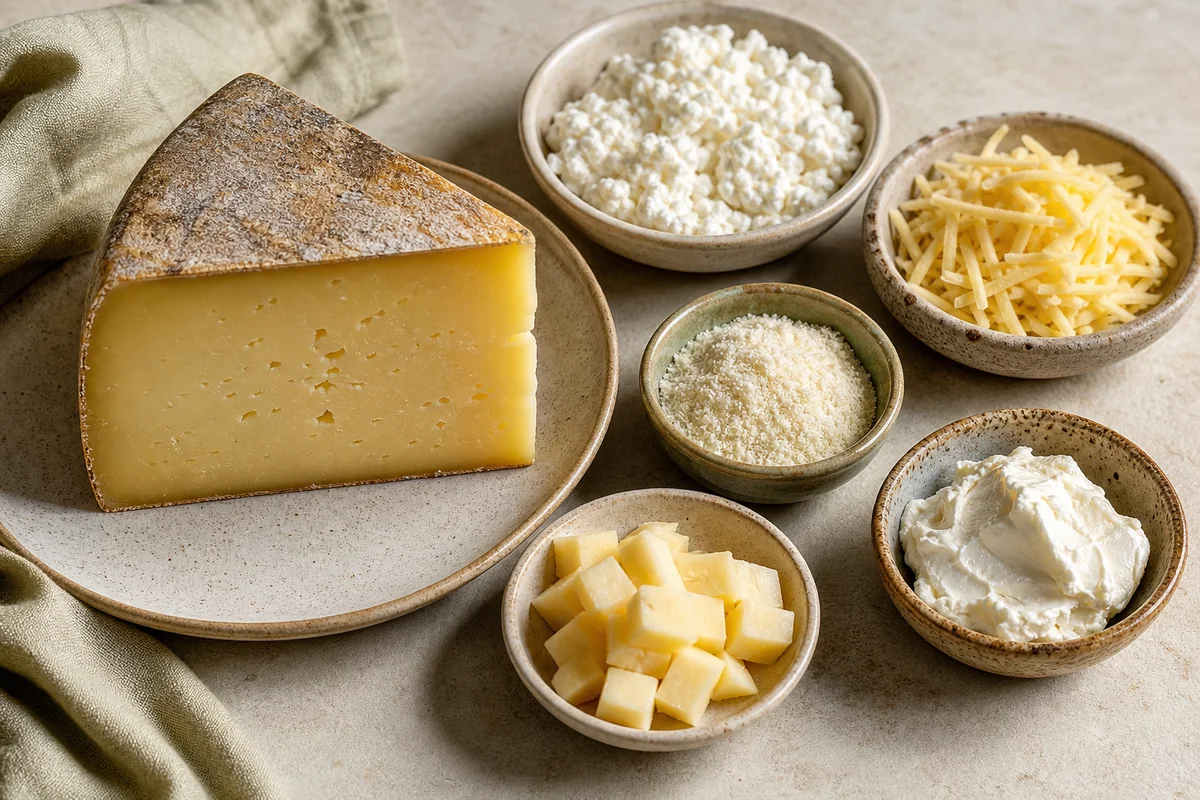
5 Best Cantal Cheese Substitutes (Closest Match)
Ingredients
Equipment
Method
- Identify your use (melting/gratin, baking, or slicing/finishing) and prioritize melt match first for baked dishes.
- Start with the listed ratio (usually 1:1 for Swiss-style cheeses; ¾:1 for creamier swaps).
- Grate the substitute for more even melting, especially if the dish needs a smooth top.
- If the substitute browns too fast, lower oven temp by ~25°F (or cover briefly) and extend cook time.
- Taste the sauce or batter and adjust seasoning (salt/pepper) because milder cheeses can reduce perceived flavor.
Notes
- Best results come from grated, evenly distributed cheese.
- Flavor intensity varies: for milder swaps, you may need a small seasoning adjustment.
Tried this recipe?
Let us know how it was!
Carrie is a food writer and editor with more than 15 years of experience. She has worked for some of the biggest names in the food industry, including Bon Appétit, Food & Wine, and Martha Stewart Living.
As the Editor in Chief of EpicureDelight, Carrie oversees all of the content on the site. She also manages the team of contributing writers and editors, who help to create delicious recipes, helpful tips, and informative articles that you’ll find on the site.
A native of the Chicago area, Carrie is passionate about all things food. She loves trying new restaurants and experimenting with new recipes in her kitchen. She’s also a graduate of the Culinary Institute of America, so she knows a thing or two about food!



