
Curry leaves bring a citrus-wood aroma and a faint bitter-green note that no single spice fully copies.
Murraya koenigii carries concentrated essential oils right on the leaf surface - oils that vaporize fast in hot oil, which is why a South Indian tempering hits differently from anything else.
Fresh curry leaves are common across South Asia but routinely absent from Western grocery stores, making swaps a real practical need.
Here's what this article gives you: five ranked substitutes, exact ratios for each, and specific guidance on whether each swap works for stovetop tempering, long-simmer dishes, raw garnishes, or baking.
Standard tempering uses 6-10 whole fresh leaves per two to three servings, and chopping 8-10 fresh leaves yields roughly one tablespoon - so all ratios below are anchored to that tablespoon measure.
---
Quick Summary
Kaffir lime leaf is the strongest overall substitute for curry leaf, used at one whole leaf per four to six curry leaves.
It covers tempering and cooked applications well, though its citrus-peel edge is more pronounced than curry leaf's subtler citrus-wood tone.
Kaffir lime leaf is the top curry leaf substitute, used at 1 whole leaf per 4-6 curry leaves. It works for tempering and cooked dishes but carries a stronger citrus-peel note. For long simmers, use bay leaf. For raw finishes, reach for Thai basil.
---
5 Best Substitutes for Curry Leaf to Try
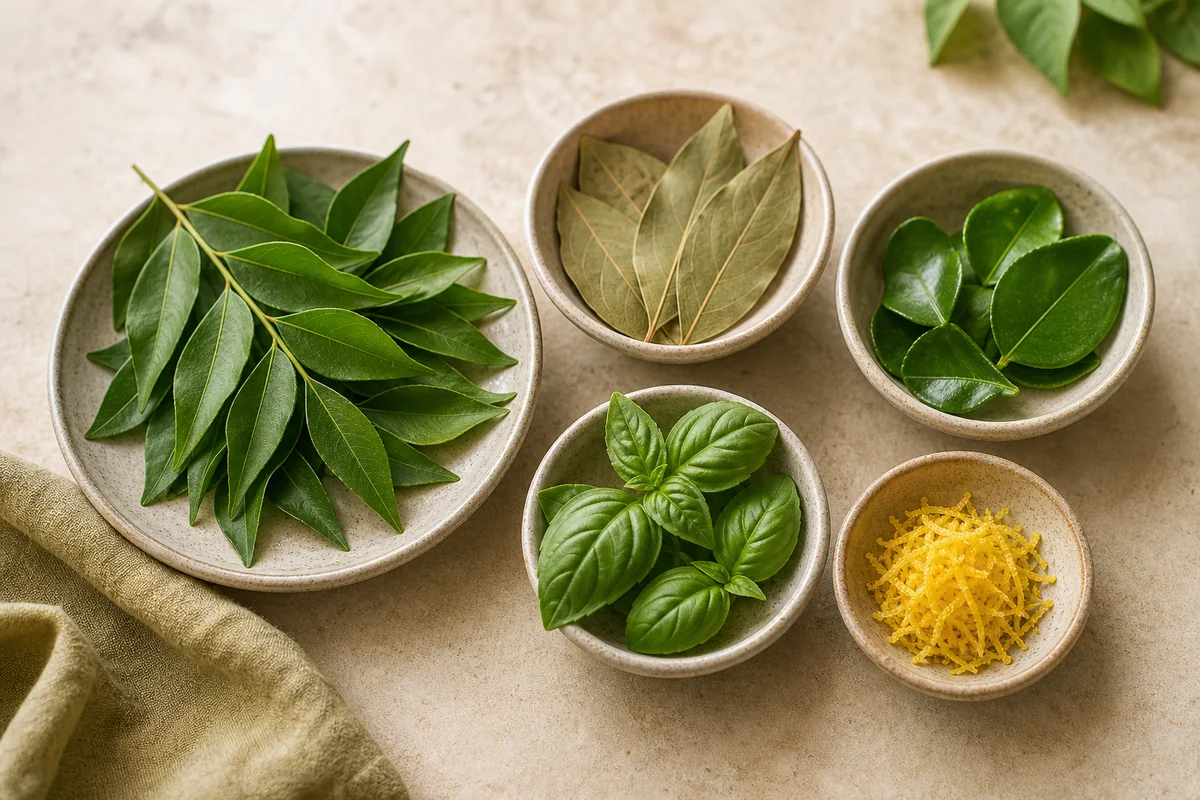
Each substitute below is ranked by overall usefulness across cooking applications - tempering, slow simmering, raw use, and baking. The table gives you the ratios at a glance.
| # | Substitute | Best For | Ratio | Key Note |
|---|---|---|---|---|
| 1 | Kaffir lime leaf | ✨ Both | 1 leaf : 4-6 curry leaves | Strong citrus-peel edge |
| 2 | Bay leaf | 🍳 Cooking | 1 bay leaf : 8 curry leaves | Long simmer only |
| 3 | Thai basil | 🥗 Raw | 1 tablespoon : 1 tablespoon curry leaves | Add at end of cooking |
| 4 | Lime zest + curry powder | 🧁 Baking | ½ teaspoon zest + ¼ teaspoon powder : 1 tbsp | Best for dry mixes |
| 5 | Dried curry leaf powder | ✨ Both | 1 teaspoon powder : 1 tablespoon fresh | Bloom in oil before using |
---
Why Curry Leaf Is Hard to Replace
Understanding curry leaf's character in cooking helps explain why swaps require technique adjustments, not just ingredient swaps.
The leaf's value is almost entirely aromatic - volatile essential oils sit on the leaf surface and release explosively when the leaf hits hot oil at 325-375°F (160-190°C), which is the standard tadka technique.
Most leafy herb substitutes add a grassy, green bulk flavor rather than an aromatic hit.
When you're tempering, prioritize substitutes with surface oils - kaffir lime leaf and lime zest both release volatile citrus aromatics quickly in hot fat, making them the better technical match for tadka.
---
1 - Kaffir Lime Leaf
Kaffir lime leaf (also called makrut lime leaf) is the closest structural and aromatic match for curry leaf. Both are glossy, oil-rich leaves that release aroma quickly in hot fat.
Use one whole kaffir lime leaf per four to six fresh curry leaves, or one teaspoon chopped kaffir lime leaf per one tablespoon chopped curry leaves.
Remove the central vein before chopping - it's fibrous and holds back aromatic oil release.
Four to six shredded kaffir lime leaves roughly match the surface-area aroma output of eight curry leaves.
The main limitation: kaffir carries a more pronounced citrus-peel note, so the swap tastes slightly more citrus-forward than the original.
If you ever need to go the other direction, common kaffir lime leaf swaps cover that ground well.
Kaffir Lime Leaf
Works for: tempering, South Indian curries, chutneys, coconut-based dishes
Skip if: recipe needs a subtle background note - kaffir's citrus-peel aroma dominates lighter broths
Curry Leaf
Works for: all tempering, rice dishes, dals, chutneys, stir-fries
Skip if: unavailable - no true 1:1 replacement exists, but kaffir lime leaf comes closest
---
2 - Bay Leaf
Bay leaf (dried laurel) is a pantry staple that earns its place here because of how it releases aroma - slowly, over heat, into fat or liquid. That matches the way curry leaf works in long-simmered dishes far better than any fresh herb does.
Use one dried bay leaf per eight curry leaves in braises, slow curries, and stewed lentils.
The key limitation is timing.
Bay leaf needs 15-30 minutes of simmering to extract its aroma fully, so it simply won't work for quick-tempering or raw garnishing. How bay leaf tastes compared to curry leaf is worth knowing - bay is more eucalyptus and herbal, less citrus - so adjust expectations for the finished dish.
A few practical rules for using bay leaf as a curry leaf substitute:
- Add the bay leaf at the start of the simmer, not at the finish, to allow full aroma extraction.
- Use dried bay leaves, not fresh - dried release aroma more reliably during long cooks.
- Always remove the leaf before serving; the texture is leathery and unpleasant to eat.
- If your dish uses fewer than 15 minutes of cooking time, skip bay leaf and use kaffir lime or lime zest instead.
If you find yourself short on bay leaf too, common bay leaf swaps are worth a look before you adjust the recipe further.
---
3 - Thai Basil (or Holy Basil)
Thai basil brings a sweet-anise and clove note that approximates the fresh-green aspect of curry leaf when used as a raw garnish or a quick finish.
It's the right substitute when the recipe calls for curry leaves as a finishing herb scattered over rice or dal, not when the leaf needs to temper in hot oil.
Use one tablespoon chopped Thai basil per one tablespoon chopped curry leaves - roughly 8-10 small basil leaves.
Holy basil (tulsi) is a closer match in peppery bitterness but more intense; use half the amount if swapping in a stir-fry.
Thai basil works well in recipes like Thai basil beef stir-fry, where the herb is added off heat to preserve its volatile top notes - the same approach that makes it useful as a curry leaf stand-in.
---
4 - Lime Zest + a Pinch of Curry Powder
This is the most reliable composed swap when no fresh or dried leaves are available, especially for baking. Per one tablespoon of chopped fresh curry leaves, use ½ teaspoon lime zest plus ⅛-¼ teaspoon ground curry powder.
The zest delivers the volatile citrus aromatics; the curry powder fills in a faint savory-spice backbone.
For baking or dry spice mixes, fold the lime zest directly into the dry ingredients rather than adding it to wet mixtures - this preserves the volatile citrus oils longer during the mixing process.
If the recipe relies on hot-oil tempering for richness, stir one teaspoon of neutral oil into the zest-powder mixture before adding it to the pan; this mimics the fat-carrying effect of tempering whole leaves.
The main gap is the lack of green-leaf bitterness - this swap reads as citrus-forward, not herbal.
For context on lime zest's strengths and limits as a flavor contributor, that's covered in more detail separately.
---
5 - Dried or Crushed Curry Leaf Powder
Dried curry leaf powder is the pantry backup with the closest flavor DNA to fresh leaves, because it's literally the same plant in a shelf-stable form. The conversion is straightforward: one teaspoon dried curry leaf powder per one tablespoon fresh chopped curry leaves.
It works in spice blends, baked goods, long-simmer curries, and any application where leaf texture isn't expected.
The critical technique step is blooming.
Add the dried powder to hot oil and let it cook for 20-30 seconds before adding any other ingredients - this rehydrates the powder and forces out remaining volatile oils.
Skip this step and the powder tastes flat and dusty.
Dried curry leaf is slightly more bitter and noticeably more muted than fresh, so if your recipe already includes bitter elements like fenugreek or mustard seeds, reduce those slightly.
Proper curry leaf storage methods can also extend the life of your fresh leaves so you reach for the dried version less often.
---
Picking the Right Curry Leaf Swap
The substitute that works depends almost entirely on how the recipe uses the curry leaf - not just what it's being cooked with. A quick decision by application:
Tempering / Quick Oil Release
Works for: kaffir lime leaf (1-2 shredded leaves + ¼ teaspoon curry powder for fuller base note)
Skip if: you only have bay leaf - it won't release aroma fast enough in a tadka
Long-Simmer Stews & Braises
Works for: bay leaf (1 per 8 curry leaves); dried curry leaf powder bloomed in oil first
Skip if: the simmer time is under 15 minutes - neither substitute extracts aroma quickly enough
Raw Garnish / Finishing
Works for: Thai basil added off-heat; a pinch of lime zest scattered over the finished dish
Skip if: the recipe needs the leaf to hold texture - basil wilts immediately on a hot surface
Baking / Dry Mixes
Works for: lime zest + curry powder folded into dry ingredients; dried curry leaf powder in spice blends
Skip if: recipe needs a leafy visual element - neither substitute provides that
No fresh leaves for a recipe calling for eight curry leaves and tempering? Use one to two shredded kaffir lime leaves in the hot oil plus ¼ teaspoon curry powder stirred in afterward for a fuller base note.
---
Frequently Asked Questions
Fresh curry leaves keep for one to two weeks refrigerated when stored on the stem in a loosely sealed bag or container lined with a dry paper towel. The paper towel absorbs moisture that would otherwise cause blackening. Remove any already-yellowed leaves before storing - they accelerate spoilage of the rest.
Yes - fresh curry leaves freeze well for up to three months with minimal aroma loss. Spread dry leaves in a single layer on a tray, freeze until solid (about one hour), then transfer to an airtight bag. Use directly from frozen in tempering; there's no need to thaw.
It's reliable for the aromatic and savory notes but won't replicate the green-leaf bitterness. For baked goods, fold ½ teaspoon lime zest and ¼ teaspoon curry powder into the dry ingredients - not the wet - to keep the citrus oils intact through mixing. If you ever need to work without zest, working without lime zest covers your options there.
No - they're completely different products. Dried curry leaves are simply dehydrated Murraya koenigii leaves and carry the same botanical aroma as fresh leaves in a more muted form. Curry powder is a blended spice mix - typically turmeric, coriander, cumin, and chili - with no botanical relation to the curry leaf plant. If you need to adjust your curry powder blend, common madras curry powder swaps break that down separately.
Not 1:1 - kaffir lime leaves are larger and more aromatic per leaf, so the ratio is one kaffir lime leaf for every four to six curry leaves, or one teaspoon chopped kaffir per one tablespoon chopped curry leaves. Using a true 1:1 count would overpower most dishes with citrus-peel intensity. Check how long kaffir lime leaf keeps if you're buying in bulk to have on hand as a substitute.
5 Best Curry Leaf Substitutes Worth Trying
Ingredients
Equipment
Method
- Identify the application: tempering/finish, long simmer, raw garnish, or baking — choose the substitute grouped for that use.
- Measure the substitute at the stated ratio (e.g., for 8 curry leaves use 1 kaffir leaf or 1 bay leaf for long simmer).
- If substituting dried/crushed curry leaf, bloom it in hot oil for 20–30 seconds before adding other aromatics to rehydrate and release oils.
- For lime zest + curry powder swaps, add the zest late in a cook or fold into dry mixes in baking to preserve volatile citrus oils; add 1 teaspoon neutral oil if a fatty mouthfeel is needed.
- When using fresh herbs (Thai basil), add at the end of cooking or as a garnish to preserve aroma — heat destroys basil’s volatile top notes within 2–3 minutes.
Notes
- Dried curry leaf and curry powder are different: dried leaf is the leaf alone; curry powder is a blend — adjust for added spices
- When tempering, oil temperature 325–375°F (160–190°C) releases aroma from citrusy leaves
Tried this recipe?
Let us know how it was!
Carrie is a food writer and editor with more than 15 years of experience. She has worked for some of the biggest names in the food industry, including Bon Appétit, Food & Wine, and Martha Stewart Living.
As the Editor in Chief of EpicureDelight, Carrie oversees all of the content on the site. She also manages the team of contributing writers and editors, who help to create delicious recipes, helpful tips, and informative articles that you’ll find on the site.
A native of the Chicago area, Carrie is passionate about all things food. She loves trying new restaurants and experimenting with new recipes in her kitchen. She’s also a graduate of the Culinary Institute of America, so she knows a thing or two about food!



