
Mashed potatoes that turn out gluey, or soup that stays thin when it should be thick. That's what happens when a recipe depends on potato flakes substitute swaps that don't match the job.
The fix isn't guesswork. It's knowing whether your dish needs hydration and body (mash-style) or fast starch thickening (soup and gravy).
Potato flakes work by absorbing hot liquid and expanding into a smooth, starchy mass almost instantly. That dual role is what makes finding a swap tricky.
No single ingredient does both jobs equally well.
For mashed potato texture, reach for instant mashed potatoes or warmed leftover mash. For soup and gravy thickening, potato starch slurry or cornstarch works faster. Greek yogurt adds creaminess in dips and sides. Roux is the go-to when you want body without potato flavor.
5 Best Potato Flakes Substitutes (Ranked by Texture)
When you're choosing a swap, the ratio is only half the answer. Texture goal matters more.
The table below maps each substitute to its best use so you can skip straight to the right one.
| # | Substitute | Best For | Ratio | Key Note |
|---|---|---|---|---|
| 1 | Instant Mashed Potatoes | Both | 1:1 | Closest hydration behavior |
| 2 | Leftover Mashed Potatoes | Mash | 1:1 | Warm and thin before adding |
| 3 | Potato Starch Slurry | Thickening | 1:1 | Mix cold, add to hot liquid |
| 4 | Cornstarch Slurry | Thickening | 1:1 | Can turn glossy; simmer gently |
| 5 | Greek Yogurt + Starch | Mash/Dips | ¾:1 | Blend smooth to cut tang |
1. Instant Mashed Potatoes
Plain instant mashed potatoes are the closest swap available. They hydrate at nearly the same speed as flakes, and for picking a sturdy potato base, they give you the same fluffy, starchy result without any extra steps.
The one common mistake is dumping them in all at once. The texture goes from loose to pasty fast.
Add slowly, stir fully, and wait 30 seconds before adding more.
- For mash: Use a 1:1 ratio by volume, hydrate in hot milk or broth, and stir until smooth.
- For soup: Whisk 1-2 tablespoons into the hot liquid and simmer 1 minute before checking thickness.
- Flavor note: Plain, unflavored instant potatoes are essential here. Seasoned varieties will overpower the dish.
Skip if: your instant mash contains milk or butter powders and you need a dairy-free result.
2. Leftover Mashed Potatoes
Warmed leftover mash is surprisingly effective when you blend it smooth first. It carries potato flavor already and thins easily with savory dehydrated allium swaps or a splash of broth to match the dish's base.
The key step is temperature. Cold leftover mash clumps when stirred into hot liquid.
Warm it in a small pan first, thin it with 2-3 tablespoons of milk or stock until it's just pourable, then stir it in.
- For mash: Use a 1:1 ratio; blend smooth and fold in rather than stir to keep texture even.
- For soup thickening: Thin ¼ cup with broth to a loose slurry, then whisk into the pot and simmer 2 minutes.
- Lump prevention: If the mash has chunks, press it through a fine sieve before adding.
Skip if: your leftover mash is heavily seasoned with garlic or herb packets and you need a neutral potato flavor.
3. Potato Starch Slurry
Potato starch is a clean, neutral thickener that sets smoothly without any graininess. The key is technique: always mix it with an equal weight of cool water first, then add the slurry gradually to hot liquid while stirring.
This stops it clumping on contact.
It has no real potato flavor on its own. What it does is thicken beautifully, and because it stays clear rather than glossy, soups and gravies look more natural than with cornstarch.
For anyone who wants to know how this fine white starch holds up over time, it stores well in a sealed jar away from moisture.
Start with 1 tablespoon of starch per cup of liquid and work up from there. Once thickened, don't boil it hard or the structure breaks down and the liquid thins again.
Skip if: you want fluffy mashed potato structure. Starch thickens liquid but won't build that soft, scoopable body.
4. Cornstarch Slurry
Cornstarch is the budget option in every kitchen drawer, and it does a solid job thickening soup and gravy when potato flakes aren't available. It won't add any potato body or flavor.
But for body and smooth consistency, it holds up well at a 1:1 ratio.
The glossiness is the main drawback. Cornstarch gives sauces a slightly shiny, Chinese-takeaway finish that potato flakes never produce.
Simmer it gently rather than hard-boiling after it sets, and the sheen stays subtle. For a side-by-side look at how the method stacks up, the slurry vs. roux choice comes down to speed versus flavor depth.
Cornstarch Slurry
Works for: fast thickening in soups, gravies, and stews where you need body quickly.
Skip if: you want potato-like mouthfeel or a mash texture-cornstarch is thickening only.
- Ratio: Mix 1 tablespoon cornstarch with 2 tablespoons cold water per cup of liquid.
- Technique: Whisk the slurry into simmering (not boiling) liquid and stir constantly for 1 minute.
- Avoid: Reheating at high heat after it sets. It can thin out and go stringy.
5. Greek Yogurt + Starchy Lift
Full-fat Greek yogurt adds creaminess and a slight tang that works in mashed side dishes and thick dips. On its own, though, it doesn't have the starchy body that potato flakes provide.
For choosing a light starch to pair with it, tapioca starch is the smoothest blend option.
The fix is pairing yogurt (¾ part) with a small amount of mashed potato or tapioca starch (¼ part) to build structure. Blend them together before adding to your dish.
That smooths out the tang and gives you a cohesive texture rather than streaky patches.
- Ratio: Use ¾ cup yogurt blended with ¼ cup smooth mashed potato per 1 cup potato flakes.
- Tang reduction: A pinch of extra salt and a teaspoon of butter rounds off the acidity well.
- Best dishes: Thick potato dips, baked potato skins, and creamy soup toppings.
- Avoid cold mixing: Yogurt seizes if added directly to very hot liquid; temper it first with a spoonful of hot liquid.
Skip if: you need a dairy-free result, or the recipe is sensitive to tang.
Making Any Potato Flakes Substitute Work
The first decision to make is whether your dish needs hydration or thickening. For mash, you need a substitute that absorbs liquid and holds shape.
For soup or gravy, you need one that disperses into hot liquid without lumps. Choosing the starchy dried base for mash and a slurry for soups keeps both results clean.
If you're also working with pantry dry goods that age, check your flour and starches for freshness before using them as thickeners.
- Hydrate vs. thicken: Mash-style swaps (instant mash, leftover mash, yogurt blend) go in and stir until absorbed. Slurry-style swaps (potato starch, cornstarch) go in a tablespoon at a time with constant stirring.
- Fix too-thick results: Loosen with warm broth or milk, added 1 tablespoon at a time. Never add cold liquid directly to a hot starchy base or it may seize.
- Taste after substituting: Most swaps absorb salt differently from potato flakes. Add salt and fat (butter or cream) after the substitute is fully incorporated, not before.
Frequently Asked Questions
Potato starch thickens liquids but won't recreate fluffy mashed potato body. For mash, use instant mashed potatoes or warmed leftover mash instead.
Mix potato starch or cornstarch with cold water first, then whisk the slurry into simmering soup gradually. Both dissolve clean when added at the right temperature.
Stir in warm broth or milk one tablespoon at a time over low heat until the texture loosens. Avoid adding cold liquid, which can cause starchy bases to seize.
Yes. Cook a butter-flour roux over medium heat until it turns pale golden before adding liquid. Raw flour taste disappears after about 2 minutes of cooking.
It thickens at a 1:1 ratio but adds a slight gloss and no potato flavor. Use it when body is the priority, not taste match.
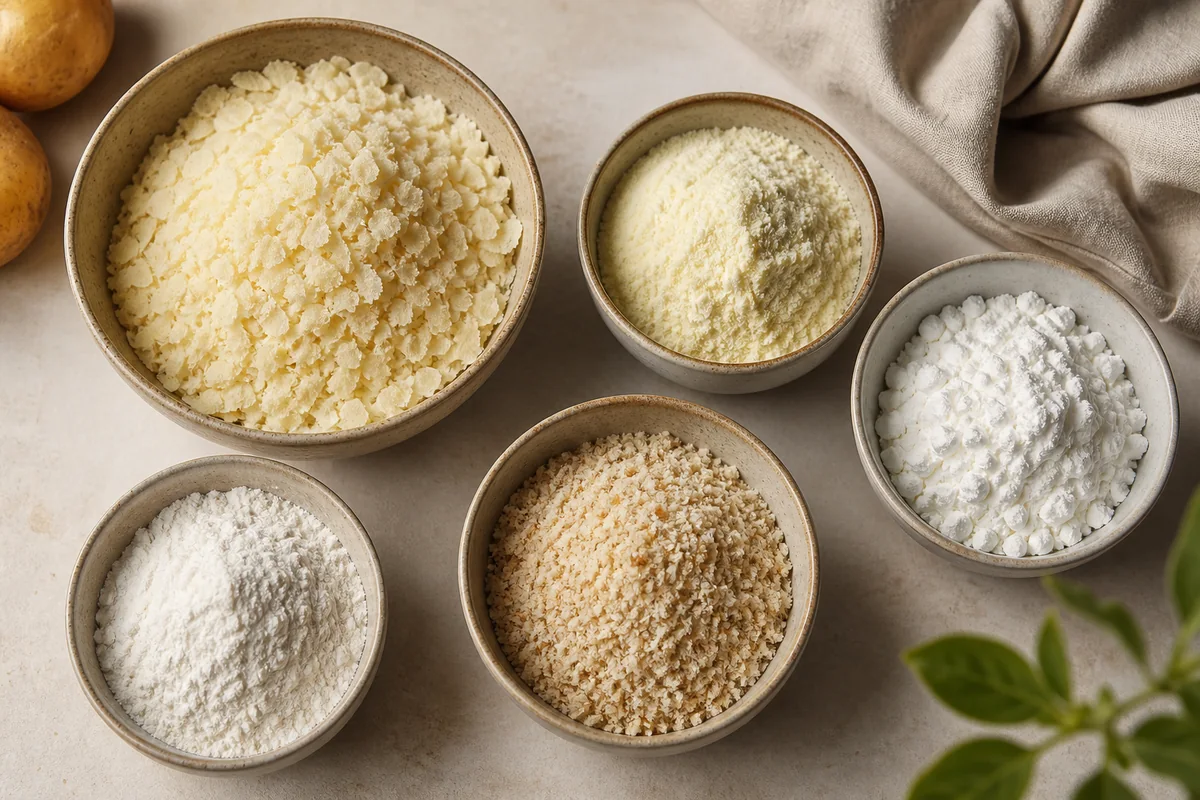
5 Best Potato Flakes Substitutes for Better Results
Ingredients
Equipment
Method
- Decide what you need: fluffy mashed texture or soup/gravy thickening, then choose the substitute that matches that goal.
- Use the listed ratio, hydrate in hot liquid (or warm mash) until smooth, and stir to remove lumps.
- If the result is too thick, loosen with warm broth or milk a splash at a time; if thin, simmer 1-2 minutes or add a small extra slurry.
- Taste and adjust salt and butter/creaminess after hydrating, because many substitutes absorb seasoning differently.
Notes
- Potato flakes hydrate quickly; thickening substitutes need gradual slurry addition to prevent lumps or over-set texture.
- For the closest mash feel, warm and blend substitutions until smooth before serving.
Tried this recipe?
Let us know how it was!
Carrie is a food writer and editor with more than 15 years of experience. She has worked for some of the biggest names in the food industry, including Bon Appétit, Food & Wine, and Martha Stewart Living.
As the Editor in Chief of EpicureDelight, Carrie oversees all of the content on the site. She also manages the team of contributing writers and editors, who help to create delicious recipes, helpful tips, and informative articles that you’ll find on the site.
A native of the Chicago area, Carrie is passionate about all things food. She loves trying new restaurants and experimenting with new recipes in her kitchen. She’s also a graduate of the Culinary Institute of America, so she knows a thing or two about food!



